
Laurisa Dohm: Since when do lobbying groups get to demand constitutional change?
The Assembly of First Nations has no legal mandate to represent or act on behalf of any First Nation in Canada in negotiations with the Crown regarding Section 35.


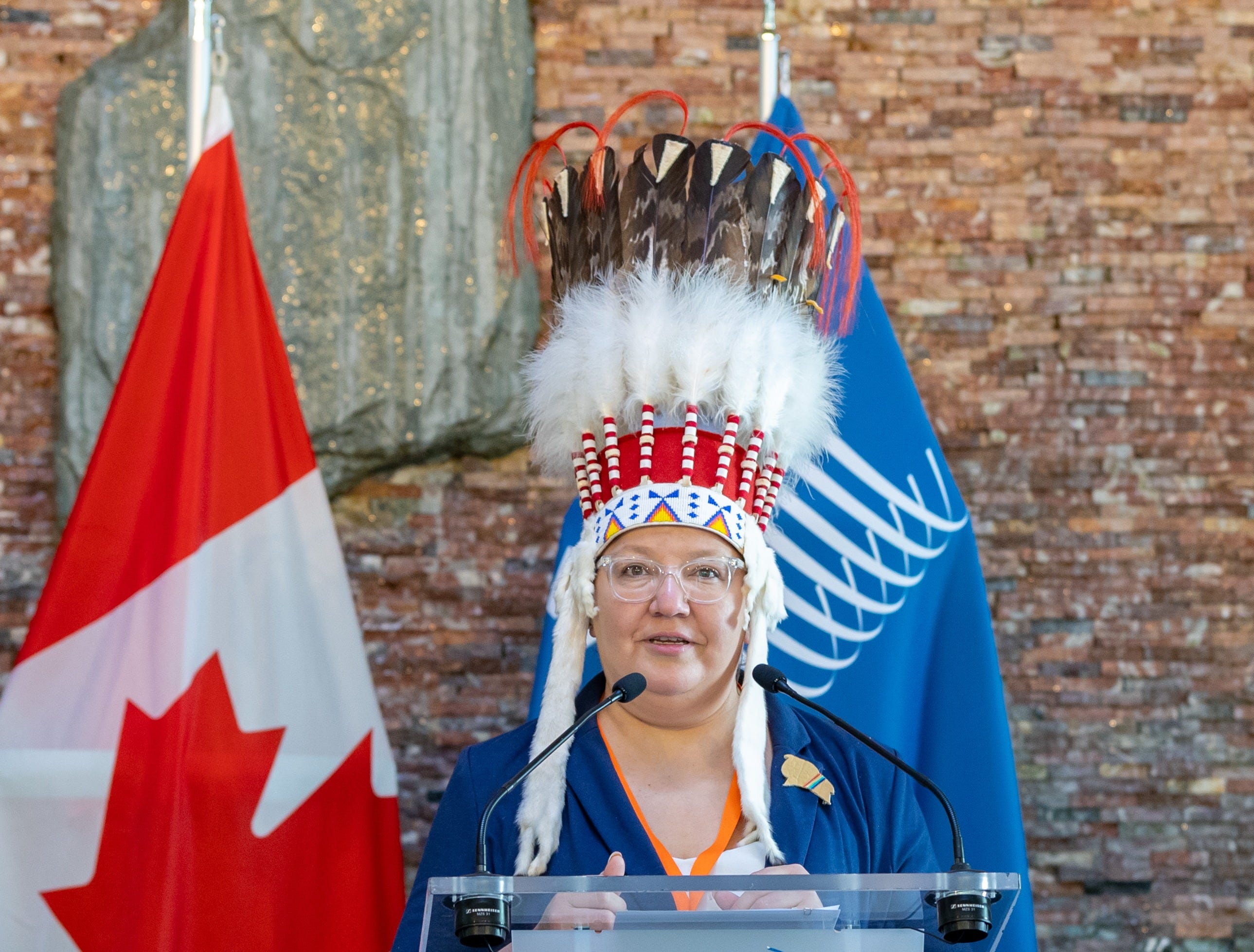
On Wednesday in Ottawa, the Assembly of First Nations (AFN) resolved to make constitutional change its primary agenda item at this autumn’s first-ever First Nations–First Ministers’ Meeting (FNFMM).
‘It is up on the screen. You do not have a hard copy, but if you can look at the screen, there are amendments that have been proposed behind the scenes … so please follow the screen. This side is French, and this side is English. The English has the amendments.’
So ran the introduction to Resolution 39 on the second day of AFN Week in Ottawa. Originally drafted with five sub-resolutions, the final version had nine. It was passed with 114 votes in favour, two opposed, and seven abstentions, for a total of 123 ballots out of 634 eligible delegates.
One hundred and fourteen votes are apparently all the mandate you need to formally raise the issue of constitutional change directly with Canada’s First Ministers (nobody tell Jeff Rath, or at least have him chew a few aspirins before breaking the news).
The resolution directs the AFN to ‘ensure that the primary agenda item at the upcoming [FNFMM] is the establishment of a jointly governed process with First Nations to develop a national First Nations–Crown table on Confederation and constitutional change, including both political and technical tables to advance constitutional discussions that support the recognition, affirmation and implementation of First Nations’ inherent and treaty rights’.
The subsection of Resolution 39 that immediately follows clarifies that ‘the role of the AFN will be relegated to coordination and administrative duties only, with no authority to negotiate or discuss First Nations’ treaties, rights, lands, jurisdiction or Crown relationships independently of affected First Nation rights-holders’.
This illustrates the problem with the premise of the resolution from the outset: the AFN is not a constitutional rights-holder. It is a lobbying organisation, albeit one that is about 90 per cent funded by the federal government, to the tune of $51.9 million in the last fiscal year; it is certainly effective.
Nevertheless, the AFN has no legal mandate to represent or act on behalf of any First Nation in Canada in negotiations with the Crown. Yet Carney agreed last summer to include the organisation in the FNFMM, effectively putting the AFN on a par with elected provincial and territorial premiers.
With a decisive mandate from 18 per cent of eligible delegates, the AFN will use that position to raise the issue of constitutional change. The resolution says discussions are to be ‘grounded in the affirmation and recognition of First Nations’ treaty, inherent, unextinguished and section 35 rights and jurisdiction’.
Geoffrey Moyse: The First Nations Leadership Council wants co-governance, or else

The B.C. First Nations Leadership Council (FNLC) is adamant that it will accept no changes whatsoever to the Declaration on the Rights of Indigenous Peoples Act (DRIPA) and insists that the government live with the result of the Un…
From the preamble to the resolution, the United Nations Declaration on the Rights of Indigenous Peoples (UNDRIP) appears likely to be central; in addition to being mentioned several times throughout the resolution, Articles 4, 5, 9 and 12 of UNDRIP are quoted explicitly. If the fight to keep the Declaration on the Rights of Indigenous Peoples Act (DRIPA) in British Columbia (BC) is any indication of how strongly the AFN feels about this issue, its effort to have the rights and jurisdiction described in the UN Declaration constitutionalised could be formidable.
UNDRIP was codified into BC law through DRIPA while Eby was Attorney General, and he subsequently altered BC’s Interpretation Act in such a way that the BC Court of Appeal concluded last year that all laws in the province are now required to align with DRIPA — and therefore with UNDRIP itself. His ‘flip-flops’ while trying, and failing, to amend the legislation this spring to deal with the Gitxaala judgment have helped earn him the second-lowest approval rating of any premier in the country. The Supreme Court of Canada will hear an appeal in the case at a future date and will be asked to decide whether DRIPA remains positive law in BC, with consequent negative effects on all other statutes.
Often glossed over is the fact that UNDRIP also became federal law in 2021; Ottawa is committed to an action plan and a rolling review of federal statutes for consistency with UNDRIP. For now, Parliament could, in theory, rescind or gut that legislation with a simple majority whenever it chose. Incorporating it into section 35 of the Constitution, however, would lock it behind the Part V amending formula.
This saga could turn into a colossal headache for Carney and his nation-building agenda.
While the Supreme Court has held that consultation under section 35 is not a ‘duty to agree’, Article 19 of UNDRIP instead requires ‘free, prior and informed consent’, (FPIC) ‘before adopting or implementing any legislative or administrative measures that may affect them’. Note that FPIC applies to legislative measures, meaning that the state must obtain the consent of Indigenous peoples before making laws. That is why leading Aboriginal law experts in BC have sounded the alarm that DRIPA has effectively plunged the province into ‘co-governance’ with the First Nations Leadership Council — a political lobbying organisation similar to the AFN.
All of this would spell disaster for the delivery of major projects and, in particular, for the Crown’s case in future lawsuits similar to those brought by bands against Carney’s signature legislation, the One Canadian Economy Act, which they argue is unconstitutional. One might think constitutional amendment is not an immediate concern, but perhaps the AFN assesses that such amendment is nearer than others perceive. If so, opening discussions on strengthening section 35 rights is shrewd: it shifts the opening position towards asking for more, allowing the retention of the clause’s current wording to be framed as the compromise.
Carney may end up regretting becoming the first prime minister to invite a political lobbying organisation to participate in an FNFMM. For a skilled negotiator, his commitment to letting the AFN set the agenda is curious: the first rule of getting what you want out of a meeting is to control what it is about.
Laurisa Dohm is a BC-based consultant and policy advisor. She holds an M.Sc from Gothenburg University.

For more from Without Diminishment and its contributors, follow along on X, YouTube, and Instagram.
Without Diminishment is a project of the Without Diminishment Foundation, a registered non-profit in British Columbia. If you value the unique perspective we bring to Canada’s cultural landscape, consider supporting our work with a generous donation.
We Canadians have been assured that Mr. Carney is a skilled negotiator and a calm, calculating sort of fellow.
The evidence suggests otherwise, of course; Mr. Carney has revealed himself to be an activist, an intellectual scoundrel, and someone whose relationship with the truth is quite tenuous.