
John Bonnett: The adaptations of Harold Innis
The second of a two-part feature.


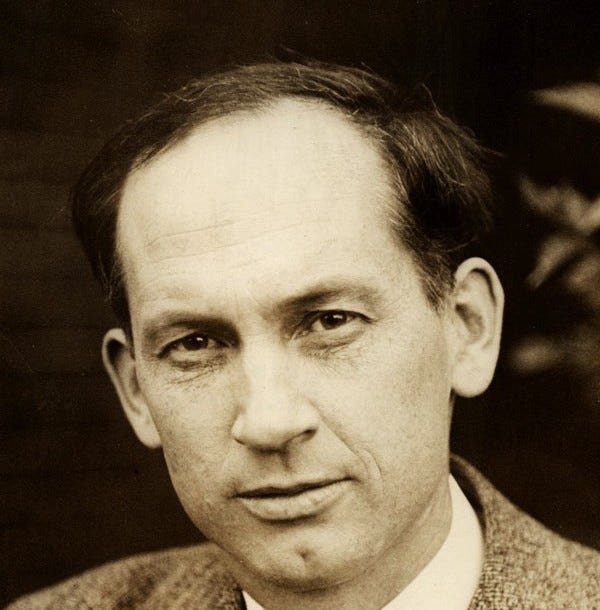
In my previous posting, I suggested we live in a time of tumult – national and technological – that has persuaded conservatives to embrace a concern that for the past half-century they have ignored: culture. I further recommended that conservatives turn to contributions from Harold Innis, a conservative Canadian academic who has made important contributions to Canadian and global history on the topic of communication. Innis’s writings here have never received the attention they deserve. We should reverse that neglect because they have important things to say to us in the present.
In the preceding posting, I presented Innis’s key insights on how our communication technologies impinge on societal and individual thought, and presented a key theme that pervades his histories: all this has happened before. We worry about our inventions. We should. But Innis also urges us not to remain passive users of the instruments bequeathed to us. Via the Oral Tradition – a combinatorial mode of thought, expression and practice – users and cultures mix and remix content, and in turn adapt to emerging opportunities and threats presented by their environments.
John Bonnett: Fixing a country in search of itself

In the closing decades of the twentieth century, culture was an easy concern to demote. Inflation had to be tamed, the national debt curbed, and the vast pretence of the welfare state extinguished. In this decade, however, we have learnt, to our shock, that culture is not a minor concern best kept on the periphery.
The purpose of today’s post is to explore how Innis’s ideas regarding cultural adaptation can be applied. We can escape our cognitive traps, traps he referred to as Biases and Monopolies, if we make it a point to detect them and challenge them via the Oral Tradition. Let us see how.
The first adaptation: Integrate the ‘Wisdom of the Crowd’ into cultural decision-making
One of the truisms of contemporary society is that our major institutions have been captured by a single class. We have various names for it – Bobos, Symbolic Analysts, the Creative Class – but most descriptions employ a label we all know: the Woke. This class has captured the commanding heights of industry, government ministries, universities and the media. It has sought to leverage its cultural and economic power to become our current manufacturer of consensus. David Brooks notes, ‘It constitutes the massive network of academics and analysts who determine what is true’. More importantly, he writes, ‘It possesses the power of consecration; it determines what gets recognised and esteemed …’
‘The setters of elite taste,’ he continues, ‘tend to be graduates of selective universities …’ ‘If you feel seen in society, that’s because the creative class sees you; if you feel unseen, that’s because this class does not’.
One would be hard-pressed to find a description of the present that better aligns with Innis’s monopoly of knowledge. Our society is filled with such monopolies, and they are all aligned – or biased – in a common direction. And, because of the imprimatur of expertise conferred by our universities, the inhabitants of these same monopolies now presume to rule.
In Canada, the scenario Brooks describes is fully reflected in the Canadian government’s patronage of the arts. The Canada Council for the Arts, for example, likes to present itself as a neutral arbiter that operates free from political interference. Via peer-review panels composed of artists and professionals, as well as representatives from Canada’s multiple regional, social and linguistic locations, the council purportedly oversees a neutral and fair system of patronage. We would be wise to ignore the marketing. While panels do not receive direct instruction from government, they are required to conduct their adjudication using values and criteria set by bureaucrats and government. Those values, Graeme Gordon writes, reflect the values of ‘a Laurentian elite largely appointed and tied to Canada’s natural governing party’. They are values harvested from ‘the country’s left-leaning academic establishment’ and run counter to individuals, such as Don Cherry, who have an ‘unapologetic, blue-collar, proudly nationalist sensibility’.
In the face of such siloing, Innis’s advice is to create policies that enact fusion and practise the Oral Tradition. He doesn’t tell us how, but it is plain that he is calling for the construction of decision-making systems in which our country’s disparate parts encounter each other and account to each other. We all have biases. Through interaction with fellow citizens, we can see them and confront them. His writings further suggest we must apply the Oral Tradition not only to our cultural constructs but to our political ones as well: we must reconfigure their operations and potentially acquire new practices when they are no longer fit for purpose. It is an idea echoed in the present by Beth Simone Noveck, author of Smarter Citizen, Smarter State. ‘The design of our current institutions of governance,’ she writes, ‘can evolve. No law of nature … holds them rigidly in place’.
‘Our time,’ she further writes, ‘requires a transformation, not just in the choice of policy but, more fundamentally, in the way we make policy in the first place …’
The democratic theory literature suggests one important way we could implement Innis’s programme for reform. With respect to the importation of new content or a new practice, we could use citizens’ assemblies and juries. Under such a plan, government departments, councils and institutes concerned with culture would incorporate an external entity – a deliberative body composed of a random selection of citizens – to formulate policy and select projects for funding. Such a body would be selected independently of the government ministry, not by it. It is an idea that has been tried multiple times in the past and present, and it enjoys historic and democratic legitimacy.
The ancient Greeks used random selection by lottery, or sortition, in part to populate their legislatures. Today, we use a similar principle, though less than we should, to adjudicate guilt or innocence in criminal trials via the jury. Citizens’ assemblies have been used to create new constitutions in Ireland and Iceland. In the United States (US), citizen panels are participating in the ‘participatory budgeting’ of city budgets. In the context of cultural policy, citizens’ assemblies of some 100 members or more could be assembled, say, every four years, to determine national cultural policies and priorities. Citizens’ juries of 12 members could be convened to assess grant applications. In multiple countries, governments have recognised that there are some domains too important to be left to the whims of partisans, even elected partisans. Monetary policy is one of them. Culture should be another. It is, after all, a national concern, not one that is partisan or identitarian.
The second adaptation: Support cultural innovation
Some two years ago, Rose Horowitch wrote an article in The Atlantic that attracted widespread attention. Its primary concern was that Ivy League students were no longer reading novels. ‘It’s not that they don’t want to do the reading,’ she writes, ‘it’s that they don’t know how. Middle and high schools have stopped asking them to’. Aside from mediocre public education systems, the problem has been compounded by the ubiquity of the smartphone. Students are constantly distracted even when reading something as short as a 14-line poem. ‘Whether through atrophy or apathy, a generation of students is reading fewer books’.
As we saw from Innis, concerns about technology’s impact on our cognitive stamina are not new. But it is hard not to be sympathetic to Horowitch’s core concern. If she is right, through a combination of neglect and laziness we are saying goodbye to an age that produced Balzac and Tolstoy, Cervantes and Goethe, Jane Austen and Robertson Davies. Innis’s writings on the Oral Tradition, however, point to a conclusion that should partly mitigate our regret: no form of storytelling is permanent. As we saw, the ancient Greeks created new forms of storytelling, including lyric and epic poetry, to meet their aesthetic and contemporary social needs. Perhaps we are at a similar juncture, one in which we are shifting to forms of storytelling no longer reliant on print. Through its ability to acquire and generate, convert and repurpose textual, audio and visual content, artificial intelligence (AI) is democratising visual storytelling and expression, and, in turn, expanding the expressive toolkit of the individual person.
Marshall McLuhan predicted such a transformation in a letter to Innis in 1951.