
Geoff Russ: James Cook was a hero of British Columbia's history
Celebrate the great explorer, who dropped anchor at Nootka Sound on this day 248 years ago.


In the neighbourhood of Dundarave in West Vancouver, there is a gutted single-storey building that once housed a Shoppers Drug Mart. It will soon be torn down for new developments. On the outside wall facing the intersection of Marine Drive and 25th Street, there is a mural of tall, wooden ships sailing into Burrard Inlet during the 18th century.
I have no idea how old it is, but it might have been painted in the 1980s, when performers at Vancouver’s Pacific National Exhibition dressed up as Captain James Cook.

Two hundred and forty-eight years ago, Cook dropped anchor at Nootka Sound on March 29, 1778.
Cook opened the coastline to the world. At the time, his voyage from England was as bold as travelling through space to a barely known planet, at great risk to the lives of Cook and his crew.
A confident and properly functioning province would honour Cook. As British Columbia is currently neither, the failure of nerve to protect and restore his name is not a surprise.
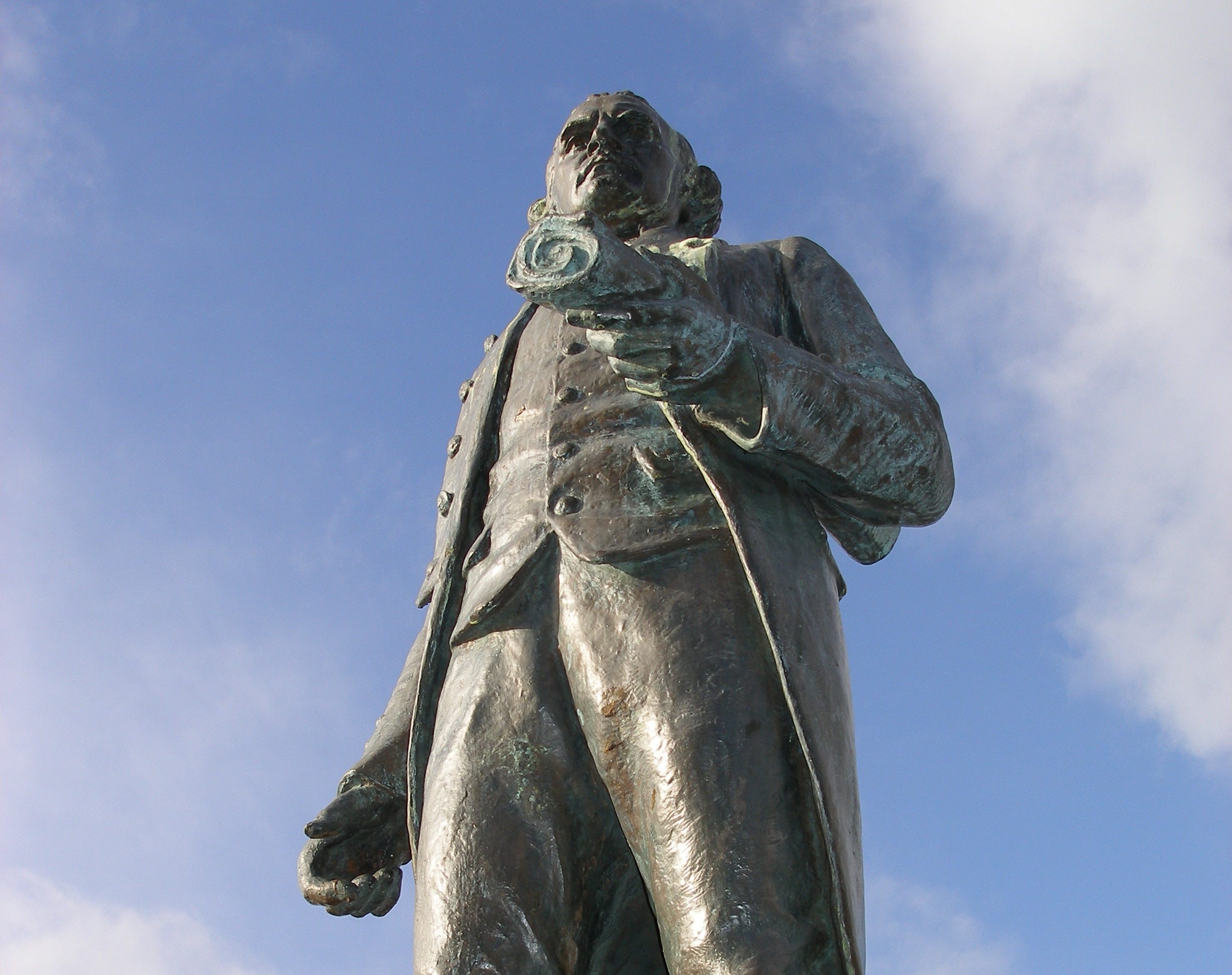
On Canada Day, 2021, a statue of Cook in Victoria’s Inner Harbour was torn down by a mob. The perpetrators celebrated it as a demonstration against “genocide” and “colonialism”, and whooped loudly as if they had just killed an enemy.
The unwillingness to confront those criminals is insulting to B.C., as is the refusal to confront the lies upon which they justified their actions.
James Cook was no genocidal villain.
When his ship arrived at today’s Vancouver Island, which was named for the young midshipman George Vancouver who served under Cook, he and his men began repairing and refitting their vessels, the Resolution and the Discovery. They also replenished their food stores, took on water and other provisions, and traded for pelts with the Mowachaht people at their village of Yuquot.
By all accounts, the linguistically fraught encounters between Cook’s men and the Mowachaht were productive and amicable, if not overly friendly. No blood was shed.
In late April, Cook and his two ships departed Nootka Sound to search for the Northwest Passage, which proved unsuccessful, like so many other such attempts during the Age of Discovery. While he may have failed to find an Arctic outlet to the Pacific, he did provide the first charted and detailed description of Vancouver Island.
That voyage alone makes James Cook an essential, and admirable, figure for British Columbians, and his connection to Canada is deeper still. Nineteen years prior, he was on the St. Lawrence River beneath Quebec in 1759, watching General James Wolfe fight Montcalm at the Battle of the Plains of Abraham.
Then a young naval surveyor, Cook had helped to chart the approaches to the St. Lawrence for General Wolfe’s invasion fleet. He also charted part of Gaspé, before going on to chart the coast of Newfoundland with a remarkable skill and precision that stood above that of his peers.
Undoubtedly, Cook was a brave man, who sailed through waters like Cape Horn, off the tip of South America, one of the most vicious ocean passages in the world to this day.
Those same misty coastlines of B.C. are home to countless people today. When did obvious, productive endeavours become such a rarely celebrated quality?
Our leaders honour divisive politicians, activists, pseudo-academics, and corporate suits with the Order of Canada, but are reluctant to lift a finger to defend those who made Canada possible.
Exploration is central to the history of our province and country.
In 1808, Simon Fraser paddled across the continent through treacherous canyons to reach the same Pacific coast that Cook sailed past decades before. In the 17th and 16th centuries, Jacques Cartier and Samuel de Champlain plied the St. Lawrence. The pair are treated properly in Quebec, as founders and progenitors of the province and its people.
Quebec understands commemoration better than we do on the West Coast. Montreal has the Jacques Cartier Bridge, among other honours. It is matched by the Samuel-de Champlain Bridge at Brossard, in addition to statues and monuments in the provincial capital of Quebec City. British Columbians should take inspiration from that, and not be intimidated by noisy, bullying activists who want to make us apologise for who and what made us.
Our treatment of Cook says much about ourselves. We cannot only uphold the safest possible figures from the past as our role models and national heroes, for that is a cowardly course of action.
We have no issues commemorating great sporting men like Pat Quinn, the former Canucks coach who has a street named for him in Vancouver. Terry Fox is as unimpeachable a figure as can be found, and a genuinely great Canadian who should always be upheld as an inspiration.
But was Terry Fox the only hero that B.C.’s history ever produced? Are those who inspire charity runs the only ones deemed acceptable to rally people around today?
We should not shirk our duty to those who helped build our home, like Cook, Matthew Begbie, and Sir John A. Macdonald, to name only three. Their reputations have been slandered without a real public argument, debate, or even the discourse that set civilised societies apart from the rest.
Here I must make a confession from my lean times as a freelancer barely out of university. On July 1, 2021, The Tyee published a piece of mine, written before the events of that day. Shamefully caught up in the unthinking, immediate aftermath of the Kamloops residential school reports, I gave credence to a mass panic.
The very day that article appeared, Canada Day, a crowd ripped down the statue of James Cook in Victoria, decapitated it, and tossed it into the water. In Winnipeg, another mass of rioters pulled down the statues of Queen Victoria and Queen Elizabeth II at Manitoba’s legislature. Then churches started to be torched across Canada, with the rate of arson surging after the breaking of the Kamloops story. Most of those incidents have gone unsolved, and have not abated.
By September 1, I was deeply ashamed to ever have lent even indirect support to that mood, which can charitably be described as hysterical or barbaric.
There was no justice in the vandalism, moral blackmail, barely concealed mental illness, and racialised hatred. That derangement infected the public sector and even federal and provincial governments. City governments used it as a pretext to scale back celebrations of the national holiday, likely to save money in the budget. All of it was prompted by dubious accusations against Canadian icons, and enabled by frightened authorities.
The philosopher Roger Scruton had a similar reaction to the May 1968 riots in Paris. (The comparison stops here, for I am not vain or stupid enough to compare myself intellectually to Scruton, one of the more influential thinkers of the modern age.)
In 1968 in Paris, where Scruton was visiting, radical students and their fellow ideologues ran rampant around the French capital, smashing and burning buildings en masse in an attempt to spark a social revolution against the Fifth Republic. In an instant, Scruton turned forever against that side of politics and that way of thinking. Millions of Americans had a similar reaction after the George Floyd riots of 2020.
Many ordinary Canadians reached a conclusion vaguely resembling that in 2021, either gradually or all at once. Normal, patriotic people began to understand that they had been misled and manipulated by bad actors in the name of “reconciliation” or “decolonisation”. Elected leaders licensed the desecration by standing by and watching as mobs hunted down any statues they could find for months afterwards.
This all happened during the worst years of the COVID-19 pandemic. Intermittent lockdowns and social distancing were rigidly imposed for most people, but rabbles carrying signs reading “KKKanada” or worse were permitted to attack public property without consequence.
That energy did not disappear. Rather, it began to be institutionalised by the young zealots, who are now the people graduating from law school or taking positions in public education, school boards, museums, and the public service. The rioters have joined the ranks of the bureaucrats, arming them with real procedural and political power.
Ageing moderate politicians cannot contain them by pretending it is 1998, or even 2014. Those earnest managers and policy wonks do not understand the power of symbolism, for it is not peripheral to politics.
In the future, people will not remember briefing notes and fiscal tables, but they will recall memories and visible signs of the time when others held power. Governments can be competent, but if left symbolically vacant, they help leave the door open to the ill-informed or the ill-intentioned.
For these reasons, British Columbians who love their province and who made it must restore the statues of Cook, and others like Begbie and Macdonald when they gain power. Then they should go further. Landmarks, roads, and pieces of grand and mundane infrastructure should be named for the real builders of B.C.
Doing so would be to assert that British Columbia will remain British Columbia, and not be hollowed out and rewritten by vandals in suits and the functionaries who take orders from them. Far more has to be done about slashing the ideologically captured public service and turning out the museums and institutions, but public monuments are a good start.
In 1976, Premier Bill Bennett himself unveiled the Cook statue in Victoria.
The statue itself was not perfect, being a cheap fibreglass copy of one standing in England, at Yorkshire where Cook was born. A new one should be seven or eight feet tall, cast in 3,000 pounds of near-immovable bronze, if only to frustrate the statue raiders.
Until very recently, there was a public culture in B.C. that had celebrated Cook’s bicentennial at Vancouver’s Sea Festival in 1978, and even handed out commemorative coins for the occasion. Our province needs that spirit for the 250th anniversary of Cook’s arrival in 2028. Today, however, it will do to toast Cook’s name with a glass of beer, wine, or even Canada Dry Ginger Ale.
Restoring Cook’s rightful place in the province’s capital would show something to those who hate Canada, resent British Columbia, and sneer at the existence of Canadians and British Columbians. It would show them that they did not win. Ground should never be ceded to them, whether in argument, memory, or culture. When they appeal to “complicated history” and make a show of performative nuance, they are usually using smokescreens for an agenda that only moves toward attrition, humiliation, and erasure.
James Cook’s legacy is not complicated. He was a heroic explorer who helped make B.C. possible, and ranks among the greatest navigators to ever sail the high seas. It is an honour that the history of our home contains him. It connects us to countries like Australia, where his legacy still looms large, despite attempts to erase him there too. Perhaps the good people advocating for CANZUK should take note of this connection.
The exploration of unfamiliar coasts, rivers, and mountains is deeply Canadian, especially in a mountainous, rugged province like B.C., where Cook came ashore 248 years ago.
Greatness is not guilt, and by all measures, the Age of Discovery was an age of heroes. We do not honour it nearly enough, for we are not good at remembering things in Canada. A new government can change that.
This country and province do not exist by accident, and if their existence is considered to be good, then Cook shared in that. Let us restore our pantheon, fully and with great enthusiasm.
Geoff Russ is the Editor-at-Large of Without Diminishment. He is a contributor to a number of publications, including the National Post, Modern Age, and The Australian Financial Review.

What vile sanctimonious reprobates who are interested in history only to find villains so they can feel better about their own insignificant lives. Thanks for respecting those who achieved so much and left a better world for all of us.
Bravo!