
Geoff Russ: The trouble with Dief
While an admirable man, Diefenbaker left no real conservative legacy, and helped pave the way for Trudeau and the Charter.


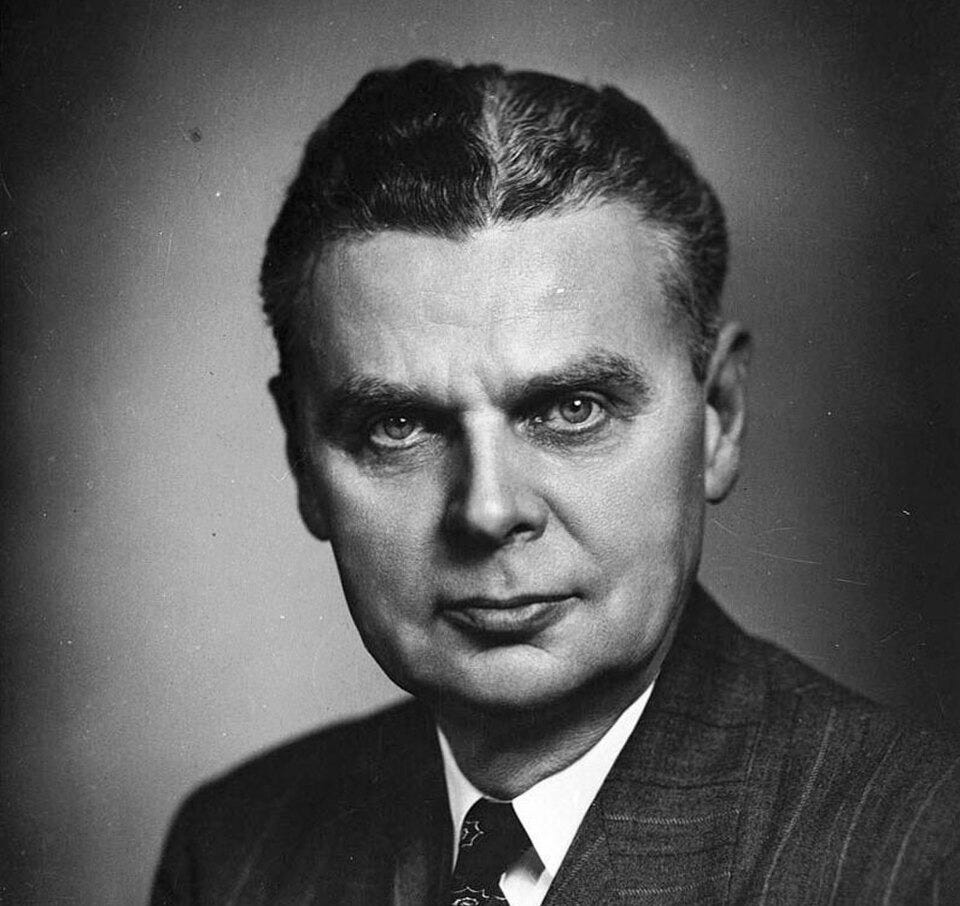
Today marks sixty-nine years since John Diefenbaker led the Progressive Conservatives to victory in the 1957 federal election. At the time, it was the first non-Liberal government in 22 years.
Diefenbaker would follow that up a year later with a spectacular humiliation of Lester Pearson’s Liberals, winning re-election with a majority of 208 out of 265 seats.
A nationalist and genuine populist, Diefenbaker was one of the few Canadian political leaders of the twentieth century who tried to stop the country’s absorption into the American-led international order. Diefenbaker is a mythical figure among conservatives, largely due to his victories over the otherwise unbeatable Liberals and his dogged resistance to American Cold War power.
That myth presents a problem. Diefenbaker’s 1958 majority was the high-water mark of his career, which began to wobble soon thereafter. Winning a large parliamentary majority does not make one a statesman, as Justin Trudeau and Boris Johnson have illustrated. Diefenbaker’s PCs would lose their majority in 1962, and then government entirely in a snap election held the following year.
Diefenbaker’s many admirers often confuse the size of his 1958 majority with the use he made of it. Certainly, the man brilliantly harnessed populism, but he failed to turn it into a durable, winning conservative doctrine.
No doubt, Diefenbaker stood up for Canada, but imperfectly and, ultimately, unsuccessfully. Even when he tried to champion an older, more venerable vision of Canada, he kicked the legs out from under many of its remaining foundations for personal and political reasons.
The irony of Diefenbaker’s legacy is that the most celebrated parts are progressive, not conservative. He gets credit for reforming health care and putting it on the road to our single-payer programme. Praise is heaped upon Diefenbaker because he broke various barriers for minorities and women, such as appointing Ellen Fairclough to Cabinet; she would spearhead progressive reforms, including the elimination of national-origin immigration restrictions.
Diefenbaker is also widely praised for his Bill of Rights, a statute passed by Parliament which is cited as a precursor to Pierre Trudeau’s Charter of Rights and Freedoms. Far from being a Tory restorationist, Diefenbaker was an outsized contributor to the rights-based vision of Canada that would be cemented by Lester Pearson and Trudeau.
Diefenbaker’s weaknesses were personal too. One of his biographers stated that the man was ‘never fully in control of his emotions’. He was also suspicious of colleagues, poor at compromise, and reluctant to share authority. Some of it went back to Diefenbaker’s childhood and early adulthood during the First World War, when his German surname made him a target of mockery.
‘I used to get quite upset when my schoolmates teased me about my name,’ Diefenbaker wrote in his memoirs, adding that he was referred to as a ‘Hun’ in his adult life. This trauma, if it can be called that, became the basis for Diefenbaker’s insistence on ‘unhyphenated’ Canadianism as a politician.
It is easy to sympathise with these very human emotions, but they are not the basis for conservative statecraft, nor is erasing national adjectives conducive to that objective. Canada is a compact between two peoples. From them stem all the institutions and trappings that made Canada into a worthy country, not the other way around.
Diefenbaker understood this, to a degree. His PCs were tossed from government in the 1963 federal election by Pearson’s Liberals, with the help of American political operators connected to President John F. Kennedy, but Diefenbaker was not done yet.
From 1963 to 1964, Lester Pearson’s Liberals embarked on a crusade to replace the Red Ensign as Canada’s flag with a more modern and ‘inclusive’ symbol.
Diefenbaker became the champion of the grand old banner, campaigning tirelessly to preserve it. His efforts were well received by English Canadians, only 35 per cent of whom wanted to see the Red Ensign hauled down. But the political power of Quebec and the wider French Canada carried the day, despite the jeers and anger of English-Canadian veterans, in whose faces Pearson all but spat. The iconic photo of the Red Ensign being lowered for the last time on Parliament Hill in 1965 shows Diefenbaker with his head bowed in indignation and protest.
Though a doomed effort, there can be no sneering at Diefenbaker’s defence of the Red Ensign, the most prominent symbol of the British connection. He understood the value of a people’s symbols and history far better than Pearson, whose new flag ironically did little to assuage the rising nationalism in Quebec.
Nonetheless, Diefenbaker’s devotion to the old flag in the 1960s, and his devotion to the British world, was at odds with his enthusiasm for the Commonwealth of Nations, already transformed from an imperial family of nations into a post-colonial forum for Africa and Asia’s third-world revolutionaries. As prime minister, Diefenbaker frequently put Canada on the same side as those seeking to eradicate British colonial legacies, much as Pearson did in his own way.
As with so many other Canadian conservative leaders, Quebec was Diefenbaker’s Achilles’ heel. When he won a decisive share of Quebec’s seats in his 1958 majority, it was not a realignment but a transaction.
Quebec’s provincial government of the time, led by the right-wing nationalist Maurice Duplessis, was at loggerheads with the Liberals and wanted them out of power in Ottawa. Duplessis committed his political machine to helping Diefenbaker get rid of the Liberals, to great effect. By 1963, Duplessis was dead and his government had been ejected from office. Diefenbaker was left with no allies in Quebec, leading to the party’s annihilation there in the 1963 federal election.
Diefenbaker did not help his case by rejecting special status for Quebec and an expansion of recognition for the French language. He thought he was defending Confederation from splitting into ‘Two Nations’ by insisting on a single national identity. In reality, not recognising Quebec as a distinct nation went against Canada’s founding compact, and he paid the price.
By losing Quebec, Diefenbaker lost government, paving the way for a future defined almost solely by the Liberals. Even Diefenbaker’s vision of a single Canada that included just two languages and a limitless bounty of new rights to be created was more similar than not to the country that Pierre Trudeau would officially remake with the Charter of Rights and Freedoms in 1982.
In fairness to Diefenbaker, his stridently progressive conservatism was not out of place in the Anglosphere at the time.
In 1964, Enoch Powell, who would make his famous ‘Rivers of Blood’ speech a few years later, was becoming a pariah within the Conservative Party by calling for far stricter restrictions on immigration. Prior to 1964 and the rise of Barry Goldwater, the American Republican Party of the 1950s expanded the size of the federal government and enforced civil rights literally at the point of the rifle and bayonet.
Concurrently, the centre-right Coalition government of Australia was, like Canada, liberalising immigration so that countries of origin were deprioritised.
Still, this only magnifies the failures of the Canadian right, which has mistaken moderation for a political identity for far too long. There are countless examples of this.
Ontario’s vaunted former premier Bill Davis, who is still admired by conservatives today, was a major booster of Trudeau’s Charter of Rights and Freedoms. Brian Mulroney strengthened multiculturalism by codifying it with the 1988 Multiculturalism Act. The modern Conservative Party still often shakes in its boots when given the opportunity to differentiate itself on culture and identity.
Diefenbaker was an indisputably admirable man, as his many biographies attest. These accounts include his support for natural resource sovereignty and northern development, which are more relevant than ever. His support for property rights is salient today, and his strong anti-communism and devotion to the Crown and Canadian traditions should be emulated.
However, his canonisation among Canadian conservatives is the result of his ability to win a historic majority, rather than his having left a solid ideological legacy. The next two decades following the fall of his government were among the most progressive and revolutionary in Canadian history. It should make conservatives question whether this was helped or impeded by Diefenbaker’s government.
Diefenbaker loved Canada’s history and culture, but was not capable of crafting a plan to defend them. He could win the largest majority in Canadian history but could not establish a new counter-regime following 22 years of Liberal government. He briefly defeated the Liberals, but did little to stem the tide of capital-L Canadian Liberalism.
Diefenbaker was not some sort of great conservative exception to the unravelling of Canada, only a remarkable interlude.
Geoff Russ is the Editor-at-Large of Without Diminishment. He is a contributor to a number of publications, including the National Post, Modern Age, and The Australian Financial Review.

Conservatives have always eaten their own while Liberals will defend theirs to the death.
An excellent essay and an enjoyable read.
Well done.
I have one quibble: that being, one can favour a liberalization of immigration requirements, and support codifying personal rights, without being the precursor of the lasting damage done by the Trudeau Governments.
“The Chief” championed personal rights and personal responsibilities.
His pan-Canadian sensibility was the exact opposite of what the Trudeaus tried to accomplish, and destroy.
Other than that, a thoughtful and engaging essay.