
Geoff Russ: Does Anglo-Canada have the will to live?
Right now, it is the janitor of the mythical Canadian mosaic.


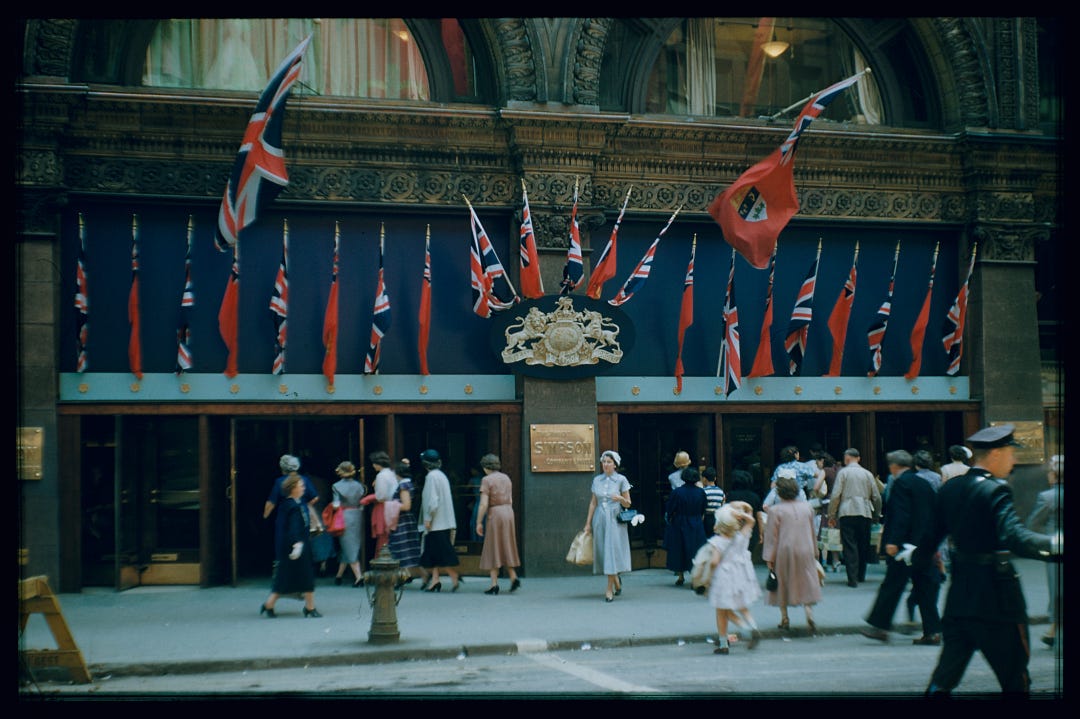
Last Sunday was Flag Day. With it came the annual debate about the replacement of the Red Ensign with the Maple Leaf in 1965.
There is no doubting the passion of those arguments against the change, much of it justified.
61 years ago, Lester Pearson’s Liberal government celebrated its replacement of the flag that Canadian soldiers flew during the World Wars. For them, it was a moment of national maturation. Others saw it as an unjust rejection of Canada’s British heritage, and of its history within an empire that defeated the Nazis.
Nonetheless, relitigating the merits of the Red Ensign or the Maple Leaf misses the point. Anglo-Canada’s identity crisis is a matter of the will to survive, not of the country’s flag.
A better question to ask is what happened to the country that treated the Red Ensign as an uncontroversial banner of the Canadian people. How did it come to be seen as a quaint or embarrassing relic that is now only unveiled on Remembrance Day?
Whether they label themselves as English, Scottish, or simply Canadian on this year’s census, Anglo-Canadians still constitute the single largest bloc within the multicultural mosaic imposed by the Liberal regime. They are also the least celebrated, and the most exposed to symbolic and institutional erasure.
Today’s “anti-colonialism” amounts to picking off traces of Anglo-Canada wherever they are found, often with the full endorsement of elected governments. All are targets, whether they are the heraldic crests of industry associations, municipal symbols that honour the monarch, or portrayals of British settlers in museums and galleries.
The venerable name of the Law Society of Upper Canada, which evoked Ontario’s long and honourable history, was vanquished in 2017 because it was allegedly not “inclusive” and reminded people of colonialism. For the same reasons, the City of New Westminster abolished its title as the “Royal City” in 2022.
There is no debate that Canada emerged from British cultural, constitutional, and economic traditions, but this foundational process is usually minimised. The most common exception to this is when Canadian history is treated as a sort of “colonial” disease forced upon a virgin North America.
This movement had its seeds, one of which was the top-down “Canadianisation” in the 1960s, led by Lester Pearson’s Liberals.
In The Strange Demise of British Canada, C.P. Champion writes that the Liberal government’s anticipation of Canada’s Centennial in 1967 resulted in a cultural “storm”. Victims of this “storm” were the symbols of British North America. In their place came fashionable replacements to suit Pearson’s vision of modern Canada.
Champion described the now-iconic Maple Leaf as an invented tradition that was weaponised against Canada’s longstanding national emblems. Military uniforms, the flag in 1965, the honours system, and the term “Dominion” were substituted or suppressed. It was a deliberate attempt by the state to reinvent Canadianness and its meaning.
Without Diminishment contributor Michael Bonner described the Maple Leaf flag as “incongruous as the Nike swoosh or the Starbucks logo” on monuments to imperial wars. He cites Michael Ignatieff, who called it “a passing imitation of a beer label”.
That being said, the Maple Leaf flag itself is not illegitimate. Whether by the passage of time or the changing of tastes, a huge majority of Canadians are proud of it. Stephen Harper himself has lauded the flag for what it has come to represent, and most Canadians agree.
Attempting to abolish the Maple Leaf in favour of the Red Ensign is a fever dream unless dramatic and drastic changes happen in the minds of millions of Canadians. That does not change the fact that it was part of a calculated reengineering of the country.
This reengineering happened despite the votes of often Tory-voting Anglo-Canadians in Ontario and Western Canada, as Liberal dominance in Quebec enabled them to prevail and implement their agenda.
Amid this radical, arbitrary transformation, immigration law was loosened to open up Canada to people from more diverse and multicultural backgrounds. They entered a country that was neutralising its historical core, and turned integration and assimilation into a choice, rather than an obligation.
There is an assumption that Canadians of non-British heritage find the country’s historical character to be offensive, or at least morally suspect. This flies in the face of Canadians like John Weissenberger, born in Montreal to postwar refugees.
Writing for C2C Journal in February 2021, Weissenberger made a passionate defence of Anglo-Canada, and condemned its hollowing out by the governing class of the time.
“Was there no value whatsoever to English-Canada’s culture? Was it necessary that it be reduced to a kind of grey grout amongst which the innumerable colourful mosaic stones would be set?” Weissenberger asked.
Anglophilia is not restricted to love or fondness of modern England. It also encompasses respect for its civilisation, which exists in many forms and on all continents, save for perhaps Antarctica. That civilisation is what made Canada, and continues to give it a semblance of coherence.
It is worth mentioning that Britain remains one of the most well-liked countries among Canadians today.
In a miniature way, this is represented by the city of Victoria on Vancouver Island. Victoria remains deeply attractive to visitors and many locals precisely because it retains a stubborn British colonial aesthetic. The entire Inner Harbour is flanked by the Empire’s political and architectural legacies, including the Legislative Buildings, the Empress Hotel, and the Crystal Garden building.
Ironically, Victoria’s local governments are among the most progressive in the entire province of British Columbia. Would they demolish their city to meet their goal of “decolonisation”? Of course not.
Yearning for beauty, social order, and continuity with the past is a deeply human instinct.
Cultural survival is a conscious choice by people and governments. A modern nation is maintained, reconstructed, or restored through its accepted norms, schools, and daily rituals. The remaining question is who leads that nation-building, and for what ends?
It is not enough to daydream about seeing the Red Ensign flutter over Ottawa once again, while what remains of Anglo-Canada is steadily melted down.
Canada’s cultural tastemakers and gatekeepers are, on balance, hostile to heritage and continuity.
This is why they refit institutions, replace plaques and place names, and pretend the country only truly began after 1982 with the Charter of Rights and Freedoms. They want Canada to be a purely managerial state with no true idea of a national community.
Many of Canada's legal and political pillars are still of British origin. But, if the bureaucracy and courts are today’s sum of Anglo-Canadians, they are merely the country’s institutional janitors.
A procedural regime can administer rights, but it cannot generate loyalty or sustain trust.
So much of the current “Elbows Up” patriotic surge in Canada is being driven by older citizens whose childhood was spent under the Red Ensign and in a more tightly-knit, culturally uniform country. When they pass, will their grandchildren care for Canada as they did?
Anglo-Canada can still have a future, but it requires consciousness, and cannot afford to wait for the Liberals to embrace that. Although not nearly as far gone as Anglo-Canadians, the Québécois are facing a similar question about their right to exist as a people.
In his 2024 book, Le Schisme identitaire, Étienne-Alexandre Beauregard has argued that survival is a deliberate choice to refuse to be dissolved, and that Quebec is embroiled in a culture war over the definition of the nation, its history, and its future.
If Anglo-Canadian consciousness is only dormant, not extinct, its revival would be a reversion to the historical norm.
It was only in the second half of the 20th century that Anglo-Canada became expected to behave as a non-assertive host culture, or that “grey grout”, as John Weissenberger writes.
In modern Canada, an enthusiastic identity is permitted for all minority groups, and many are even subsidised to help ensure their preservation. This is an unjust double standard.
The purpose of reinvigorating Anglo-Canada should not be to oppress, nor should it assume inherent hostility from other sections of Canadian society. What it should include is a reassertion of its importance to this country’s history.
People from many backgrounds recognise this, and some will gladly defend the Red Ensign. Rejecting or making enemies of them is needless and self-defeating, not to mention antisocial.
What is desirable is a cohesive and stable society. It was, ironically, Mark Carney himself, the quintessential managerial Liberal, who made the token point of describing the British as part of the bedrock of Canada’s Founding Peoples.
Pushing politicians to answer questions about what it means to be Canadian beyond carrying a passport is important, and so is actively attacking narratives that cast the colonial origins of Anglo-Canada as evil. No Canadian is an accomplice to a crime because their ancestors lived and died as loyal British subjects, and helped build such a remarkable nation.
There should be cultural associations that go beyond monarchist gatherings, and movements to re-raise the fallen statues of our heroes, or even to raise money for new ones. The narratives that Canada tells itself must be changed by any lawful means necessary.
This movement cannot be based in nostalgia either, for the British Empire is gone. The mainline Protestant churches that united it in faith are increasingly deserted. It must be thoroughly modern.
Identity is one of the central questions of this decade.
It has animated political movements around the world, from Japan to Brazil to Italy and the United States.
A country as vast as ours requires a strong core to bind it, lest it cannibalise itself by retreating into dogmatic provincialism. But bedrock is not invulnerable to decay, and once its foundations collapse, the downfall follows.
Does Anglo-Canada, the scorned Founding People of our country, have the strength and courage to dare to endure?
Geoff Russ is the Editor-at-Large of Without Diminishment. He is a contributor to a number of publications, including the National Post, Modern Age, and The Spectator Australia.

A very enjoyable article.
"Tradition is not the worship of ashes, but the preservation of fire." Gustav Mahler.
When we were young and in school, we sang "God Save the Queen", we spoke the Lord's Prayer, and we were taught that we were fortunate to have stood on the shoulders of the giants who came before.
We were taught the beneficence of our British Heritage, of being on the right side of history for 800 years, and that it was that tradition that we could thank for our economic ascendancy, cultural conformity, and political stability.
We were the grey grout that held together the Dominion. I like that.
But the Constitution put a knife in the back of the quest for a pan-Canadian identity, and every attempt was made to weaken the traditions, customs and conventions with which we identified.
When one takes away those guardrails, standards, and notions of civic order, we are prepared not for that which steps into the void.
Great essay, Geoff.
Our ancestors competently engineered a country that has no serious threats, therefore no need to emphasize the rituals that ensure cultural strength. I assume that people coming here did so, because of what our heritage was good at delivering, a society that ranks among the highest in the world on all measures of human well-being. As our country descends into the kind of society that exists in most other parts of the world, there might be a revival in this amazing culture that produced the things we will come to miss...