


It has become an ugly thing to call ordinary Canadians settlers. The term ought not to be a slur, yet everybody knows that it has become one.
The “settler” universe is one where humanity is quartered into permanent culprits and innocents, and it has damaged our language, our politics, and our art. That cultural wreckage is most clearly seen when we look at the creative stories it has produced.
Earlier films could use conquest and colonisation as the backdrop for rich, eternal human themes. When those topics are tackled today, the result tends to be the same story of “settlers” and the “oppressed” told over and over again.
Take Aguirre, the Wrath of God. Werner Herzog’s 1972 film portrays a doomed Spanish expedition drifting down the Amazon in search of El Dorado. Were it simply a tale of imperial villainy, it might be forgotten.
However, it has endured because it is so much more than that. Film aficionados still describe Aguirre as a fevered descent into madness and myth which tells the story of power and futility instead of a sermon on the ills of empire.
One of the film’s most famous shots is in the opening minutes, where a column of conquistadors and native porters snake down a treacherous Andean slope. They are eerily bathed in mist, while an ethereal choral-organ score rises ever more menacingly.
A writer once noted that the mountain seems utterly indifferent to the exploits of man, and that is the point. These themes are transcendent, and include monomaniacal ambition, the seduction of authority and the rot that can follow, collective delusion, and the frightening indifference of nature.
Klaus Kinski plays the charismatic lunatic Aguirre, with a gaze that frightens men into their own destruction. The man limps across raft decks like a crab, with glassy eyes lit up with terror and grandeur as the expedition disintegrates. As the film progresses, and their raft falls apart and bodies begin to slip beneath the Amazonian waves, the men see a great sailing ship somehow perched aloft in the jungle trees.
If the ship is real, the power of nature is beyond the dying conquistadors’ comprehension, and if it is fake, they truly have slipped into insanity. In either case, it is a scene that drives home the themes of madness and meaning, rather than a thesis of “settler colonialism”.
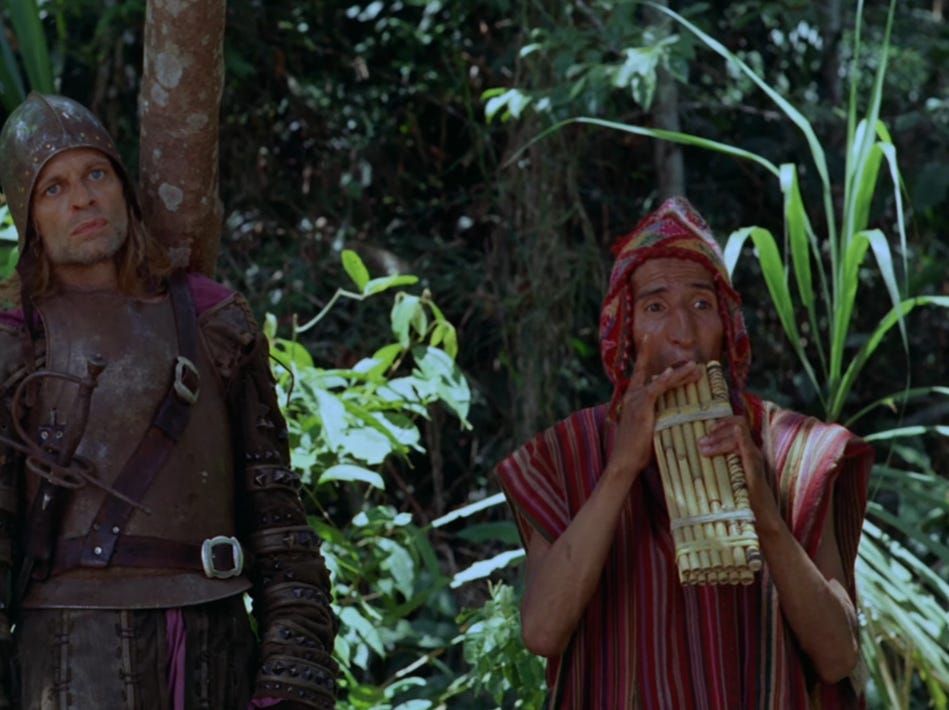
Absurdity is a constant in the film, such as the iconic moment when Aguirre orders a native porter to play his pan flute as the expedition is starving and the jungle closes in. The jaunty tune over the plainly hopeless situation turns the enterprise into a deranged court pageant.
The colonial setting is simply a backdrop for this magnificent film.
Mel Gibson’s Apocalypto moves in the same territory, but in a different key. Roger Ebert declared it to be a film about the demise of the Mayan civilization. The protagonist is Jaguar Paw, a Central American tribesman whose village is raided by the Maya. He is captured and dragged to a great Mayan city for ritual sacrifice, only to escape and race home through the jungle with vicious warriors on his trail.
Archaeologists and historians have quibbled about the accuracy of the details in Apocalypto. However, what matters in this modern classic of cinema is the combination of dread and propulsion, buttressed by long sacrificial sequences where blood-gushing hearts are held aloft to the Sun God before a hysterical crowd and captives are beheaded before thousands in the plaza. It soon pivots to a survival story as Jaguar Paw slips his captors and sprints through rainstorms and jungle mud as he is hunted and turns the tables. His goal is only to rescue his child and pregnant wife before the rising water drowns them in their hideout.
Mayan civilisation is collapsing in the film, but the focus is on the fear, cruelty, courage, love of family, and the stubborn refusal to be killed. The city, rituals, and costumes make it all vivid.
As director, Gibson wastes no time on lectures about systems of oppression. He assumes that the viewer is intelligent enough to understand the peril of human sacrifice and slavery in this tale of a man trying to reunite with his family. Apocalypto was released in 2006.
Consider the films now being made in the new climate.
Beans is a 2020 coming-of-age film about a young Mohawk girl living through the Oka Crisis of 1990. Reviews call it a story of adolescence and a twelve-year-old’s juggling of innocence and youthful recklessness, only to be forced into maturity by a summer of racial hatred and clashes with the Quebec police and the Canadian army.
All the promotion and reception of Beans slot it into an inevitable film about Indigenous resistance to “settlers” and oppression by the Canadian state during the 78-day standoff at Oka. The Oka Crisis, and colonialism explicitly, become the meaning of the film, rather than a backdrop, with the characters mere carriers for the lesson.
Similarly, Jason Momoa’s Chief of War is a deeply impressive achievement in many ways. Using the Hawaiian language extensively, it charts the tale of the unification of Hawaii under King Kamehameha, with assistance, and then opposition, from Kaʻaina, played by Momoa. The spectre of the Europeans and white Americans still lingers over the show, alternating between allies and enemies of Kaʻaina and the Hawaiian people.
It is a thrilling watch, and well worth it. Yet it still cannot escape the lure of the decolonial universe. Reviewers have gushed about the story sovereignty and clashes with colonialism, and how it corrects the colonising Hawaii of popular culture.
The series itself has come to be sold as an ostensibly subversive political act.
On the more cartoonish side of things, there is the new film Palestine 36, which has been feted for portraying British soldiers in the Palestine Mandate of the 1930s behaving like barbarians. They kill innocent Arabs and burn their village, with every Arab character shown to be noble and humane, while the British officers are caricatures that might have been ripped from Schindler’s List, a callback contradicted only by those same characters’ exaggerated and fanatical support for Zionism. The sole sympathetic British character is a powerless liberal functionary.
This is all aesthetically downstream from the new discourse of “settlers”.
Historian Christopher Dummitt very succinctly summed it all up in a paper written for the Macdonald-Laurier Institute. He describes the strange habit among academics and activists of listing themselves as “settlers” in their email signatures alongside tortured land acknowledgements.
This habit, Dummitt writes, has taken on uniquely religious characteristics. The colonial era is cast as the Canadian original sin, and announcing yourself as a settler and then proclaiming your desire to do better sets you apart as among the righteous.
It is an exercise in pious devotion, rather than a mere description. For now, the rest of the country has remained largely secular in this regard. A survey by Leger found that 47 per cent of Canadians will not call themselves “settler colonists”, while 30 per cent have no clue what it even means.
Nonetheless, it is striking that nearly a quarter of the country accepts it. The portion is large enough for our dominant cultural institutions to treat it as common sense.
For activists, this is the point of their work.