


This is a tale of two museums, and of two diametrically opposed ways of responding to the historical and identity debates that have rocked Canada since 2020.
In British Columbia, the NDP government presided over the “decolonization” of the Royal BC Museum, whose narrative now questions the very legitimacy of the province’s citizens. Meanwhile, Quebec announced a new national history museum, which aims to foster pride in the Québécois nation.
These two contrasting experiences demonstrate the extent to which the symbolic role of public institutions is now being challenged, at a time when it seems controversial for the state to honour its own people rather than constantly criticizing them.
The fall of the Royal BC Museum
At the end of 2021, the Royal BC Museum in Victoria, the public museum telling the story of British Columbia, announced the temporary closure of certain exhibitions in order to “decolonize” their content. This initiative is clearly part of the ideological tsunami that has been sweeping across the Western world since 2020, when the death of George Floyd led to an escalation of cancel culture in universities, public institutions, and even large private companies.
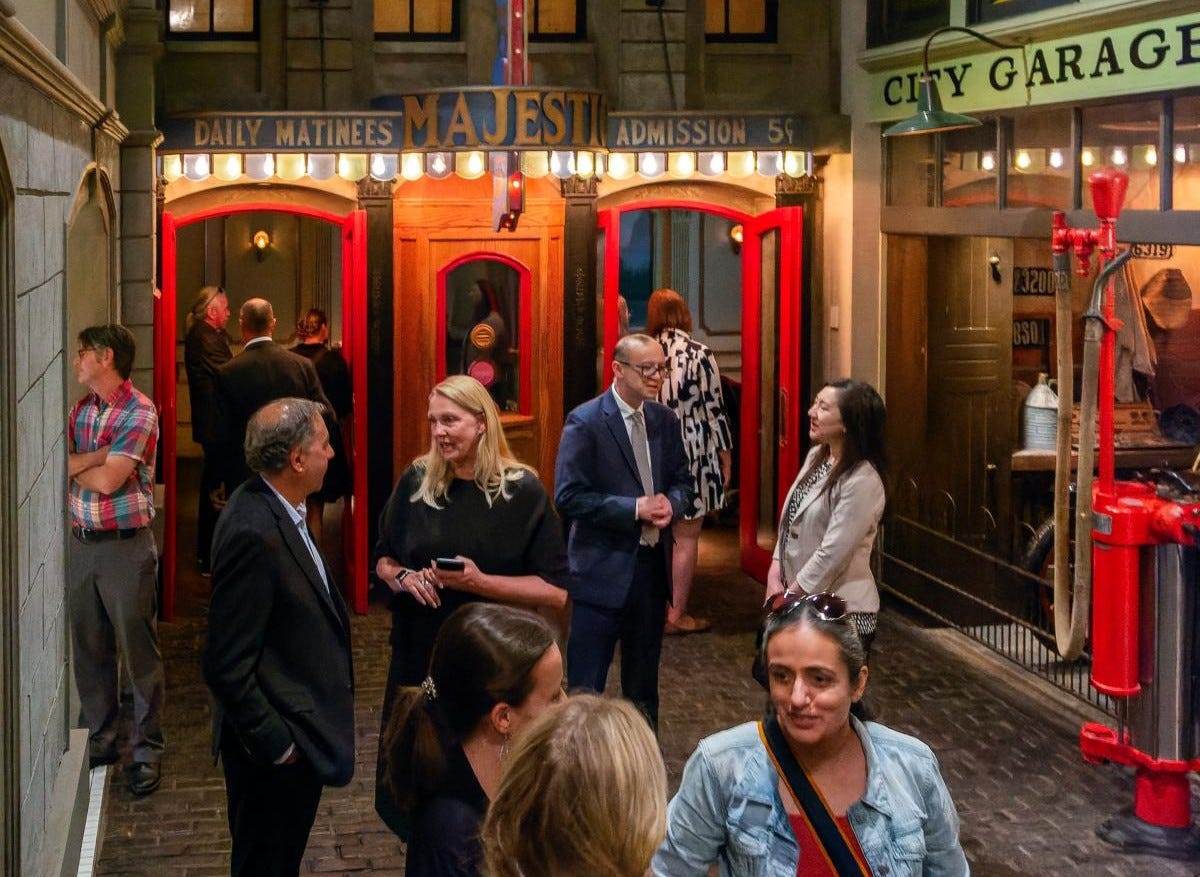
Widely recognized as one of the most beautiful and innovative museums in Canada, the Royal BC Museum has stood out since 1972 with its life-size reconstructions of immersive historical scenes. The most famous of these, Old Town, recreated the old city of Victoria with its late 19th-century wooden buildings. This beloved institution, which welcomes nearly 800,000 visitors each year, has begun a major overhaul of its exhibits to stop “propagating colonial narratives” and thus be more “inclusive.”
The change in philosophy is now palpable. Visitors entering the Royal BC Museum are greeted by a sign stating: “Today, we acknowledge that we are uninvited guests of the lək̓ʷəŋən People, the Esquimalt and Songhees Nations, on whose lands we reside.” The fact that a government museum whose mission is to reflect the history of British Columbia is telling its own citizens that they are unwelcome in their very home demonstrates the extent to which this ideological drift has subverted public institutions.
More broadly, the “inclusive” redesign of the museum has set aside the complexity and specificity of the province’s history in favour of a black-and-white worldview, with “colonialists” on one side and “racialized people” on the other, the latter being described as perpetual victims of the former. Moreover, by systematically denouncing the European presence that built modern British Columbia, one gets the impression of a museum that is more interested in criticizing its own people than in telling their story.
The Musée de l’histoire nationale du Québec
The new Musée de l’histoire nationale du Québec, which will open its doors in the summer of 2026, appears in a way to be a mirror image of the sad redesign of the Royal BC Museum. The two initiatives came about at the same time, but while one sought to “decolonize” history, the second explicitly sought to stimulate Quebecers’ national pride. The youth wing of Premier François Legault’s party launched the idea by stating bluntly that “we don’t have to apologize for our history, quite the contrary.”
Saying such a thing in 2021 was certainly countercultural. It was high time to establish a museum entirely dedicated to telling the story of the Québécois nation, the French-speaking people who planted their roots in America with the arrival of Cartier and Champlain.
Naturally, the announcement of the museum sparked controversy in progressive circles, especially since the government clearly stated its position. For Premier Legault, the goal was to make it “a place that makes Quebecers even prouder to be Quebecers.”
Éric Bédard, a respected historian who is acting as a consultant for the future museum, also stated that while he did not want a “jovialist” interpretation of history, it would simply not be interesting for visitors to turn it into a “museum of horrors.” In other words, Quebecers have the right to see their history told by a museum in a way that recognizes the exceptional journey of this nation in North America, without turning it into a permanent trial, as some would like.