


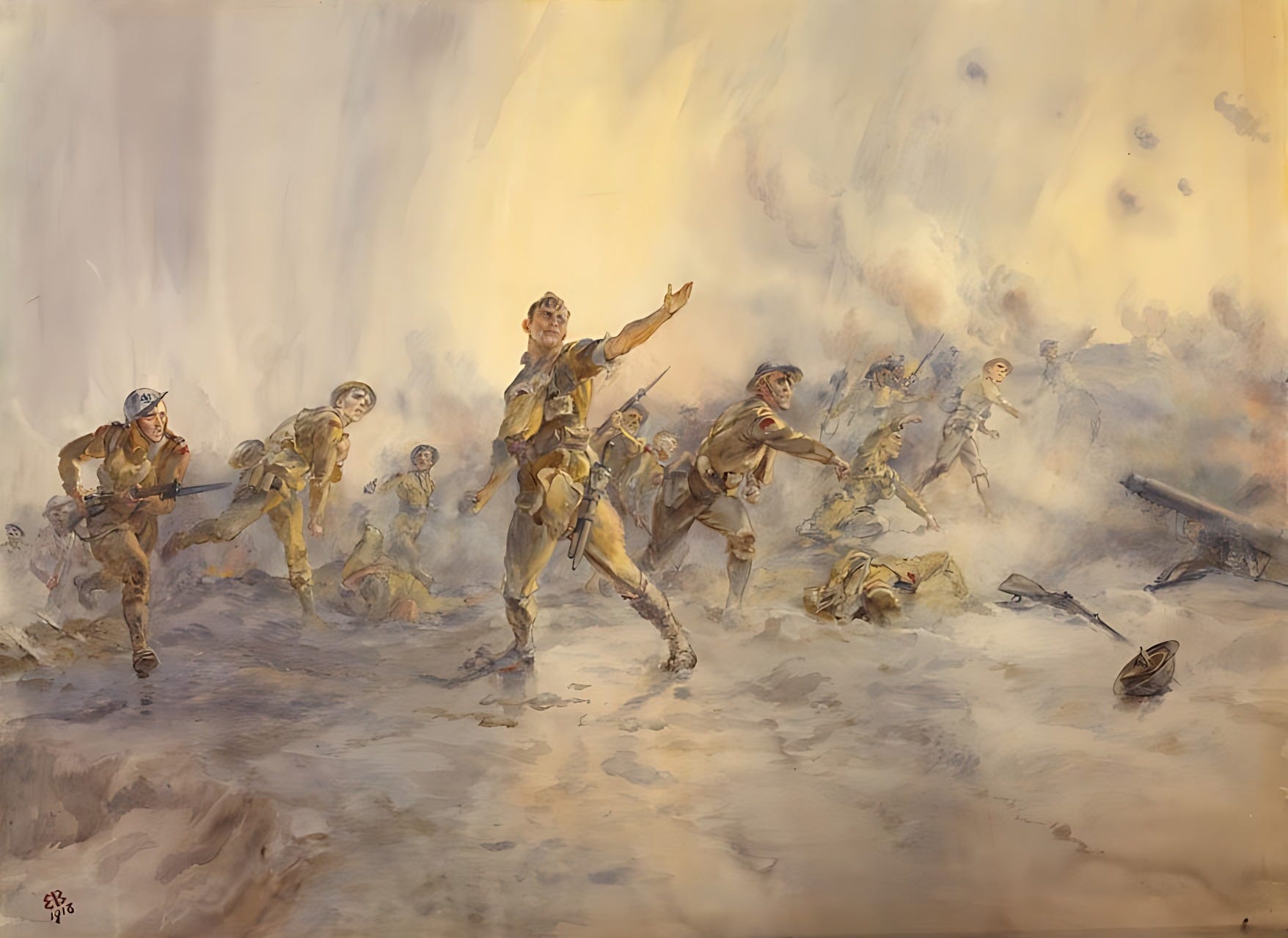
As dawn began to break on Easter Monday in 1917, four divisions of Canadian soldiers trudged through the mud toward the German stronghold of Vimy Ridge. Under a creeping barrage of artillery fire, waves of men threw themselves into the bedlam of battle in search of victory. As one combatant put it: “Thousands of guns of every size were roaring at once. The air hit you in the face as if someone was thumping with a towel . . . You should have seen how Fritz’s trenches were smashed up by our gunfire.” Back at home, friends and family of the soldiers slumbered peacefully, unaware that their sons and brothers were about to make history.
Troy, Waterloo, Saratoga, Vimy — great battles are like waypoints on a country’s map of meaning. For it is from battles waged that a nation variously derives its origins, its ethos, or its pride.
Yet Canada had only a thin martial mythology to speak of at the turn of the century. The two major efforts of the Canadian military had been the North-West Rebellion of 1885, and the much-celebrated contribution to the South African War that lasted from 1899 to 1902. That pantheon was greatly expanded after tens of thousands of Canada’s sons stormed Vimy Ridge.
Part of a nine-kilometre-long strategic vantage point, the Germans had held the ridge since 1914, with unsuccessful attempts to dislodge them previously undertaken by both British and French forces. After three years, it was the Canadian Corps, fighting together for the first time, that finally got the Kaiser’s men to budge. While Vimy was indeed “the first clear-cut victory” of Canada’s war, “a place where the Canadians succeeded and the French and British had not”, many historians have noted that Vimy contributed little to the war’s final outcome. So, then, why was this modest triumph made so magnificent in its aftermath, and is there any truth to the idea that Vimy Ridge gave birth to our nation?
The Canadian victory at Vimy did lead to a sense of national pride, but it was also followed by a national crisis, as it was in the wake of Vimy’s 10,000 casualties that Prime Minister Borden introduced the highly controversial policy of conscription. It is well known how conscription divided the country, especially along English and French lines. Yet, despite the absence of a masterstroke on the battlefield and despite the rift that conscription opened back at home, Vimy became prominent because of what it came to represent after the dust of the First World War had settled.
The idea of Vimy as a nation-maker is certainly not without its detractors, distinguished historian and former director of the Canadian War Museum Jack Granatstein perhaps chief among them. In a widely read article for Maclean’s, for example, Granatstein purports to bust the “myth” that Canada became a nation at Vimy.
Yet is this much-in-vogue “second look” at Vimy — which amounts to a deconstruction of Canada’s foremost national myth — merited? Further, why is it especially critical that Canadians hold on to and venerate our shared history?
To answer these questions, we must look beyond the casualty count at Vimy or the tactical gains the Canadian Corps achieved; instead, we must examine why national stories are important and explore why the idea that Canada was born out of Vimy is a defensible example of national mythology that Canadians should continue to hold dear.
The tradition of myth-building
National myths can be more central to a country’s identity than either ethnicity or geography. They are foundational stories that offer an explanation for a people’s existence; understandably, latching on to such origin stories is something humans have done for millennia.
Of course, some national myths are invented, but even the most astonishing legends aren’t entirely fictitious; they blend aspects of historical events with fiction to convey important symbolic and cultural truths, though the author may gloss over certain details.
Though examples abound, Virgil’s Aeneid is a clear exhibit of this kind of mythological nation-building. Commissioned by the Emperor Augustus around 30 BC, the historicity of the poem and its hero, Aeneas, is up for debate, but the impact Virgil’s storytelling had on the Roman people is undeniable. Aeneas appears as a minor figure in Homer’s Iliad, but through Virgil’s skilful storytelling, the defeated Trojan warrior is transformed into the legendary founder of Rome. The Aeneid remains one of the most lauded epics of all time, and though countless readers have asked themselves whether Aeneas really founded the Eternal City, for Virgil’s audience, this would not have mattered. His poem became something Romans across provincial boundaries could point to and say, “This is who we are. These events brought us here.”
While the Aeneid may be more legend than history, the same is not true for the Battle of Vimy Ridge. It is a well-documented historical fact that the Canadian Corps won its first battle on that stretch of French hillside. Yet, like the Roman origin story, the tale of victory and valour at Vimy Ridge can be an inspiration for Canadians. It marks the first moment that Canadians from coast to coast fought together and won.
After the war, the story that Canada became a country at Vimy slowly gained acceptance. As an origin story, it was a classic admixture of historical fact and fashioned narrative. But, while the battle itself was certainly remarkable, the symbolic meaning that Vimy came to hold is much more important.
So, what is it exactly that made Vimy stand out as pre-eminent in the Canadian consciousness? Firstly, at Vimy, Canadians fought together for the first time, and secondly, they were successful. Thirdly, for the purposes of post-war commemoration, Vimy benefited from being a prominent, easily identifiable battlefield. Yet the fourth reason why Vimy is so unique a battle is because it forms the basis of a key national myth. That is why it is of paramount importance for scholars to look past what Vimy accomplished as a set-piece engagement to how the victory at Vimy was received in 1917, and what it came to signify thereafter. For it is certainly the myth that matters to us more today than the battle’s strategic outcome back then.
Uniting the tribes
In 1917, Canada as a confederated country was just fifty years old. Many of its inhabitants had been born overseas, and the population was composed of people with ethnic, religious, and geographical differences.
The various diaspora communities did not always get along, and many brought their old-world prejudices with them to the Dominion. Yet the First World War united these disparate groups in common cause under a common flag. And, after the war, the shared experience of having endured battle or lost loved ones brought citizens of the new country together regularly, most visibly at local cenotaphs for Armistice Day commemorations from 1919 onward.
As the comprehensive Government of Canada publication Canada and the Battle of Vimy Ridge notes, Canadians emerged from the First World War a distinct people:
“[In] 1914, Canadians still had little in common…there were, overall, nearly as many foreign-born as native-born…Before the war was over, six hundred thousand of them would have worn the king’s uniform, and more than four hundred and fifty thousand (out of a male population of two-and-a-half million between the ages of eighteen and forty-five) would have served overseas, where they were, one and all, labelled by their allies as Canadians rather than New Brunswickers, Quebeckers, Albertans or whatever, as they had naturally categorized themselves in pre-war days at home.”
The late Canadian journalist Frank Underhill summarised nationhood this way: “A nation is a body of people who have done great things together in the past and who expect to do great things together in the future.”
Vimy was the first opportunity for a large number of many new Canadians to do something great together. It was the first time all four divisions of the Canadian Corps, consisting of English, Scottish, French, Irish, and Indigenous soldiers from Ontario, Quebec, the prairies, and the coast, all wearing a “CANADA” badge on their shoulders, marched as one.
When the First World War broke out, Canadians of all backgrounds shared the same trenches. And it was at Vimy that Canadians shared their first collective victory. As General Sir Arthur Currie wrote, those who died at Vimy “went out to their death with no provincial prejudices and no racial suspicion in their hearts.” Vimy was a unifying moment.
Detractors will dispute this claim by pointing to conscription, which became a radical divisor between English and French Canada, as an aftershock of Vimy that mars its legacy. Yet this simplistic accusation fails to appreciate the substantial number of French Canadians who volunteered to serve in Canada’s army, some of whom served in English-speaking regiments and fought alongside English-speaking soldiers. It also conveniently overlooks the fact that conscription was opposed by, albeit in smaller numbers, English-speaking Canadians as well. What should instead be emphasised and lauded is that, at Vimy Ridge, Francophone and Anglophone Canadians fought together, a sight that would have been unthinkable to both peoples’ ancestors at the Battle of the Plains of Abraham two centuries prior.
The unity represented by Canada’s four divisions coming together at Vimy was novel for the newly confederated country; Canada was, and is, geographically massive, and had only relatively recently been connected by rail, so most people would have had neither occasion nor funds to travel to other provinces and interact with their fellow Canadians. After Vimy, both Canadian commanders in the field as well as members of the government were keen to seize upon what was clearly an opportunity to bind a young country with regional and ethnic differences around a collective story. They were right to do so; as the years since have demonstrated, the story has strengthened its grip on the Canadian consciousness in a way that has bound our nation. To wit, the Vimy monument adorning our twenty-dollar note, various awards and ceremonies named for the battle, and the ongoing pilgrimage of thousands of Canadians from across the country to the site more than a hundred years after the fight all point to the significance of this event in our history.
Deconstructionists and those who advocate identity politics fundamentally fail to understand the importance of a national identity. While collective identities are paramount in their minds, a myopic politics of recognition clouds a bigger picture: that of the nation. The looser the ties that bind, the less Canadian our citizenry will inevitably feel, and the less likely this unique political experiment north of the forty-ninth parallel will endure. The Vimy myth resists this rising tide; it subsumed ethnic and regional identities in 1917 and was used retrospectively to shape a new national character. As a national myth, it can and should continue to cover whatever differences we might have as Canadians of varying tribes and remind us that we are the inheritors of a noble tradition of coming together for common aims.
Our heroes, our triumph, our memory
It is popular to try to diminish the Canadian victory at Vimy by emphasising its minimal impact on the final outcome of the war, or the fact that it was chosen as a civilisational landmark merely because it is also a geographical one, but those who contend either of these views miss the point.
Vimy came on the heels of the darkest months in British military history, the Battle of the Somme, which lasted from July to November of 1916 and resulted in more than 50,000 casualties for the British on its first day. By the time the Somme offensive was over, Canadians had contributed substantially to the ultimate casualty count of more than one million men on both sides. Thus, when a few months later the Canadians claimed Vimy Ridge in the span of just four days, there was real cause to celebrate in Britain, in France, and at home. The capture of a well-defended, strategic German position in 1917 was a great achievement and an undoubted morale boost to the beleaguered British forces.
Further, four Canadians were awarded Victoria Crosses for actions taken on the Ridge, while King George V publicly praised his Canadian troops for their “splendid achievement”, and the Ridge’s capture was eulogised in the French press.
The Battle of Vimy Ridge marks a critical juncture that divides Canada’s past as a colonial project protected by Britain from its future as an independent country with an ability to marshal its own formidable fighting force. Vimy was also a harbinger of events that would follow it — further Canadian Corps victories at Passchendaele and Amiens, Canada’s independent signature on the Treaty of Versailles, its own seat at the League of Nations, and, eventually, control of its foreign policy.
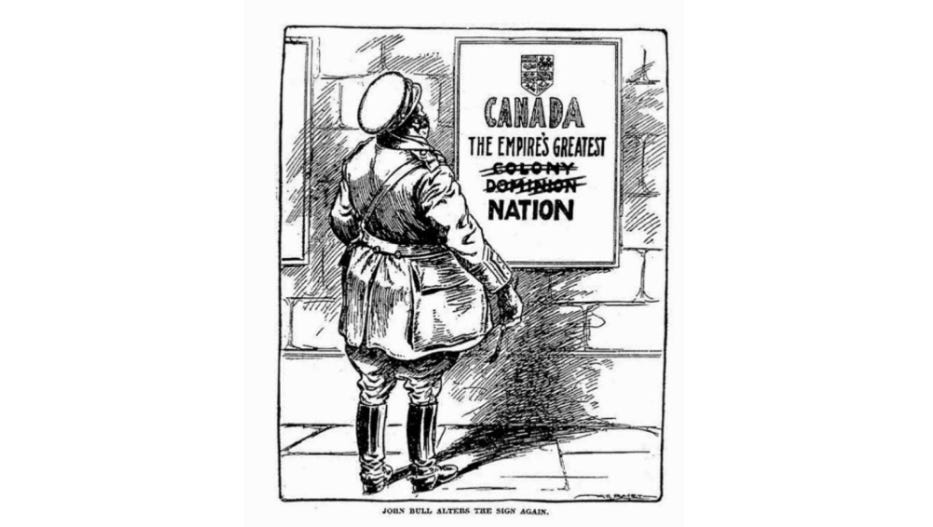
These obvious indicators make it difficult to contend that Vimy was not highly regarded in its time. Yet, in recent decades, it has become fashionable to argue that Vimy’s place at the heart of Canadian history is still unjustified. Its importance has been shamefully downplayed. To this the rejoinder must be made that Vimy’s centrality to Canada’s story exists, whether one thinks it justified or not, and to diminish the battle for one reason or another is simply wrong-headed.
Critics who attempt to make little of the sacred battlefields where Canadians have gone to die take aim at our national mythology so as to “de-bunk” history; yet in so doing, they effectively level critiques at our country itself.
Something similar happened with Dieppe, the Second World War raid in which Canadians were thoroughly vanquished by the defending Germans along the French coast. At the time, Canada’s military commanders and politicians were reticent to diminish the honour due to those who went willingly to the beaches; thus, Dieppe was correctly portrayed in the press as a daring and necessary attack, and the losses incurred were portrayed as a gallant sacrifice. Canadian authorities demonstrated an understanding of an Aristotelian adage: “Brave men are found wherever brave men are honoured.” Few men would enlist if the government were to lambaste its military’s most recent operation.
Yet no sooner was the failure of the Dieppe raid made apparent than many came along to gainsay it, to label Dieppe as being of no strategic importance and, thus, a complete waste of Canadian lives. As decades passed, the anti-myth metastasised: Dieppe did not matter.
Yet the tragedy of so many Canadians slaughtered and taken prisoner did matter, just as our triumph at Vimy mattered, and matters still, regardless of the ultimate outcome. For a nation that does not honour those who have been victorious, killed, or humiliated in its service rejects the relationship that underpins nationhood itself — ties of blood and soil between peoples, and the social contract a state shares with its inhabitants. When a citizen offers service to his country, his nation owes him its gratitude.
To say a soldier’s sacrifice is of little consequence because it had little impact on the grand chessboard might be pragmatic, but it neither honours those who died nor inspires those who live.
Dieppe and Vimy are very different military operations with starkly different outcomes. However, after Dieppe, as after Vimy, Canada had a choice: reject the myth-building narrative or add to it. The latter would encourage patriotism and unity, while the former would demoralise a country at war.
When detractors come along to argue that Vimy is not all it was cracked up to be, they are wrong. It is everything it has been portrayed as and more. It is the Canadian military’s inaugural shining moment. There would be other victories, sure, greater victories even, in the First World War and the next, but Vimy was the first, and Canadians have made it a key part of our story for good reason. And, because we have made it integral to our story, it must be properly cherished.
In retrospect
Was there a strategic advantage to the Spartans holding off Xerxes at Thermopylae? Perhaps. Yet the courage of those 300 Spartans is not revered today because of that particular battle’s outcome. And who can help but swell with pride when he surveys the Hot Gates?
Similarly, Vimy Ridge, with its towering monument to the fallen, offers more than just a point of focus for the grief of a generation which has long since mourned its dead and passed away; it is a waypoint on the present-day Canadian map of meaning, a landmark — both literal and figurative — that every Canadian can point to and say, “This is who we are. These events brought us here,” as the Briton does at Nelson’s Column or the Roman once did at the triumphal arch. It offers Canadians from disparate regions of our nation a common sense of history, belonging, and identity, and is a key part of our canon of collective memory that we can and should cling to when regional tensions abound and differences threaten to disintegrate our unity.
Of course, Canada, as a large country, retains cultural and regional differences, but collective memory still has the power to bind us together. Today, as we contend with a fractured national identity and increasingly tense interprovincial relations, we would do well to remember our past accomplishments together and the mythology that has fostered our collective identity.
Vimy is Canada’s “hallowed ground” both because of what was achieved on the Ridge and because we decided retrospectively to make it so. As a national myth, it is rooted in truth, because it is Canada’s first triumph, yet if Canada did not strictly “become a nation” on Vimy Ridge in April 1917, then the lore of the Battle of Vimy Ridge in retrospect certainly has had the effect of unifying our country. In the words of the late historian Tim Cook, “[Vimy] has become an important touchstone that . . . has come to signify Canadian martial strength and unity of purpose.” May it remain so for many future generations.
D.C.C. (Danny) Randell is a doctoral student in Intellectual History at the University of Buckingham. His work has been published by National Post, C2C Journal and the Aristotle Foundation for Public Policy.

Great article on an important day.
Great piece. Thank you.