


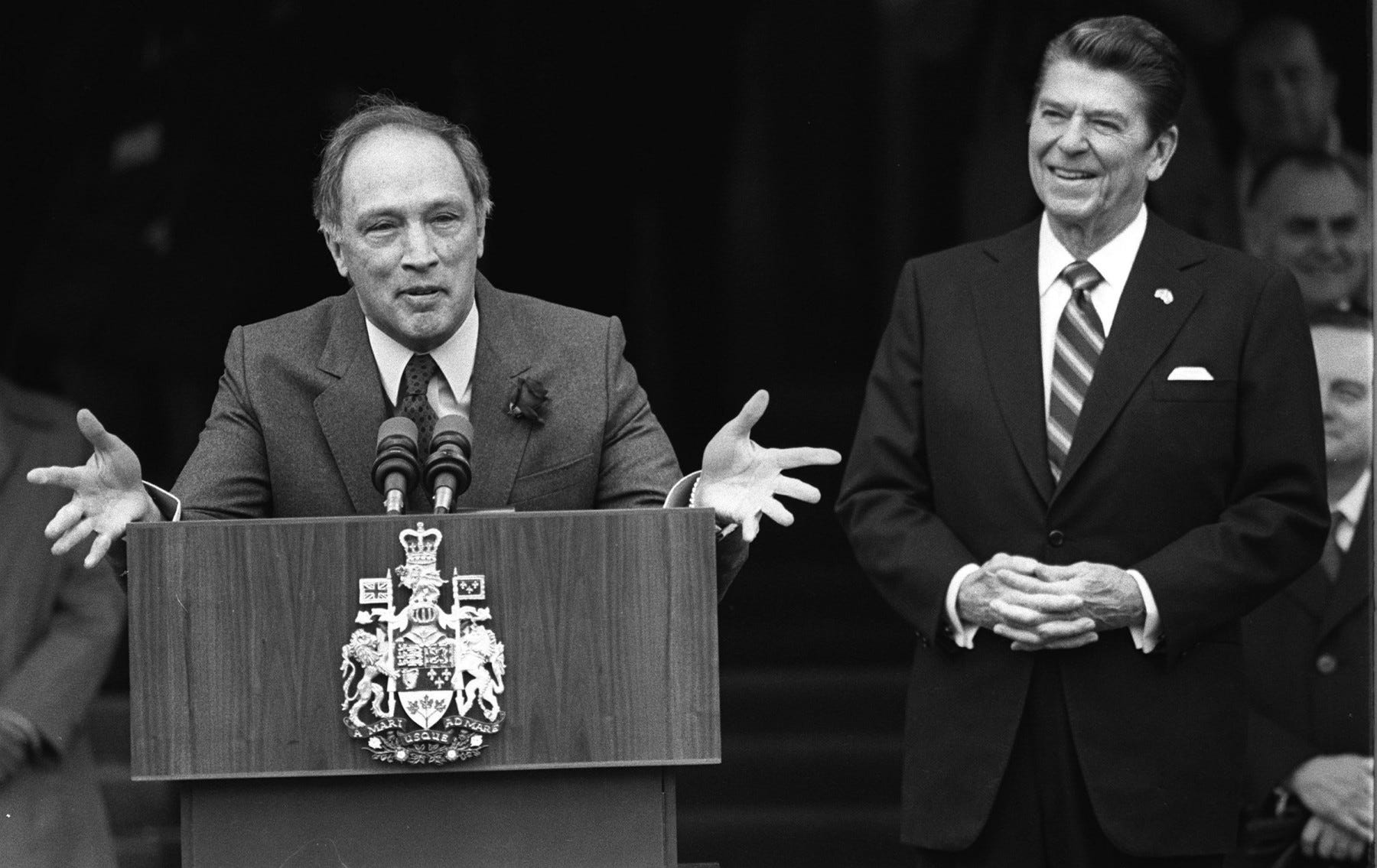
The Coutts Diaries by Ron Graham exposes how profoundly disinterested Pierre Elliott Trudeau was in the material pressures that shape our daily lives, like inflation and unemployment.
These subjects did not energize his imagination or fit his temperament. Instead, Trudeau fixated on abstractions such as constitutional re-engineering Canada, the debate about rights-based governance, and the remaking of Canada into a country governed by ideology instead of inheritance.
Trudeau sought to refound Canada, not merely govern it. He set out to construct a framework and a reworked national identity designed to long outlive his premiership, and he succeeded.
As Anthony Koch observed in the National Post, “The Charter of Rights and Freedoms ensured that Trudeau’s ideas would govern Canada long after he no longer could.” Koch went and accurately diagnosed the country that Trudeau bequeathed to us, “a centralized, rights-oriented, technocratic state bound more by judicial doctrine than by tradition, more by universalist abstraction than by concrete inheritance, and more by administrative management than by civic duty.”
That transformation was not cheap.
Brian Mulroney’s failed Meech Lake and Charlottetown accords were, in their own way, attempts to manage the centrifugal forces Trudeau unleashed. They collapsed under the weight of a country that was already strained by endless constitutional soul-searching.
The fallout was severe. Quebec was further alienated, the Bloc Québécois was born, and in 1993 it won 54 seats. Just two years later, Canada narrowly survived dissolution when a tiny majority of 50.58 percent of Quebeckers voted against sovereignty, even though over 60 percent of Quebec’s Francophones voted Oui.
At the same time, Western alienation hardened into a political uprising.
Preston Manning’s Reform Party capitalized on opposition to Meech and Charlottetown, winning 52 seats in 1993 and becoming the Official Opposition by 1997, when the country was exhausted. Canadians were done with constitutional crusades, lawyers, commissions, and referenda.
However, the consequences were not buried. The marathon constitutional project Trudeau initiated reverberated for decades, and it permanently fractured provincial-federal relations, while alienating large swaths of the population. Mulroney bears some responsibility here for not trying to more forcefully or artfully push back on the new status quo, but the originating force was Pierre Trudeau. His son Justin Trudeau picked up the family torch, and targeted Western Canada through hostile energy policy and moral disdain.
Canadians are entitled to ask if Canada’s annoying dysfunction would exist at all had Pierre Trudeau not treated economic policy as an afterthought.
After watching Liberals govern uninterrupted from 1993 onward, Canada’s conservatives regrouped. The Progressive Conservatives and the Canadian Alliance merged to form the Conservative Party of Canada in 2003. The party contested its first election in 2004 and won government in 2006.
Under Stephen Harper, conservatives made a deliberate choice. His governments largely avoided constitutional battles, opting instead for open federalism, decentralization, and respect for provincial jurisdiction, including the devolution of powers to the Northwest Territories.
Such restraint was understandable, but it further entrenched the Charter regime at a time when the public was weary, and reopening questions of national identity seemed politically radioactive.
Since then, the conservative response to Pierre Trudeau’s omnipresent legacy has been avoidance. Questions of identity and national meaning were sidelined or even ignored during the Harper era. The mantra of sticking to pocketbook issues was baked on, because that’s how conservatives won from 2006 to 2011.
However, a holding pattern makes for poor governing philosophy. It does not inspire young Canadians. Those attempting to articulate a deeper conservative vision are warned off, accused of waging “culture wars,” as though culture were not the terrain on which politics ultimately rests.
What has this abdication produced?
We have a fractured country defined more by provincial identities than by a shared national one. Canadians have become a nation incapable of saying what it is, only what it is not.. Their official national culture is severed from its history, its institutions, and from one another.
Our institutions hover above the people they are meant to serve. The federal civil service is bloated, unaccountable, and incompetent. The judiciary is granting itself the powers of governance, and flippant to questions of common sense or democratic restraint.
Meanwhile, ordinary Canadians are being crushed. They are overtaxed and unable to afford groceries or rent. Home ownership has become a fantasy. Housing, healthcare, and the job market have been suffocated due to untethered mass immigration. Life in Canada is becoming unaffordable, and hope is evaporating among young Canadians.
Koch is right to argue that escaping Canada’s decline will “require a movement that does what Trudeau did: articulate a governing philosophy, drive it through the machinery of the state, embed it structurally, and refuse to apologize for exercising power in service of a national vision.”
The lesson must be unavoidable; Conservatives will not repair Canada by tinkering at the margins. To win, they must not be cautious, and must match Trudeau the former’s seriousness about power and nation-building.
Some insist the institutions are too captured, the culture too far gone, the country beyond saving, but a conservatism that hides from these battles is not conservatism at all.
As Canadians, and as conservatives, the true failure is the refusal to try.
Cole Hogan has played a leading role in conservative campaigns in Ontario and Alberta, and has advised elected conservatives across Canada. He is a regularly featured national media pundit.
A separate version of this column was first published on X.

If the last election told us anything, it told us that non of this hard work will begin until the boomers are no longer with us. They are the generation that voted for Trudeau Senior and Junior, and they are the ones that rejected any dearly needed change to our constitution.
Their overwhelming rejection of change and retrenchment against Trump, again to protect the current Canada, doesn't serve to make the changes needed. Carney wasn't elected to change Canada but to preserve the entitlements of the boomer generation.
Tony Blair engaged in a very similar project in the UK, rewiring the British state in order to increase the power of the legal establishment to defy elected governments. Successive Conservative governments failed to undo those changes, with the result being the sorry shambles that the UK is in today.
If conservatives in Canada want to make progress on the key issues facing the country they will need to get to grips with the fundamental wiring of government, including the constitution, the courts and the civil service.