
Étienne-Alexandre Beauregard: The post-national state's Governor General
Louise Arbour is the perfect representation of the deracinated Canadian elite.


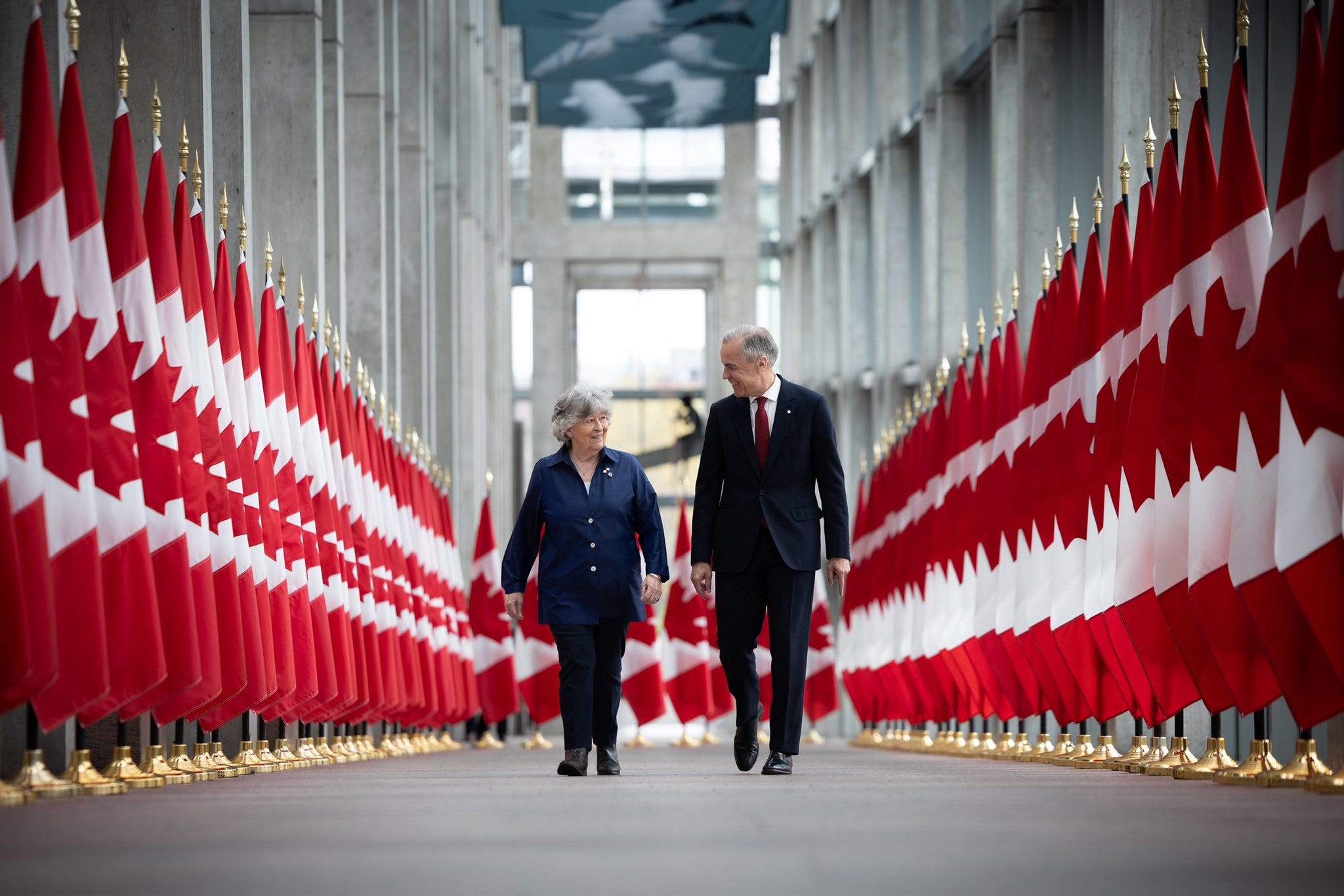
On Tuesday, Prime Minister Mark Carney selected Louise Arbour as Canada’s next Governor General. Following Mary Simon’s tenure, who never spoke French properly during her five-year term, some will view her appointment as a conciliatory gesture towards the country’s Francophones. We can bet that in Western Canada, this choice will be seen as yet another victory for the “Laurentian elite” of Montreal and Toronto.
In truth, the appointment of Louise Arbour represents the confirmation of the power that has already been supreme in this country since 1982, the “Court Party”, to use the term coined by F. L. Morton and Rainer Knopff. The regime change initiated by Pierre Trudeau with the Canadian Charter of Rights and Freedoms effectively stripped elected officials of supreme power and entrusted it to the apparatus of lawyers, activists, academics, and judges who work to interpret the Charter in order to impose policies on citizens from above, inventing new “rights” from its vague language. Ms. Arbour is a true product of this system.
From Supreme Court justice to post-national activist
After a remarkable legal career as Chief Prosecutor of the International Criminal Tribunals for the former Yugoslavia and Rwanda, then as a Justice of the Supreme Court of Canada, Louise Arbour reinvented herself as a post-national activist at the United Nations (UN), serving as High Commissioner for Human Rights and then as Special Representative for International Migration. For several years now, she has been speaking out in the media to repeat the same message: the era of nations is over.
Following the migrant crisis in Europe in the 2010s, Louise Arbour described Western peoples’ desire to reduce immigration as the product of “hysterical fears”, and advocated for the Marrakesh Pact, which specifically urged signatory states to stop funding media outlets that did not portray immigration from the perspective favoured by the UN. During the debate on the Quebec Charter of Values, she denounced “a certain backwards nationalism” that she claimed had inspired this “odious” bill. In 2023, the future Governor General asserted that “we no longer have the choice but to be global citizens,” and that “we must make room” for far more migrants than Western countries currently welcome.
It would be wrong to unduly personalise this debate, insofar as Ms. Arbour is more of a typical representative of the views accepted by the “Court Party” than an anomaly. It should be noted, however, that these radical ideas, often openly dismissive of the views of ordinary people, are the very ones that enable one to hold the highest offices in Canada and at the UN, as her own résumé shows.
Who are the Canadian elite?
The strong symbolism of this appointment also raises the question of the true nature of the Canadian elite. Particularly in Western Canada, one often hears the term “Laurentian elite” used to refer to the Ontario and Quebec power structure that is said to run the country. While there is some truth to this theory, particularly within the Liberal Party, is geography really the criterion that determines access to power in Canada? Let us not forget that Liberal Canada’s new darling, Mark Carney, grew up in Alberta, after all.
Morton and Knopff’s thesis on the “Court Party,” which imposes its progressive rewriting of the world from above, is certainly more precise and accurate, as it focuses primarily on the ideological dimension of this elite, which carries far more weight than its geographical component. Quebec nationalists, Pierre Elliott Trudeau’s bête noire, certainly do not belong to it, although they are concentrated around the St Lawrence River. Quite the contrary: multiculturalism has been the creed of Liberal Canada for over fifty years, and explicitly opposes nationalism.
Such is the irony of the “elbows up” movement, which drapes post-nationalism in the Canadian flag to play the patriotism card in the face of Donald Trump. Appointing a self-proclaimed “citizen of the world” as Governor General illustrates the absurdity of this hollow “pride”, built on the negation of its own identity.
Étienne-Alexandre Beauregard is an author and researcher at Cardus. His latest book, Anti-Civilization: Why Our Societies Are Collapsing from Within, was published in September 2025 by Presses de la Cité. He was formerly a speechwriter and strategic planning advisor in the office of the Premier of Québec.

Very well written but I would disagree with one point partially; you say the Quebec Nationalists do not belong to the Laurentian group. You may be right in that they are not an accepted part with "a say" but they are without doubt the Useful Idiots of the Laurentians because they continue to foment the exact unrest that the Laurentians use to concentrate their power and to over represent Quebec in everything associated with national decisions. These folks are the secondary enemies of western Canada (basically everything west of Hwy 25 in Ontario) because they, like the Laurentians, don't care a bit for anyone else and are striving to make the rest of Canada serfs to feed them and to cement their view of their proper place directing the rest of the country.
Whether you call them post-national globalists, Laurentian elites, or Liberal/NDP alliance members, they are still the same tarnished brand of Keynesian protagonists and borrow, tax and spend technocrats.
“A rose by any other name would smell as sweet"
So said William Shakespeare.