


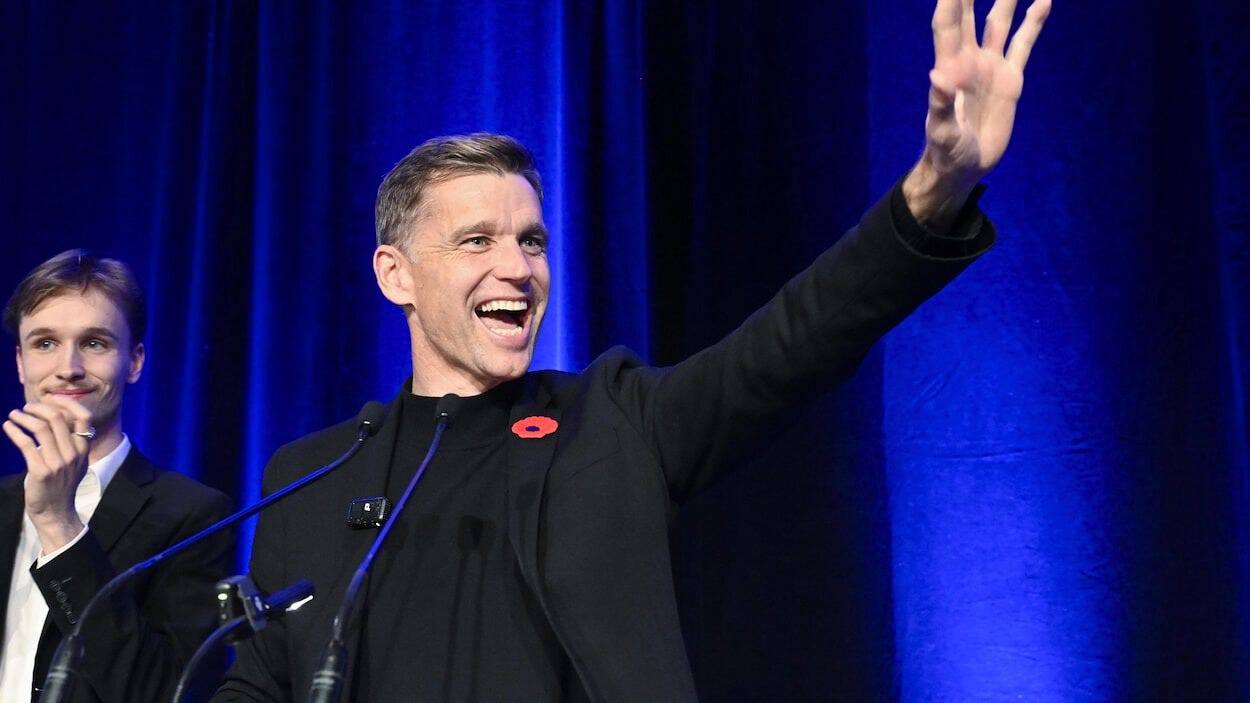
Quebec City has a reputation for being the quintessential conservative city. This large suburban community, where cars still reign supreme, embodies the opposite of the relentless densification that is now fashionable in most metropolises. With its strong regional identity, local sports teams, iconic winter carnival, and right-leaning radio ecosystem, the “old capital” stands in stark contrast to Montréal. For the better, says the author of this article, who grew up and spent most of his life there.
In the Conservative Party’s only stronghold in Quebec, however, a real culture war has been raging since Bruno Marchand was elected mayor in 2021. Upon his arrival, the new mayor made it clear that he would not be just another conservative mayor content to keep municipal taxes low and deliver basic services to citizens. On the contrary, he belongs more to the class of mayors who, like Anne Hidalgo in Paris, Sadiq Khan in London, and Valérie Plante in Montréal, champion a new way of life that must be imposed on citizens.
Abandoning the city’s primary missions in favour of ideology
The municipal level is unique in that it directly affects people’s daily lives, and its primary responsibilities are, above all, pragmatic, such as garbage collection or snow removal in the case of a northern city like Quebec City. However, more and more mayors are losing interest in these responsibilities and instead interfering in the lives of citizens, injecting a strong ideological component into municipal politics, which is traditionally less polarised than other levels of government.
Quebec City, under Bruno Marchand, has reduced both the frequency of garbage collection and the speed of snow removal after a storm. This has not prevented municipal taxes from increasing, nor has it prevented the introduction of a strange $12 tax imposed on all cat owners, supposedly to compensate for the externalities of their pets. Also noteworthy, in the middle of the holiday season, is the ban on the use of residential fireplaces, which the municipality sought to enforce by tracking down offenders with thermal cameras during Christmas week.
We could also mention the laughable DEI offensive launched by the city in 2021. Through television and bus advertisements, residents are invited to visit a website to “educate” themselves in order to be more open to immigrants, filled with platitudes such as: “Smile and say hello to people from diverse backgrounds to include them in our daily lives.” In the same vein, a historic mosaic of the city’s founder, Samuel de Champlain, has also been hidden in City Hall, as it was deemed offensive to Indigenous peoples. Ironically, this mirrors the scenario in Denys Arcand’s film Testament, which is intended as a satire of contemporary cancel culture.
The highly polarising issue of the Quebec City tramway is part of the same trend. Adored by Montréal commentators but rejected by the majority of Quebec City residents, Mayor Marchand’s public transit project has become the spearhead of those who want to “metropolise” the old capital by fighting against the daily use of cars in the city. With its eco-friendly veneer, this $10 billion project represents the ideological determination of a mayor who deeply wants to change the city he leads, often against the wishes of its own residents.
Immigration: Mayor Marchand’s new warhorse
Among Canada’s major cities, Quebec City also stands out as the one with the lowest level of immigration. As the expression goes, Quebec City is “a big village” where most people know each other and have rubbed shoulders at school or in associations, despite its size of over 500,000 inhabitants. As professors Pierre Fortin and Mario Polèse pointed out in Policy Options, while many large cities suffer from a lack of social capital, Quebec City stands out for its low levels of crime and inequality, as well as its strong economic vitality, which are the result of a “tight-knit” city. Until recently, Quebec City embodied a “different way” of being a major city, one that resisted excessive densification, cracking down on cars, and immigration-led growth.
That was before Bruno Marchand’s new crusade, which this fall revealed him to be one of the fiercest opponents of the Quebec government’s immigration restrictions. At a time when most political actors, including Mark Carney’s Liberals, recognise that migration policies have gone too far in recent years, the mayor of Quebec City continues to push in the opposite direction. Stepping up to the plate as if he were the leader of the official opposition in the National Assembly, he has repeatedly called on the Legault government to ensure that temporary workers whose permits have expired are not forced to leave. A few days ago, in the pages of The Globe and Mail, he rejoiced that the demography of his city is changing dramatically following a 57 percent increase in its immigrant population since 2016.
Yet, while he celebrates, Quebec City is on track to have the highest population growth in the entire province by 2050, and this is not without consequences. While the rapid rise in property prices seems to be slowing down somewhat, it continues unabated in Quebec City, which at the beginning of last year was the city in Quebec where house prices were rising the fastest, twice as fast as in Montréal. The situation is such that the municipality is now organising a lottery to distribute interest-free loans from its home ownership programme, for which applications have skyrocketed. Quebec City, once a great family-friendly city, is now joining other large cities where it is increasingly difficult to find housing.
Another city is possible
It would therefore seem that what has long set Quebec City apart is at risk of disappearing, to make way for the vision of worldly metropolises, which rely on densification and uncontrolled immigration to produce unaffordable cities with a serious social capital deficit. However, we dare to believe that the dream of a city on a human scale with deep roots, single-family homes, and driveability is still shared by many, especially young people who want to start a family.
We must therefore ask ourselves where the municipal alternative is, which opposes this counter-project by emphasising families and social capital, rather than a vision that is damaging so many cities where life was once good.
Étienne-Alexandre Beauregard is a contributing editor at Without Diminishment, an author, and a researcher at Cardus. His latest book, Anti-Civilization: Why Our Societies Are Collapsing from Within, was published in September 2025 by Presses de la Cité. He was formerly a speechwriter and strategic planning advisor in the office of the Premier of Québec.

This is a great essay.
I have never been to Quebec City, and it is unlikely that I will visit any time soon.
But the sentiments and content expressed remind me of my hometown and the slow, torturous decay we have endured beneath the guise of woke, progressivism and false progress: London, Ontario could have been the jewel of Southwestern Ontario. We, too, got preoccupied with chasing shiny objects, and lost touch of the things that really mattered: those being, affordability, livability, social capital, and functionality.
A tip of my blue cap to the author for capturing the full essence of the benefits of livability, and the true cost of change for the sake of change completely.