
Harrison Faulkner: Stop demonising hockey culture and let Canadian kids play our game
Supposed efforts to "grow the game" have instead sought to label hockey as "toxic" and "racist."


You can learn a lot about a nation by the stories it tells its children.
We introduce new generations to their culture by speaking of who and what we are at the deepest level. In this country, our most foundational children’s story is almost certainly Roch Carrier’s The Hockey Sweater.
It’s the story of a young boy in rural Quebec whose mother makes the tragic, accidental mistake of buying him a Maple Leafs sweater from an English-language Eaton’s catalogue. For a boy in rural Quebec, it’s a faux pas with dire consequences. His mother forces him to wear it, and he’s picked on by his friends, penalised by referees, and sent to church to pray for forgiveness.
So much of our national story is captured in a short book about a young boy and his hockey sweater. The quote from the book that was immortalised on Canada’s five-dollar note for over a decade captures the sentiment of what hockey means to Canadians: “We lived in three places — the school, the church and the skating rink — but our real life was on the skating rink.” It captures the divides between English and French, Catholics and Protestants, Leafs and Habs. The Hockey Sweater is a book about Canada.
The reason this story is so popular and enduring in both English and French Canada is because it touches on something we all recognise as central to our identity. Despite our very real divides, we share a deep and abiding love for this game of hockey.
Almost every Canadian has read The Hockey Sweater. Every Canadian should know who Don Cherry is. Everyone who was here in 2010 knows about the Golden Goal by Sidney Crosby. The majority of Canadians know how to skate. This is because understanding hockey has been one of the best ways to understand Canada. Put differently, without understanding hockey, one doesn’t truly know our country.
Hockey is not just a sport in Canada. It is an integral part of Canadian culture, and participating in the game as a player, as a parent, or simply as a passionate viewer is part of becoming truly Canadian.
Before proceeding any further, I must confess my own limited experience with hockey culture. I was a mediocre-at-best house league player who was on the ice twice a week for about six of those most formative childhood years. Throughout and following that time, however, I did what most Canadians do and played outdoor shinny on local public rinks.
Canada’s double Olympic defeat to the United States this week, in both the men’s and women’s games, should not come as a complete surprise. Rather, it should be seen as a wake-up call.
After years of national self-humiliation driven by Prime Minister Justin Trudeau and carried out by academics and local politicians to tear down statues, rewrite our history, and retreat from overt displays of patriotism, is it really any surprise that hockey would suffer the same fate as our history?
Hockey culture has been one of the prime targets of the political left and the media. Canadians have been told that it is “toxic” and “racist”, and that to grow the game, hockey culture needs to be completely overhauled and rewritten following a set of rules from people who have very little hockey experience of their own.
Following the 2022 Hockey Canada sexual assault scandal, which uncovered a slush fund that was used by the sport’s national governing body to quietly settle sexual assault lawsuits, the country entered into a minor spasm.
Then-prime minister Justin Trudeau made restoring federal funding to Hockey Canada conditional on the organisation committing to undergo a complete culture change. He referred to Hockey Canada as an organisation fostering an unsafe culture, while his then-Sports Minister, Pascale St-Onge, said that Hockey Canada fostered a systemic culture of toxic masculinity and sexual violence.
While Hockey Canada was under this intense microscope, not one federal politician spoke up to raise concern that this could potentially go too far.
Hockey Canada replaced its board through mass firings and published an “Action Plan” to “eliminate toxic behaviour in Canada’s game”. This was a condition for having federal funding restored, but it was considerably slashed from over $7 million to just over $4 million.
For example, this action plan states that Hockey Canada will become a “sports leader in the areas of equity, diversity and inclusion” as well as mandate diversity training for all high-performance athletes and coaches within Hockey Canada organisations.
Not once in this “Action Plan” to address the alleged horrors of hockey will you find the words “winning”, “success” or “dominance”. It appears that Hockey Canada’s new hockey culture is more concerned about scoring political points than about scoring goals on the ice.
This is not to say that hockey culture, however we are to define it, is perfect. There are, of course, meaningful reforms that can be made. But those reforms should not be made at the expense of winning.
Hockey, for much of its storied history, was a game known for ruthless self-policing. Referees and players shared this responsibility on the ice, while coaches would enforce discipline in the locker rooms. The game is changing. As fighting declines and hitting becomes less prevalent on the ice, there are new edicts from Hockey Canada about the rules of the locker room.
But the attacks on hockey culture have been completely overcooked, driven by the same people who seek to rip at the fabric of Canadian culture. Hockey, an undeniable extension of Canadian culture, is a soft, undefended target for many of these nation-hating activists to dig their ideological claws into.
This is why nationalists must understand that protecting hockey and preserving the culture of the game for our children is not an ancillary or optional part of a conservative vision for Canada; it is fundamental.
Today, hockey is far too expensive for the average Canadian family. The costs associated with joining a minor hockey association and paying for equipment make the game unnecessarily restrictive and only available to a shrinking number of Canadian families. This is to say nothing at all about the time that parents must take in order to share our national pastime with their children.
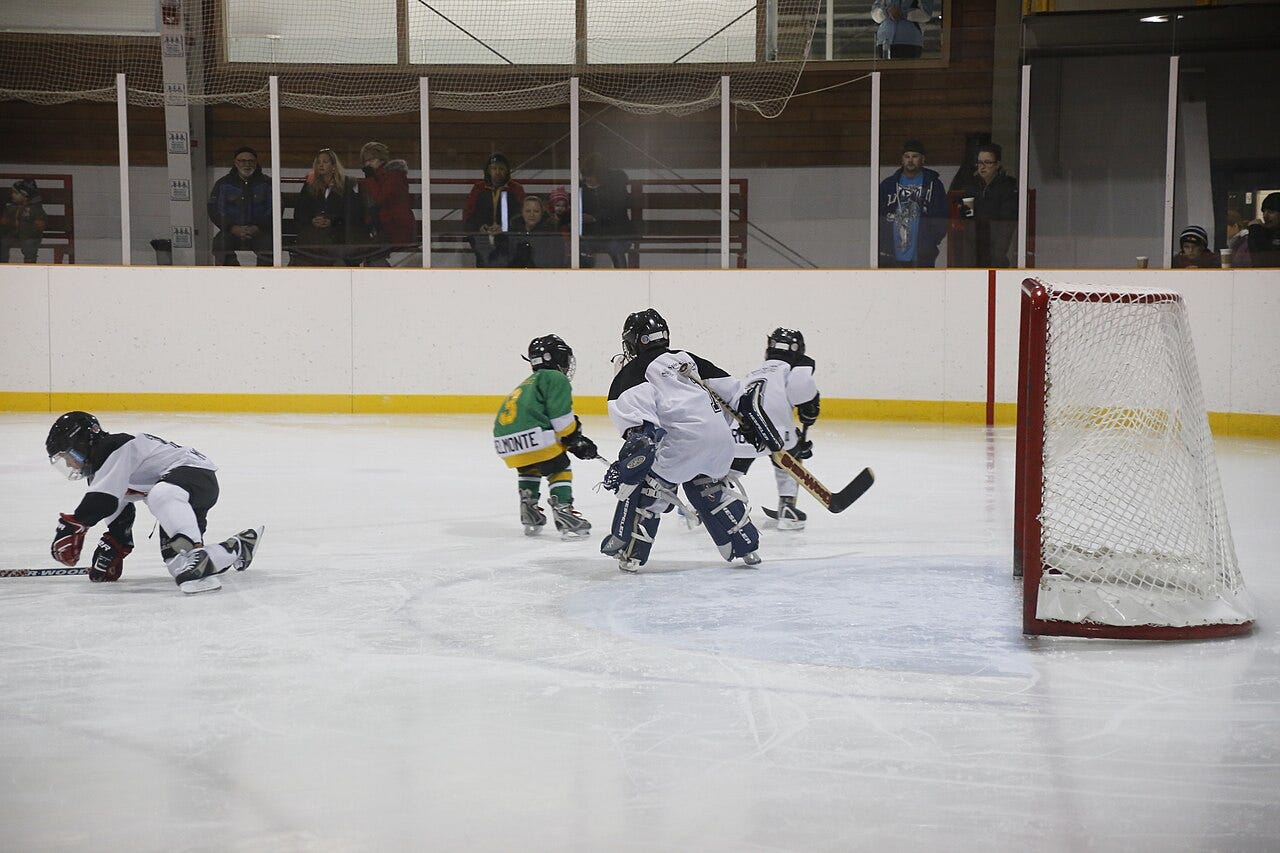
Governments at all levels across Canada should make a genuine effort to lower the financial barriers to the game of hockey. Primary schools and junior schools should stockpile skates and sticks and find ways to introduce Canadian kids to the game. Youth hockey teams should have top-of-the-line goalie equipment so that kids can learn goaltending without their parents having to dip into precious savings.
Hockey Canada, despite its flaws, has a role to play in nation-building, whether the media class or politicians would like to admit it or not. Only one sport in Canada can unite this country and overcome political and regional divides. When Canada wins in hockey, we all feel it. We know what it felt like when Sidney Crosby scored the winning goal in 2010, and the relief we all felt when Connor McDavid scored the winning goal in the Four Nations tournament in 2025. It was not simply that Canada won. It was the Americans that Canada beat that made those victories so important.
It matters because the game of hockey brings all of us together.
If we continue down the current path of demonising hockey culture while youth hockey enrolment continues to drop, the possibility of Canadians growing up without experiencing their own Golden Goal moment is very real. Hockey could be added to a growing list of Canadian cultural relics to be read about only in history textbooks and never truly experienced.
We have a choice to protect and preserve the only sport Canadians can truly claim as our own.
It should be stressed that attempts to chip away at our game, as well as the ability for Canadian kids to play it, are fundamentally anti-Canadian. It must be opposed to the utmost ends.
If hockey is inseparable from Canadian identity, which it undoubtedly is, denying a Canadian child the chance to play the game is denying that child an opportunity to truly connect with this great country.
In Canada, playing hockey should be seen as a right. Not just as a rite of passage, but as a genuine right as part of our citizenship.
Harrison Faulkner is a Toronto-based independent journalist and content creator on YouTube. His videos and writing have appeared in Juno News, The Post Millennial and Visegrad24. He has also appeared as a commentator on international news programs such as WION and GBNews.

Hockey is probably the only thing that is a common cultural touchstone in every single community in Canada. That said, it is yet another aspect of Canadian life that is slowing slipping towards mediocrity.
Can you blame provinces like Alberta and Quebec having a critical mass of people who want to jump ship if this keeps up?
Gotta say, that's pretty rich: "If hockey is inseparable from Canadian identity, which it undoubtedly is, denying a Canadian child the chance to play the game is denying that child an opportunity to truly connect with this great country."
In response, I would like to add that there are several national charitable agencies, e.g. Canadian Tire Jumpstart, and Maple Leaf Sports and Entertainment to name only two, who see the problem of high costs as barriers to entry. I'm sure the author knows this already.
I think it goes too far, and oversimplifies the challenge, to politicize the whole thing.