



Nino Melikidze and Steven Paolasini are leading immigration policy reform advocates involved in the Build Canada network.
On November 5, 2025, Immigration, Refugees and Citizenship Canada (IRCC) introduced the 2026–2028 Immigration Levels Plan. At a glance, the plan seems to be following previously stated priorities, reduced temporary resident levels with continued focus on skilled worker immigration. However, similar to the 2025 immigration levels plan, this new plan also marks a departure from the system’s intended purpose, selecting high human capital economic immigrants with potential for long-term impact.
Despite claiming to rely on stakeholder consultations and evidence-based planning, the new plan appears to prioritise political goals over economic alignment. This memo outlines four key issues we identified with the immigration levels plan, along with our recommendations to bring skilled immigration back on track.
During this memo, we’re going to cover the following key issues:
Statistical distortion and overprioritisation of Francophone immigration targets
Deprioritisation and collapse of the STEM category
Lack of planning and longterm outlook for category-based selection
Contradiction of stakeholder feedback from consultations
Statistical distortion and over-prioritisation of Francophone immigration targets
The 2025 Immigration Levels Plan outlines an 8.5 percent target for French-speaking permanent-resident admissions outside Quebec. While this figure may appear modest, it conceals its outsized impact on the Express Entry system. Because Family, Refugee, and Humanitarian streams (which make up a large share of total permanent-resident admissions) do not assess language, the entire burden of meeting the Francophone target falls disproportionately on the Economic Class. In practice, this means that nearly one in three Express Entry invitations in 2026 (27.8 percent of total invitations) will be reserved for Francophone candidates. The target is set to increase further, reaching 9.5 percent in 2027 and 10.5 percent by 2028.
This prioritisation stands in contrast to the findings of federal stakeholder consultations, where only 14.6 percent of respondents identified Francophone immigration as a top economic need. The disconnect between headline targets and their practical implications highlights a systemic imbalance, demographic objectives are being met through adjustments that sideline broader economic priorities. Without recalibrating these targets or expanding alternative immigration pathways beyond Express Entry to meet Francophone demographic targets, Canada risks constraining access for highly skilled, in-demand workers who do not meet French language criteria, ultimately weakening the alignment between immigration policy and economic realities.
Deprioritisation and collapse of the STEM category
One of the most significant shifts in Canada’s Express Entry system is the quiet abandonment of the STEM category despite its central role in Canada’s innovation economy and long-term productivity. No STEM draws have been held since April 2024, and IRCC has given no indication that they will resume. The silence is striking, especially given that in IRCC’s own 2024 stakeholder consultation, 32.4 percent of respondents identified a “great need” to prioritise the STEM category (one of the highest results across all options), in sharp contrast to feedback on the Francophone targets.
More concerning is the structural erosion of the category itself. Under the 2025 reforms, IRCC removed 19 key STEM occupations from eligibility, including: software engineers, computer systems developers, web developers, data scientists, engineering managers, and urban planners. All of these are professional occupations that command above-average incomes, require high levels of education and experience, and contribute to increased Canadian productivity. In their place, the department controversially added “Insurance agents and brokers” (NOC 63100) to the STEM list, a sales-oriented occupation with little connection to science, technology, engineering, or mathematics, and a minimum education requirement of a high school education.
This misalignment undermines the integrity of the STEM category and cuts off vital pathways to permanent residency for highly skilled international workers, many former undergraduate and graduate students already contributing to Canada’s tech sector. Those affected include graduates from leading Canadian universities in AI, engineering, and computer science. A University of Waterloo graduate in computer science with three years of work experience cannot secure permanent residence in Canada through Express Entry without work experience abroad or French-language fluency. This is a problem.
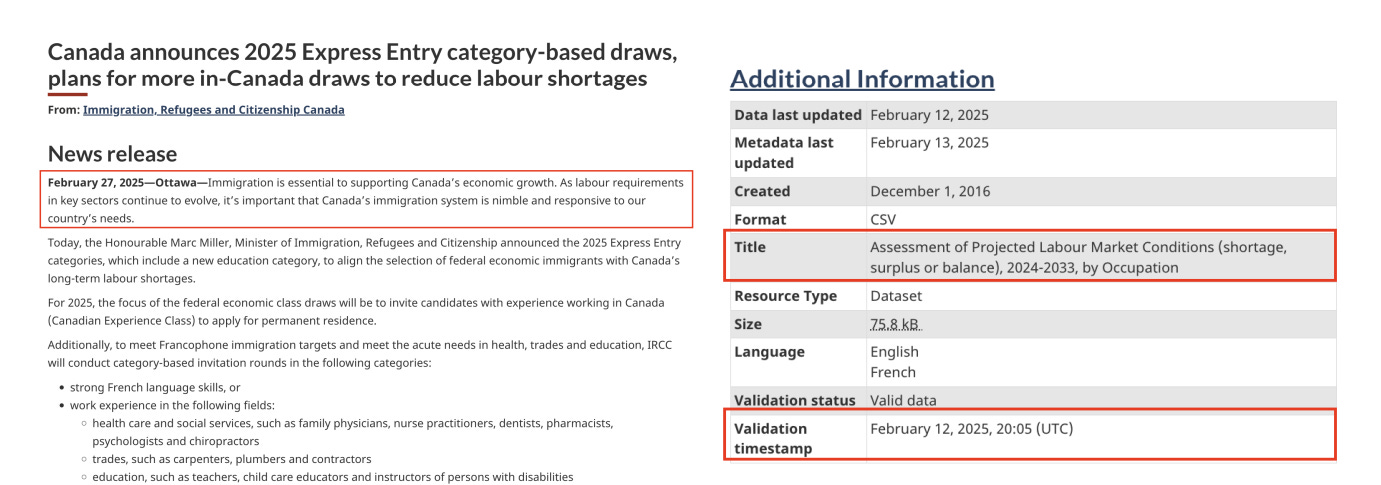
Our assumption is that these category occupations are chosen through an outdated, bureaucratic reading of labour market data (such as ESDC’s COPS projections) rather than a forward-looking strategy to attract and keep global talent for long-term productivity in the Economic Class. We noticed a correlation between when the COPS data were finalised in 2025 (early February) and when IRCC announced the immigration category designations (end of February). We believe that the categories for 2026 will be finalised once the COPS occupations data are released sometime in February of next year. You can see the screenshots of when the COPS data were finalised versus when the IRCC category-based draws were announced below.
Lack of planning and long-term outlook for category-based selection
IRCC promotes category-based Express Entry as a strategic tool to respond to Canada’s specific acute and medium-term labour market needs. In reality, the 2025 rollout reflects a system reacting to immediate pressures rather than planning for long-term needs. As of early November 2025, no categories have been announced for the coming year, leaving everyone in limbo. This absence of foresight undermines IRCC’s stated goal of aligning immigration policy with economic priorities and stakeholder input. It should be noted that the only requirement to qualify for a category-specific draw with a profile in Express Entry is to have 6 months of full-time work experience within the last 3 years in any of the selected occupations.
Even within the 2025 framework, category choices reveal fragmented, short-term thinking. “Cooks” (NOC 63200) which fall under the occupational category of “service” occupations were added to trades draws among occupations in the construction and building trades. Line cooks with master’s degrees scored higher than plumbers, electricians, and carpenters who tend to have less education. The result was more than half of invitations in trades draws going to cooks at the expense of PR aspirants in the building trades. Equally disappointing was to see the absence of higher-skilled occupations like “Chefs” (NOC 62200), a natural career progression for a Cook. This seems to be driven by the fact that Chefs are perceived as “balanced” in the COPS labour market data, whereas “Cooks” are presented as having a moderate chance of shortage. No category is safe from IRCC’s mismanagement, consider the healthcare category. Pharmacy assistants/aides (NOC 33103) with a median wage across the country of $20/hour continue to dominate as an unregulated healthcare occupation, removing spots from licensed medical professionals and technicians. For context, the only requirement for this occupation is a high school education and a few months of work experience.
The deeper issue isn’t simply a misalignment with the current labour market; it’s the absence of a holistic approach for human capital. Skilled immigration should not be used to fill immediate gaps; it should be designed to build the workforce Canada needs 10, 20, and 30 years from now. That means optimising for higher-skilled occupations and sectors that will define Canada’s economic and technological future. These are primarily roles that drive innovation, productivity, and national competitiveness. This is heavily emphasised by one of Canada’s leading economists, Mikal Skuterud, the C.D. Howe Institute’s Fellow-in-Residence.
When immigration categories are defined without this strategic lens, policy becomes transactional instead of transformational. Canada risks importing short-term labour rather than investing in long-term talent. Strategic immigration planning must look beyond annual job vacancy reports and align with a clear national development and productivity roadmap.
Contradiction of stakeholder feedback from consultations
IRCC’s 2025–2026 Express Entry and immigration priorities diverge sharply from the feedback gathered in its own stakeholder consultations. Consider a couple of examples of this from the 2025 Stakeholder Consultations on Immigration Levels report.
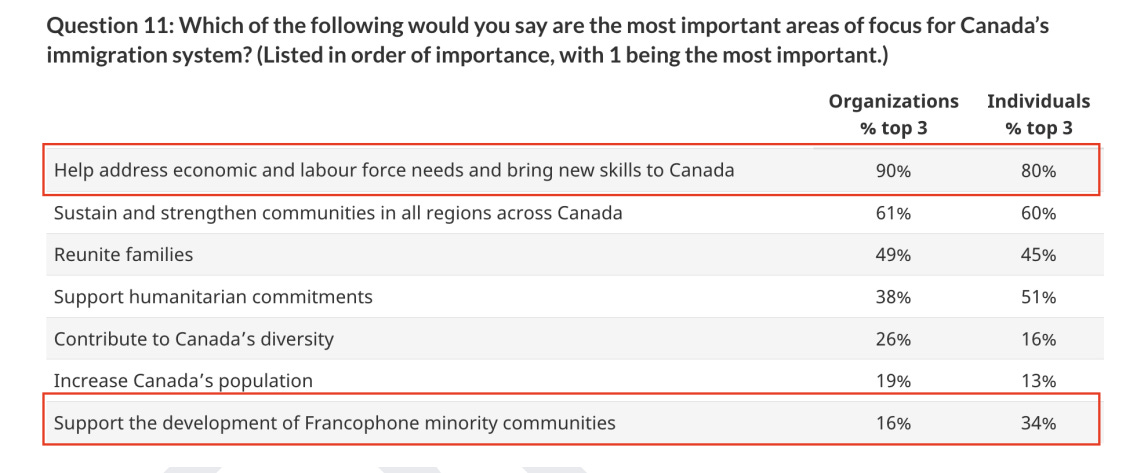
Survey data from IRCC’s own 2025 consultations makes the public consensus unmistakable, stakeholders want immigration policy to prioritise economic outcomes. When asked about Canada’s immigration objectives, 90 percent of organisations and 80 percent of individuals ranked “help address economic and labour force needs and bring new skills to Canada” among their top three goals.
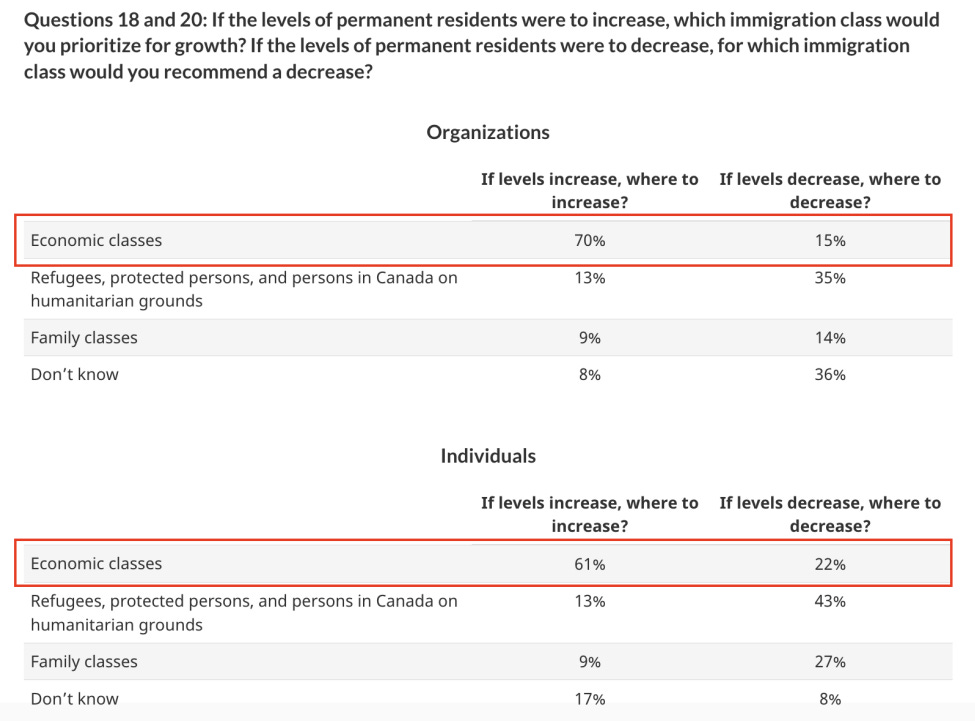
And when asked which immigration class should grow if levels rise, 70 percent of organisations and 61 percent of individuals chose the economic class. Even in scenarios where levels would decrease, respondents most often recommended reductions in humanitarian and refugee streams, not the economic class. The message is consistent and clear, Canadians expect the system to strengthen the labour market and support long-term economic growth.
In sharp contrast, support for Francophone immigration outside Quebec was limited. Only 16 percent of organisations and 34 percent of individuals ranked it as a top-three priority, and just 27 percent of organisations and 15 percent of individuals expressed interest in engaging further on Francophone minority community development.
The consultation also highlighted real integration concerns, fewer than 5 percent of prospective Francophone immigrants have adequate English proficiency, creating barriers to employment and community integration outside of Quebec. In their survey responses, stakeholders included a couple of practical recommendations to remediate this issue, such as “set Francophone immigration targets in provincial nominee programs, and expand the Francophone Community Immigration Pilot to other municipalities.”
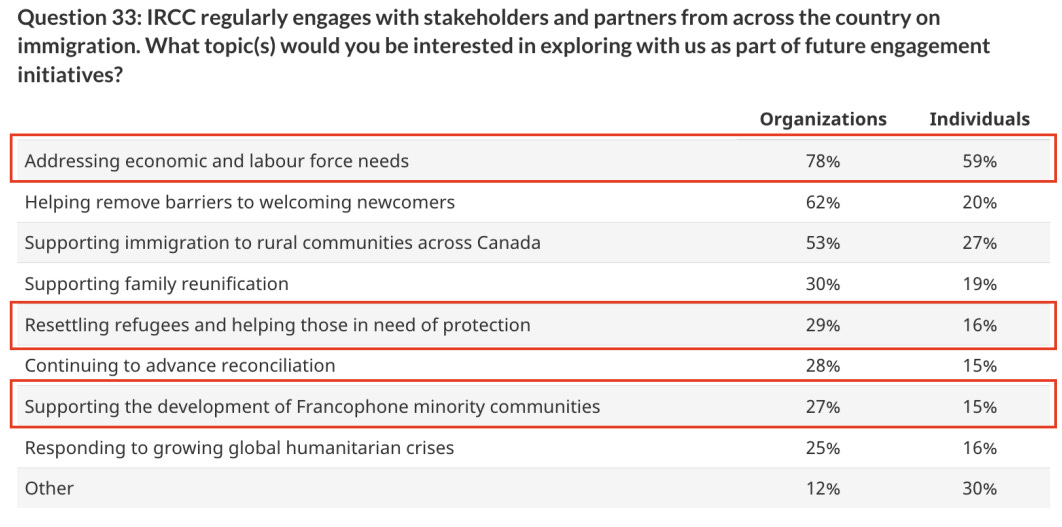
Despite this limited support and the documented challenges, Francophone immigration was consistently elevated to a central policy focus for 2025, 2026 and 2027—thus diverging from stakeholder guidance and shifting attention away from the economic class that Canadians overwhelmingly endorsed.
When stakeholder consultation results point in one direction but policy moves in another, trust in the immigration levels planning process erodes. If feedback is solicited, it should actively shape decision-making. Aligning immigration priorities with these insights would not only improve transparency and actively serve the will of Canadian stakeholders but also ensure the system reflects both Canada’s economic needs and its long-term human capital goals.
Our recommendations
The analysis in this memo points to a widening gap between how Canadian immigration policy is being designed and the outcomes of the policy, contrasted with what key stakeholders and the public consistently say Canada needs. Express Entry was built to drive economic growth, yet recent, rapid shifts in the selection process have pulled it away from that core purpose.
The recommendations that follow are grounded in analysing immigration trends and prioritising productivity and economic prosperity. They focus on restoring transparency and consistency to the system while realigning Express Entry with Canada’s long-term human capital and competitiveness goals.
Remove the dynamic category-based selection process
Canada’s permanent immigration system should be built around long-term national priorities, not short-term labour market swings. The current rotating category-based model has done the opposite, it’s introduced inconsistency, unclear priorities, and an unpredictable draw cadence that weakens applicant confidence and undermines the selection process.
The solution is focus, not constant reinvention. Canada should replace the rotating categories with a small set of permanent, high-priority categories anchored in chronic and long-term economic needs. STEM and high-skilled healthcare occupations belong at the core. These roles are foundational to Canada’s competitiveness, innovation capacity, and productivity. Their eligibility criteria and NOC codes should be tightened to reflect real skill requirements, proper credentialing, and labour demand. In parallel, the Express Entry Federal Skilled Trades draws should be restored to support trades workers with Canadian certifications and proven local work experience.
Finally, Express Entry needs to return to a transparent, predictable draw schedule. The current volatility has disrupted the system’s original intent to focus on highest skill and applicant merit. Clear timelines, skill requirements, and consistent rounds will rebuild trust among both business stakeholders and the population. It will also ensure that immigration applicants can navigate the system with confidence.
Swap out general Francophone targets for specialised programs
Canada’s current one-size-fits-all approach to Francophone immigration outside Quebec has created inefficiencies and outcomes that don’t line up with the country’s broader economic priorities. Supporting French-speaking communities is a legitimate cultural objective, but not through applying general Francophone targets across the entire country, without regard for integration capacity or labour market alignment.
A more strategic approach is needed. Instead of general nationwide targets, the federal government should allocate all French-speaking immigration quotas to the Francophone Community Immigration Pilot, a targeted, community-driven program modelled after successful immigration pilots. This pilot focuses on specific Francophone regions outside Quebec that have the infrastructure, employment opportunities, and long-term capacity to support these newcomers. Participants would receive permanent residence tied to settlement in these communities, with incentives for retention and deeper integration. This ensures that language-based immigration is tied to real local needs and economic opportunity, not distributed arbitrarily across the country.
Increase transparency in immigration planning
Transparency is the baseline for public trust in Canada’s immigration system. Yet today, the way immigration levels are set and how permanent residence spots are truly allocated are unclear. When decisions are communicated vaguely or selectively, institutions, employers, and the public are left guessing. That erodes confidence in a system that depends on clarity.
The new, 2025 federal budget made this gap impossible to ignore. It referenced two “one-time” permanent residence pathways, one for temporary workers (economic class) and one for protected persons (refugees). But only the economic class pathway was actually quantified in the budget tables, the 33,000 targeted admissions over 2026–2027 and the costs were clearly outlined. Meanwhile, the protected persons measure quantity was missing from the budget and could only be found in the 2026–2028 immigration levels plan, 115,000 admissions targeted over the same two years. Both of these measures together introduce an additional 74,000 permanent residents for both 2026 and 2027. This means that the actual immigration target for 2026 is 454,000, not 380,000.
Presenting the one-time measure’s smaller number prominently while burying the larger one isn’t just inconsistent communication, it reads as an intentional avoidance of scrutiny on a major policy shift. Additionally, when calculating the real immigration target for 2026 with these measures, it becomes clear that no significant reduction in permanent residence numbers has been made despite negative public sentiment towards immigration at this time.
Canada needs a different standard. Immigration targets and pathways must be disclosed clearly and in full, across both the Immigration Levels Plan and the federal budget. Every permanent residence pathway, regardless of class or rationale, should be fully quantified and openly communicated. Transparent numbers enable meaningful stakeholder engagement, strengthen accountability, and give Canadians an honest understanding of the choices shaping their demographic and economic future.
Incorporate key stakeholder feedback in immigration planning
Stakeholder consultations are supposed to ground immigration policy in real economic and community needs. But when feedback is collected and then ignored, the process stops being collaborative or helpful. That’s what we saw in both the 2025 and 2026 Immigration Levels Plans, which deviated sharply from the priorities stakeholders repeatedly highlighted when being surveyed.
In the 2024 consultations, stakeholders emphasised two clear goals, address structural labour shortages and align immigration with long-term economic growth. Instead, the 2025 plan leaned heavily on category-based draws that overlooked chronic skills gaps and amplified lower-priority areas such as broad Francophone immigration.
The most recent consultations (held in summer 2025 for the 2026–2028 plan) offered stakeholders another chance to guide policy with their insights. Yet, the final plan released in November showed, once again, a clear disconnect between what participants recommended and what was implemented.
If Canada wants a credible immigration planning process, stakeholder input can’t just be a checkbox. It needs to shape targets, priorities, and long-term strategy. Without that alignment, trust erodes, and the consultation process becomes performative.
Nino Melikidze is a Toronto based immigration tech startup founder, TEDx speaker, and immigration policy reform advocate. Nino has been one of the loudest voices in the Canadian immigration space since 2021 with the My Immigrant Story podcast she used to host and the Immitracker community of thousands of newcomers she is personally moderating.
Steven Paolasini is a licensed immigration consultant who works with hundreds of cases through his consultancy and regularly investigates Canadian immigration policy decisions.

How do we illicit change other than pressing our MP’s?