


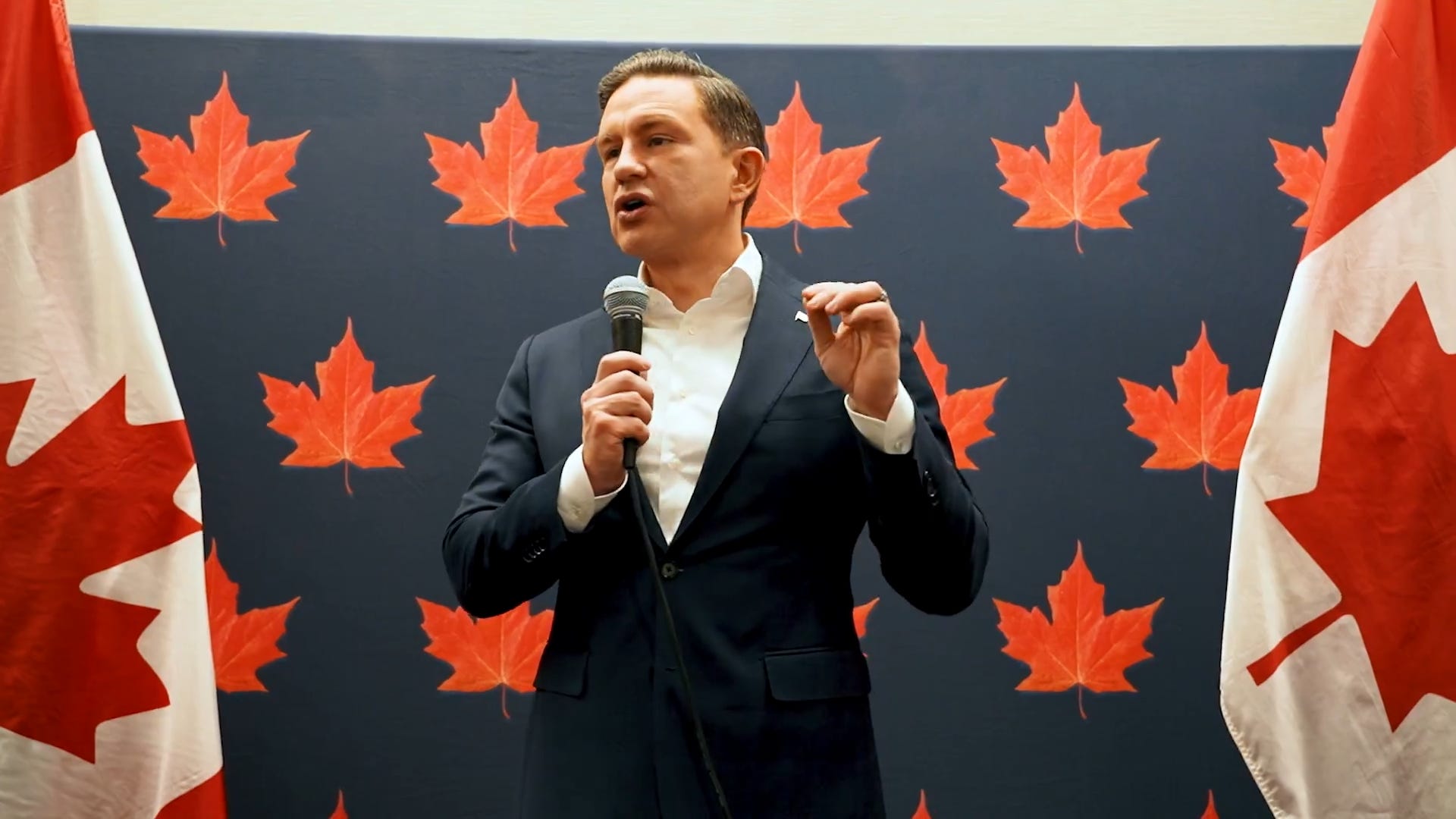
Last Friday in Calgary, Pierre Poilievre delivered a convention speech that fused small-government principles with a recognition that the right must fight not only economic battles but cultural and institutional ones as well.
The Conservative leader rightfully devoted ample time to Canada’s bloated regulatory regime and to an economy that has failed to reward hard work under the Liberals. Many convention attendees came to hear that, especially those of a particular vintage, and left feeling satisfied. Those animated by a desire to push back against the country’s left-wing cultural revolution were not forgotten either.
Even when away from the podium at the convention, Poilievre treated national identity, history, and cohesion as serious topics, rather than embarrassing, token side quests. When speaking to a room full of younger Conservative Party members during the convention, Poilievre said:
“Young people want to feel like they are part of a country; that every day they wake up and feel like they are contributing to their nation; that their sacrifices are not just for some undefined purpose; that they’re not just servants of the state. We have a common identity, purpose, history, and future in this country.”
Critics call these wedge issues, but they are existential questions for any government. Many right-of-centre leaders have previously treated them as secondary, or ignored them altogether.
One of the most notable lines from Poilievre’s Friday speech did not concern pipelines or deficits.
“We will celebrate rather than tear down our heroes in history. Our museums and heritage programs will tell the unvarnished truth that Conservatives have known all along; this is the greatest country on Earth precisely because of the goodness of those people who came here and sacrificed before us,” said Poilievre.
Politics is downstream from culture. This is especially true of the stories a country tells about itself through its institutions.
In an excerpt from his book, Lament for a Literature, Richard Stursberg argues that cultural agencies and gatekeepers have adopted DEI-driven exclusion and a punitive “right not to be offended” posture that freezes artistic risk and shrinks the national conversation.
If conservatives do not want to be governed by cultural bureaucracies, they must contest them. It is not enough to sit, hope, and pray that they will be treated kindly.
Poilievre’s speech also included an explicit call to end the epidemic of hyphenated identities in favour of a stronger, singular Canadian one.