
Michael Bonner: Our architectural decline from splendour to monstrosity
The old vision of a Canada of unity and strength, made manifest in brick and stone, has much to teach us still.


In Western Canada there is to be seen to-day that most fascinating of all human phenomena, the making of a nation. Out of breeds diverse in traditions, in ideals, in speech, and in manner of life, Saxon and Slav, Teuton, Celt and Gaul, one people is being made. The blood strains of great races will mingle in the blood of a race greater than the greatest of them all.
It would be our wisdom to grip these peoples to us with living hooks of justice and charity till all lines of national cleavage disappear, and in the Entity of our Canadian national life, and in the Unity of our world-wide Empire, we fuse into a people whose strength will endure the slow shock of time for the honour of our name, for the good of mankind, and for the glory of Almighty God.
That is the preface to The Foreigner, a 1909 novel by the Rev. Charles William Gordon (1860–1937), who wrote under the pen name Ralph Connor. He was a prominent Canadian Presbyterian minister, missionary, and one of the country’s most successful novelists in the early twentieth century.
The story of The Foreigner revolves round the figure of Kalman Kalmar, a Ruthenian immigrant from Galicia, a semi-autonomous province of the Austro-Hungarian Empire. Kalman was what we would now call a Ukrainian and, as a newcomer to Canada, he was the ‘stalwart peasant in a sheepskin coat’ that Interior Minister Sir Clifford Sifton was so eager to recruit for the settlement of the West.
The novel’s vision of the integration of foreigners and its focus on the immigrant experience were progressive for their day. But that vision is scarcely recognisable in the contemporary era of ‘diversity’. No one talks of ‘blood strains’, ‘great races’, or ‘breeds’ anymore, let alone ‘Saxon and Slav, Teuton, Celt and Gaul’. Nor can one imagine contemporary progressives embracing muscular Christianity as a force for nation-building, as the novel does.
Hard work, which is likewise a source of bonding and cohesion invoked by the Rev. Gordon, is now the object of progressive disdain. And the vision of Canada as part of a Greater Britain, uniting people of diverse habits, beliefs, and languages, evokes embarrassment, or would, if progressives could recollect it at all. The old flag, the Red Ensign, is gone, and crowns, heraldry, crosses, fleur-de-lys, and other such symbols have vanished from passports, government documents, and public buildings. Even the name of our country, the Dominion of Canada, has disappeared.
The result, as at least one author has noted, is that Canadians are like ‘Andean peasants’ dwelling ‘amid the ruins of a civilisation of which they have lost all memory’. This is an exaggeration.
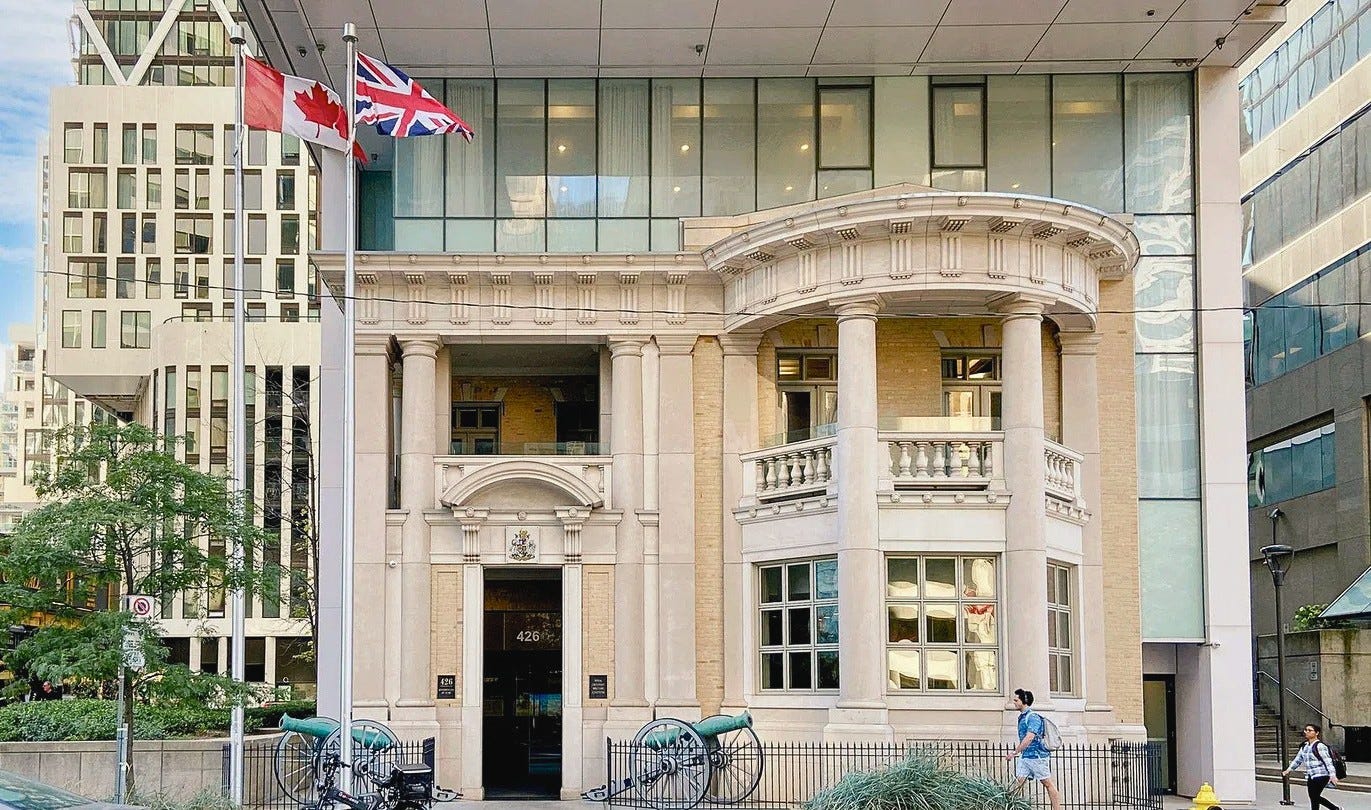
The British Empire is no more, and memories of the Greater Britain have faded, but there are no ruins, yet. In fact, the most obvious evidence of the old Canada is the late nineteenth- and early twentieth-century architecture that still stands in the city centres from Halifax to Vancouver.