


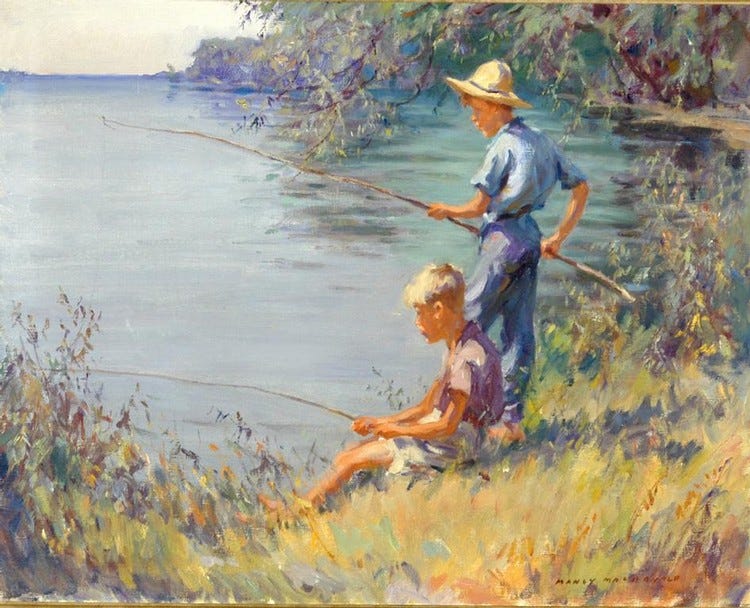
Born in the ghost village of Point Anne, near Belleville, Manly E. MacDonald (1889–1971) was known as the ‘Interpreter of Old Ontario’. The son of a Bay of Quinte farmer-fisherman, MacDonald left over 2,000 works that capture the beauty and spirit of local Canadians and their lifeways. He depicted our lands and villages, our grandparents, and countless distant-felt and rooted moments which inspire and remind us in an age of mass and scale, speed and change.
Classically trained, MacDonald began his arts education locally at the age of thirteen and continued his studies at prestigious art schools in Buffalo, Boston, and Toronto. He launched his career as an official war artist tasked with depicting the dedicated agricultural workers of the First World War – those men and women who fought the all-too-important battle against starvation at home and abroad. MacDonald’s career spanned sixty years, punctuated and supplemented only by occasional fishing, ending in 1971, when he returned to the soil of the Old Ontario core, the land he loved, was born in, and painted with deep and undeniable affection.
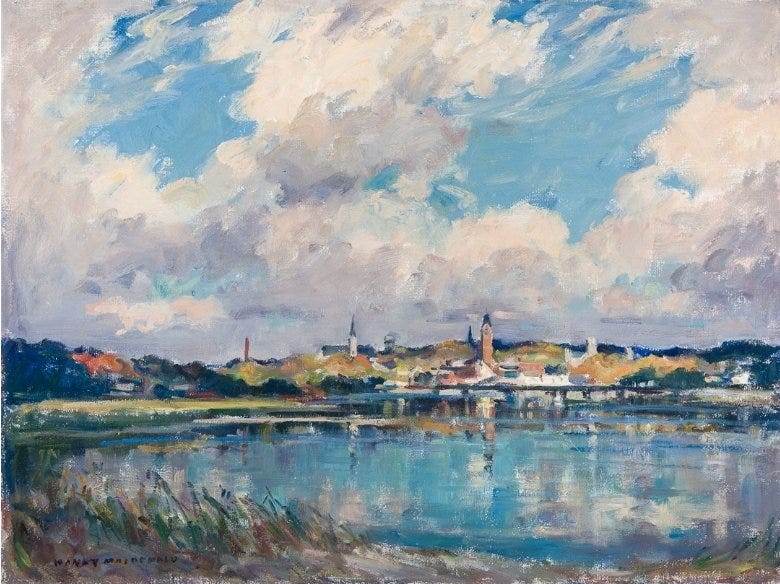
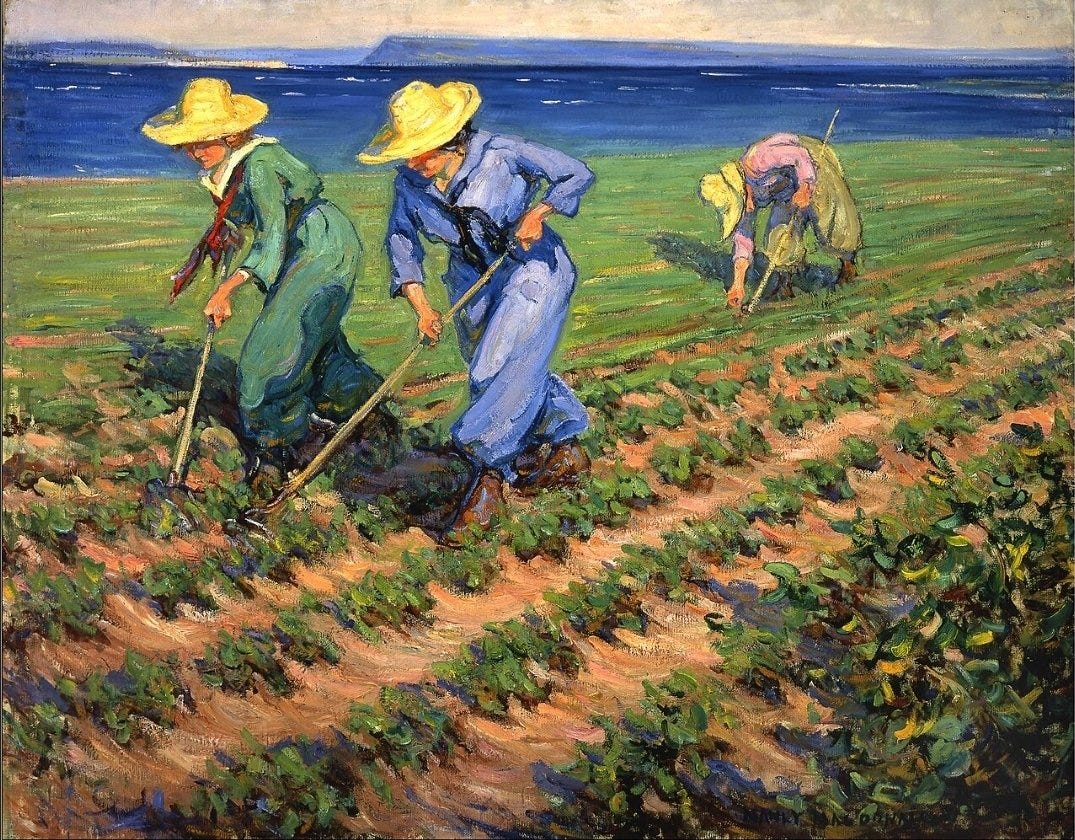
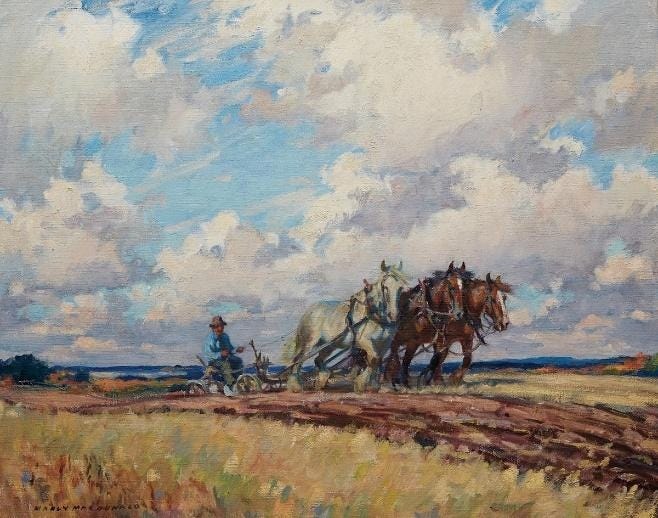
First exhibited in his home town in 1922, MacDonald went on to be included in the first British Empire Exhibition (1924), the New Canadian Pavilion (1925), the esteemed Tate Gallery in London (1938), and the 1939 New York World’s Fair. The highlight of his career was arguably his 1959 commission of the Toronto skyline for Queen Elizabeth II – an honour that the modernists and abstractionists of his day felt was a royal insult given MacDonald’s status as a traditionalist painter.
This was the defining conflict of MacDonald’s life. By the middle of his career, the tradition he participated in was falling out of fashion. New forms and movements were coming into being, and society was undergoing radical change. The human subject was beginning to be seen as outmoded and overdone. Focus not just on the human subject but on the real object became reactionary, doubly so for the rural landscapes and quaint villages of MacDonald. As new ideas and interests gained institutional sway, money and attention were increasingly directed to art which perpetuated and better represented the developing set of mid-twentieth-century values.
Elected to the Royal Canadian Academy of Art and the Ontario Society of Artists (OSA), MacDonald found that his continual protests were ill received by the ascendant progressives of the rapidly modernising art world. In opposition to what he perceived as a creeping modernism that sidelined talented artists, MacDonald resigned from the OSA in 1951. An active member for over thirty years, he was cleared from the records, and his name remains absent from the rolls to this day.
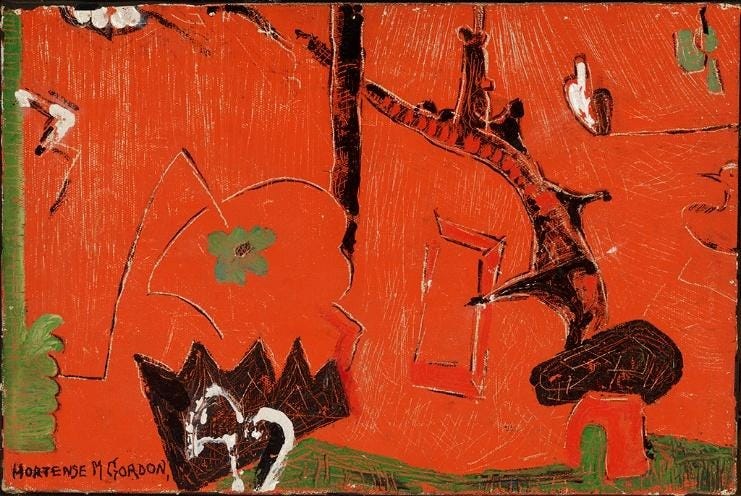
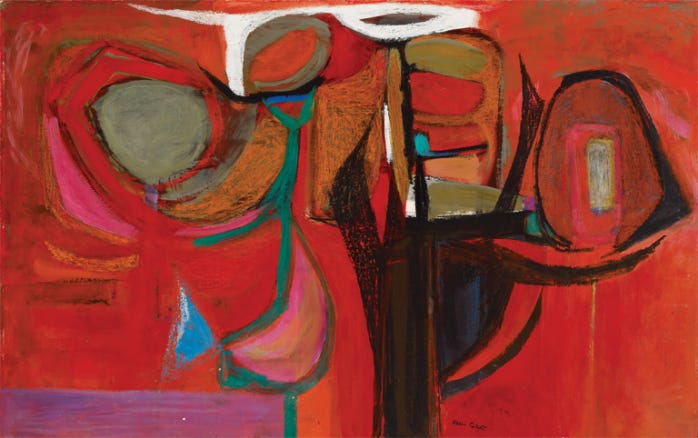
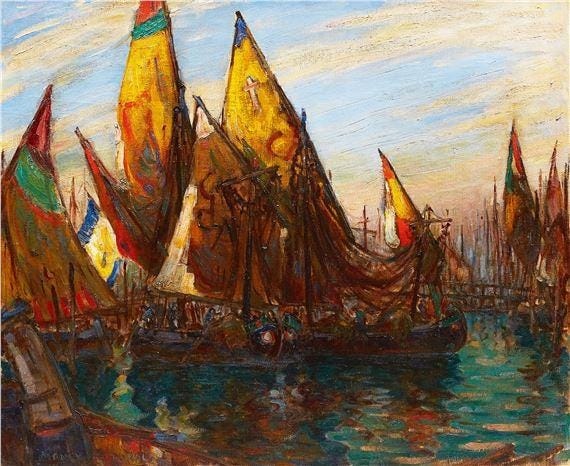
Though MacDonald received the royal commission in 1959, civic and popular commissions were slower to accommodate new and transgressive cultural developments. The next generation of traditionalists, MacDonald felt, would not be so lucky, and were well on the way to marginalisation and cultural endangerment if education and incentives deprivileged them for long enough. MacDonald was concerned not with his own personal career but with the future of Canadian culture and the foreseeable displacement of young and talented artists in the face of a critical, institutional, avant-garde shift.
Not some stodgy automaton thoughtlessly imitating the past, MacDonald cared deeply about art as an iterative and evolving practice. He personally embraced a bright, non-traditional colour palette and new impressionistic painting methods. He was never one to dismiss work merely for innovation. Instead, he is said to have commented that it was ridiculous for art students to ignore and not study the work of the Old Masters. It was not change but an explosive rupture of tradition that MacDonald feared in the abstract and deconstructive turn.
Importantly, representational art was never some stale, outmoded process of duplication. Great representational artists do not copy a given subject faithfully, as it is in the world. There is a great deal between pure abstraction and one-to-one realism. It takes tremendous skill not only to capture the essence of a thing but to draw out features with purpose and intention and cause the subject to inhabit a character and a chosen meaning. The process itself, at its most successful, is fundamentally interpretative and intrinsically semantically additive. So, it is not staleness or cultural stagnation, as modernist narratives often suggest, but the power over the culture-spirit of a given people that, for the modernists and their descendants, made traditional representational art such a thing worth deconstructing and disinheriting.
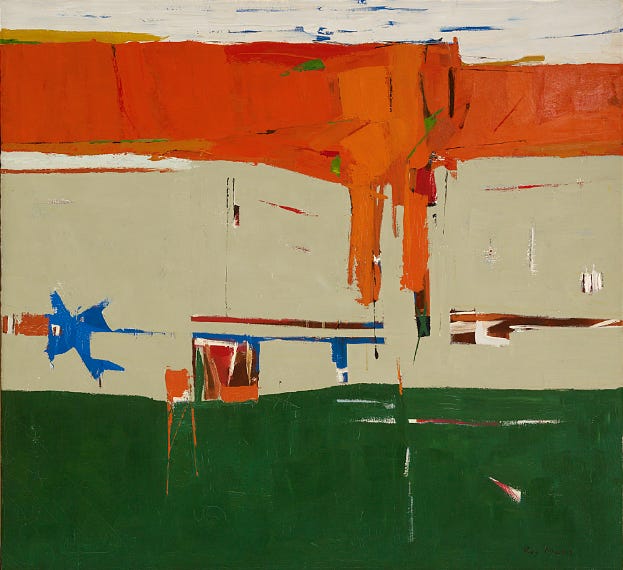
Traditionalists everywhere were starting to feel the squeeze rolling into the 1960s. Western culture was speeding towards deconstruction, the sort that would come to dominate from the academy to the cinema into the twenty-first century. Ambiguity, critique, reduction, and constructivist interpretability were ever more the standards of greatest value, depth, and quality. From the perspective of the classically educated and the traditionally rooted, there was coming to be scarcely any such thing as ‘good art’; there were no authoritative standards of merit, only equivalent meanings, preferences, and divergent artistic styles – a world defined in reality by the success of right-think, where art residencies, scholarships, and accolades accrued continuously to the revolutionary vanguard.
MacDonald was not alone in rejecting the modernist-abstractionist pivot. MacDonald was part of a talented group of skilled Canadian traditionalists who defected from the OSA, all converging on a preference for mastery and technique, and a desire to contribute to place and culture, against transgression, ‘the message’, and the accompanying yarns and nuggets of metaphor that would for decades receive the lion’s share of praise and patronage.
Kenneth Forbes (1892–1980) followed in the footsteps of his father, John Colin Forbes. His father was a founding member of the OSA and a portraitist of such venerable figures as Sir John A. Macdonald, Sir Wilfrid Laurier, and Sir William Gladstone. Kenneth, like his father, was a prime ministerial portraitist, painting prime ministers Borden, Bennett, Churchill, and Diefenbaker. In 1972, he published a scathing 67-page critique titled Great Art to the Grotesque. Going a step further than MacDonald, he argued that gallery directors, museum curators, and wealthy patrons were being duped into buying junk art by hacks, cons, and conspiratorial marketers. Forbes argued that rather than a matter of personal taste, the abstractionist pivot was a phenomenon of manufactured opinion that was supplanting the more serious and thoughtful work of talented artists who followed the painstaking methods of brilliant masters.
Marion Long was a decorated portraitist and the second woman admitted to the Royal Canadian Academy as a full academician. In her 1921 article, ‘Developing a National Art’, she called for the development of a national Canadian art rooted in local identity. She often portrayed military men and received the King Haakon VII Medal of Liberation for services to Norway during the Second World War. Exhibited across the country and throughout the Empire, her work can be found today in the National Gallery of Canada, the Art Gallery of Ontario, the University of Toronto, Annesley Hall, Queen’s University, and the Art Gallery of Hamilton.
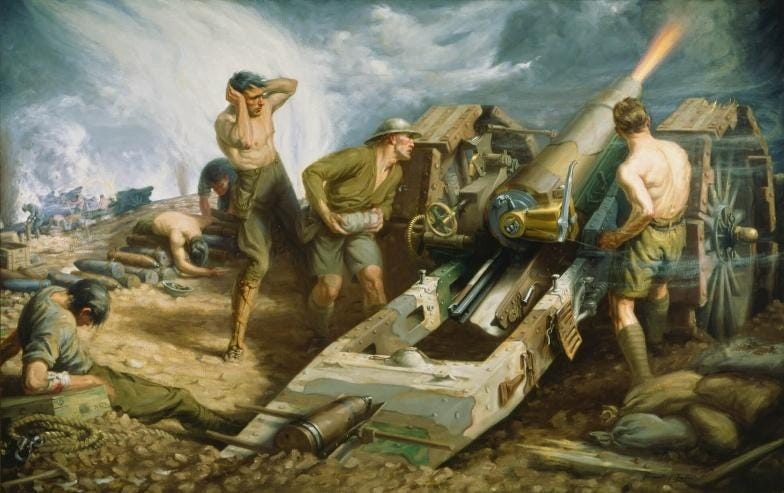
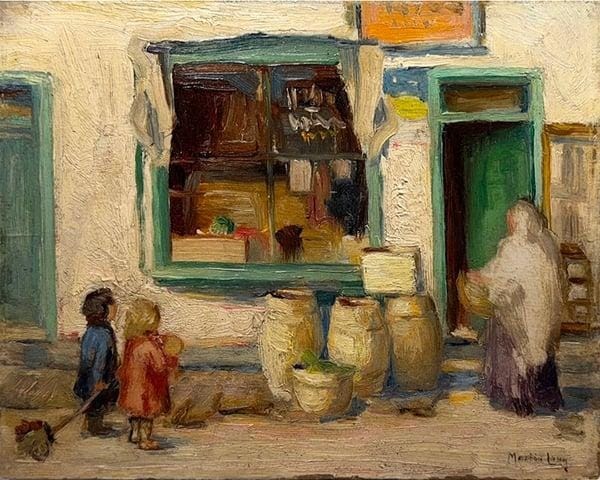
With several other collectors and painters, the traditionalist trio founded the Ontario Institute of Painters (OIP) in 1958, intending it as a rival to the OSA. Its most notable event was the 1959 ‘Points of View’ exhibition at the Public Library and Art Museum in London, Ontario, which deliberately hung traditionalist OIP works alongside pieces by the abstractionist Painters Eleven. The intent was to highlight the technical superiority of traditionalist painters. But as happened with the traditionalists in our churches, academies, and social organisations, the OIP never reached the same heights as the OSA. The traditionalist rearguard, full of conviction, stalled, having packed up and started from square one without any of the clout, money, or influence which might have steered the development of the next generation of Canadian culture. They were old. They were dying. And they left the academies, the review panels, and the next generation almost entirely in the hands of the movements they opposed. The now-defunct OIP’s primary accomplishment in real terms was to give traditional Canadian representational art a quiet place to fall into a coma. Had they weathered the storm and continued fighting within the institutions, accepting losing battles but remaining in places of influence, perhaps planting the seeds of a future counter-revolution, there is no telling how things might have developed differently. Instead, traditionalists were severed from the next generation and excluded from developing the spirit of their time.
Men like MacDonald surrendered the institutions and unwittingly contributed to the decline of the very things they aimed to conserve.
More bereft of a sense of place and identity than ever before, one can look back nostalgically on the forlorn traditionalism of post-First World War Canada. Perhaps one can believe that its falling away was part of an inevitable functional process in which tired and obsolete modes were supplanted by ones which better served social needs or material interests. The modernist-abstractionist rupture is often presented as the next stage of development following the discovery of the limitations of representational academic and folk art.
But this is just not true; abstraction itself is not intrinsically acidic to an existing culture-spirit. Before the Painters Eleven were the Group of Seven. Where might we have been had there been a constructive rather than an iconoclastic dialectic? One with a genuine synthesis of new and old. Perhaps a National Canadian Art as Marion Long spoke about, one that evoked the primal force of the land and the strength and vitality of the people who settled it. Instead, we faced the Eleven’s abstraction, one which not only rejected the Group’s nationalism and adopted a globalist American aesthetic with little to say about Canada, but also lived in eternal definition by that which it critiqued and by all that it is not.
In some respects, we must be like MacDonald. The fires of collective spirit require new wood. We must be willing to learn and adapt, able to kindle our inheritance using new and constructive methods. Unlike MacDonald, however, we must be ready to create a true syncretism – an adaptive art with the spiritual potency to shape belief and identity in the modern day. And very much the opposite of MacDonald, we must be willing to stand amongst our enemies, weather their criticism, and fight out the storm of institutional capture. We must dig in. We must hold on to institutional power, even if that means years of lost votes and countless moments shouted down.
There are some who write art off as being ‘degenerate’ or ‘subversive’. It is a common myth both that art is left-wing and that the creative process involves an openness that runs counter to the exclusionary, stodgy, and set-in-its-ways temperament of rightist men.
But even a basic survey of history suggests that this is not true. Twentieth-century art of the liberal and progressive traditions, if it is even generally good, stands almost always on the shoulders of a rooted and reactionary past. Say what you will, there is still Shakespeare at the Stratford Opera House, even if it is tired, peppered with land acknowledgements, and littered with twenty-first-century ‘enhancements’ like Bridgerton-style casting.
Our enemies are still caught deconstructing the 1950s, living in a time that doesn’t exist any more. There is nothing except for institutions in the way of our cultural power. There is no reason but low-brow, knuckle-dragging stupidity not to get serious about art.
Anyone who rolls their eyes at art is basically unserious about the future of their way of life. It is essentially impossible for them to put forward a respectable politics. There is no future without art. There is nothing to transmit. There is a blank slate, a void that some force or other will fill.
So let’s go forward. We ought not to jump back to the old ways. There is no bringing back the dead. It is our turn to batter down gates and seize castles – strike down giants – tear down icons – to have a cultural revolution – one that recovers seriousness of craft, rootedness in place and heritage, and the capacity of art to speak to the transcendent and to the collective self.
Michael J. Ruttan-Stokes is a nationalist political activist. He envisions a distinct and sovereign Canada rooted in the tradition of ‘peace, order, and good government.’ He graduated from Queen’s University with a degree in philosophy and psychology.

For more from Without Diminishment and its contributors, follow along on X, YouTube, and Instagram.
Without Diminishment is a project of the Without Diminishment Foundation, a registered non-profit in British Columbia. If you value the unique perspective we bring to Canada’s cultural landscape, consider supporting our work with a generous donation.