Léo Dupire: Has the Muslim Brotherhood infiltrated Canadian institutions?
At our peril, Ottawa downplays the influence of radical Islamist networks operating in Canada.


Léo Dupire is President of Québec FIER.
Many citizens are increasingly concerned about the rise of radical Islam. As we have seen around the world, this deadly ideology poses an existential threat to people’s rights and safety.
Unfortunately, whenever anyone dares to raise this issue publicly, the reflex of the progressive and risk-averse elites is almost always the same: to shut down the debate and smear the critics.
That is precisely what happened recently when I questioned Paul Saint-Pierre Plamondon (PSPP), leader of the Parti Québécois and possible future premier of Quebec, about the growing influence of Islamism in Quebec and Canada.
In his response, PSPP referred to the influence of the Muslim Brotherhood and its ideology (also called ‘brotherism’) and stated that the federal government refuses to take the issue seriously because it is part of its ‘agenda’.
That was enough for the Liberal Party of Canada and part of the left-wing media establishment to immediately label PSPP a ‘conspiracy theorist’.
And yet, several facts deserve to be examined seriously.
First, the Muslim Brotherhood is not an invention of the far-right or a fantasy born from the fevered imagination of Alex Jones. It is an Islamist organisation founded in Egypt in the early 20th century, whose objective is the Islamisation of the entire world through infiltration, political activism, lobbying, and sometimes violent action.
Its ties to the broader jihadist movement are well documented, and the Brotherhood is regarded as a terrorist organisation by several major international actors. These include Austria, the United States, Argentina, and Egypt. Earlier this year, the French National Assembly also adopted a motion to that effect.
In several Western countries, its influence is already the subject of serious concern.
In France, a government report and investigative journalists have documented various infiltration strategies linked to the Brotherhood and other Islamist groups. French anthropologist and researcher Florence Bergeaud-Blackler even wrote an international bestselling book on the subject titled Le Frérisme et ses réseaux, l’enquête (Brotherism and Its Networks: The Investigation). A courageous and determined woman, she continues her intellectual work despite having to live under constant police protection.
In Belgium, elected officials have called for investigations into the influence of organisations connected to Brotherhood ideology within public institutions. American national security experts have long monitored ideological networks associated with the Muslim Brotherhood.
But in Canada, and especially in English Canada, the topic appears almost untouchable, with a few notable exceptions.
This is hardly surprising. The moment a citizen, journalist, or politician raises concerns about political Islam, they risk immediate media ostracism.
And yet, right here at home, several troubling elements raise legitimate questions.
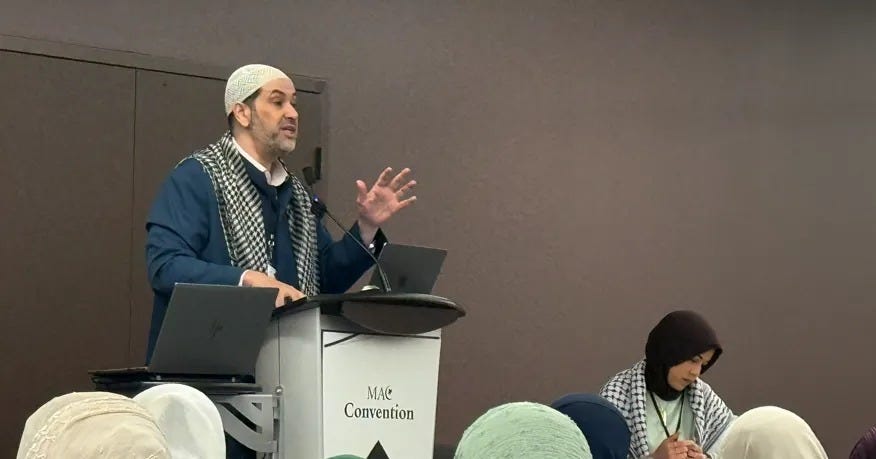
The Muslim Association of Canada (MAC), one of the country’s largest Islamic organisations, openly acknowledges on its website the intellectual influence of Hassan al-Banna, the founder of the Muslim Brotherhood. This is not a theory. It is public information.
Moreover, as investigative journalist Melanie Bennet of Juno News revealed last week, a recent youth conference hosted by the Muslim Association of Canada presented Hassan al-Banna as a model for ‘Islamic activism and social transformation’.
Global News also reported that IRFAN-Canada, an organisation banned for financing linked to Hamas, received hundreds of thousands of dollars from the Muslim Association of Canada. La Presse even revealed that a MAC school in Montréal was administered by a Tunisian Islamist involved in ‘bombings, arson, acid attacks against citizens, and plots to assassinate political figures’.
It should also be noted that Hamas is considered the Palestinian branch of the Muslim Brotherhood.
In any normal country, revelations of this magnitude would trigger, at the very least, a public inquiry and a nationwide debate.
But in Canada, the federal government continues to provide millions of dollars to MAC every year, officially in the name of promoting diversity, multiculturalism, or combating ‘Islamophobia’.
Tellingly, Mark Carney himself participated in a MAC event a few months ago. It was during that controversial speech that he declared that ‘Muslim values are Canadian values’.
The MAC is not the only apparent tentacle of the Muslim Brotherhood movement in Canada. Another major Muslim organisation, the National Council of Canadian Muslims (NCCM), is also reportedly part of this broader network. As the late historian and columnist Frédéric Bastien wrote in 2022: ‘an expert on the Muslim Brotherhood, Lorenzo Vidino, explained before a parliamentary committee that the NCCM is part of this Islamist movement. It advocates the implementation of sharia under a dictatorship. Dancing must be banned, books censored, all under the supervision of a morality police. Brotherhood supporters also favour separate schooling for boys and girls.’ (Quebec FIER’s translation).
Ironically, despite its highly regressive vision of relations between men and women, Women and Gender Equality Canada (WAGE) directly subsidises this organisation.
It should also be noted that the NCCM’s former communications director, Amira Elghawaby, was appointed as Canada’s ‘Special Representative on Combatting Islamophobia’, a position created by the Trudeau Liberals. Although the position was later abolished by Carney, Elghawaby still sits on the ‘Advisory Council on Rights, Equality and Inclusion’. She remains a highly controversial figure, accused, among other things, of disparaging Quebecers, Jews, and police officers.
Moreover, according to TVA Nouvelles, a third Islamic lobby active in this country, the Canadian Muslim Forum (CMF), is allegedly infused with brotherism. The CMF operates the Le Savoir Muslim School in Pierrefonds, Quebec. The school is funded by Kuwait, a sharia-governed country whose regime, reportedly close to the Muslim Brotherhood, imprisons homosexuals and requires women to have the permission of a ‘male guardian’ to marry.
A clear sign of the group’s influence was that Pablo Rodriguez, then the Liberal government House leader in the House of Commons, took the time to record a video congratulating the CMF during its annual banquet in 2021.
This overview is not exhaustive. But these well-known examples of the Muslim Brotherhood’s infiltration of our institutions should raise an important question: why do Canadian elites systematically downplay concerns about political Islam?
Part of the answer likely lies in the multiculturalist ideology that has dominated Ottawa for decades. Within this worldview, any criticism of an Islamist movement risks being interpreted as an attack on a religious or cultural minority. As a result, many prefer to look the other way rather than risk accusations of intolerance.
There is also an electoral dimension that cannot be ignored.
Mass immigration is rapidly transforming Canada’s demographic landscape, particularly in major urban centres. Political parties understand very well that several immigrant communities now represent important electoral constituencies. In that context, questioning certain influential organisations becomes politically risky.
The problem is that this complacency could have very serious long-term consequences. Anyone who cares about protecting freedoms and Western civilisational values should take this issue seriously.
Canadian politicians must be capable of distinguishing between freedom of religion, which should of course be protected, and totalitarian movements seeking to influence the country’s institutions, laws, and culture so as to impose themselves.
Refusing to address this issue out of fear of accusations of racism or Islamophobia does not protect democracy. On the contrary, it weakens democracy by preventing a healthy and necessary public debate while allowing a deeply anti-democratic group to take root in our society.
Citizens deserve to know the full truth about Islamist networks operating in Canada, their funding sources, their political connections, and their real influence within our institutions.
Most importantly, they deserve a government willing to take this issue seriously.
Léo Dupire is President of Québec FIER, a nationalist advocacy group.