
Kate Marland: Our cultural malaise in the age of progress
'Piss Christ' must go.


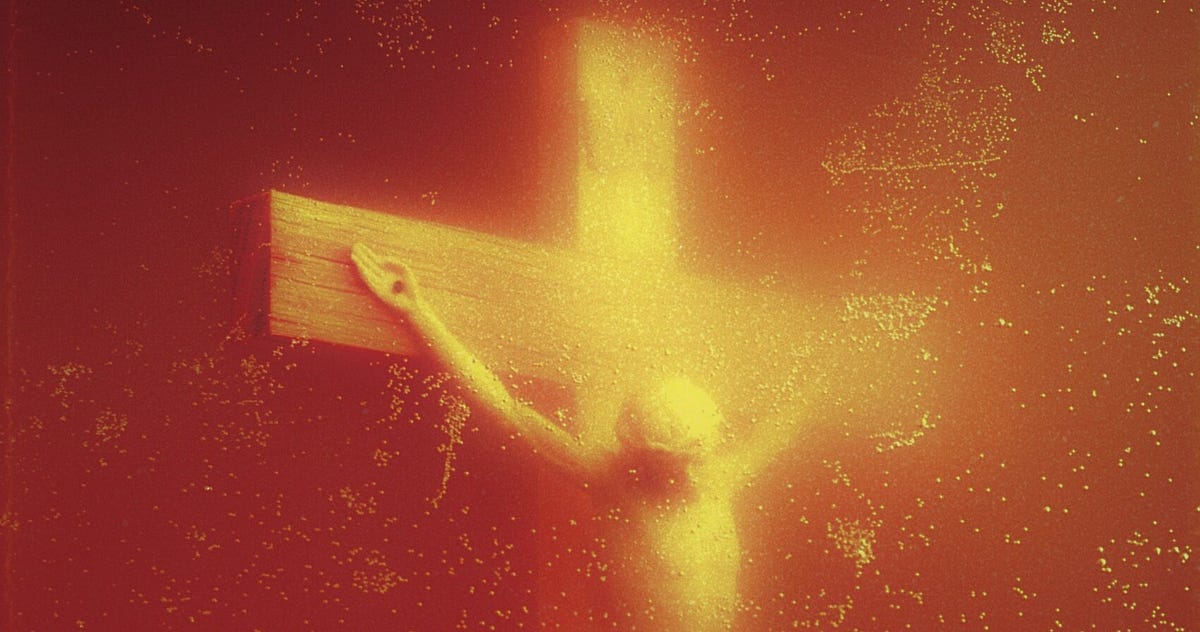
We are affected by a deep cultural malaise. News on Tuesday that the Beaverbrook Art Gallery in Fredericton is to display Andres Serrano’s controversial “Piss Christ (Immersions)” is just the latest affront to the Western canon. For those blessedly unfamiliar, the 1987 work shows a photograph of a crucifix suspended in amber fluid that Serrano has identified as his own urine.
In 1989, Piss Christ was a flashpoint in American debates over funding for the National Endowment for the Arts (NEA). Originally conceived as part of President Lyndon Johnson’s “Great Society”, the NEA’s founding mission was to encourage the development and growth of the arts throughout the nation and to “foster the excellence, diversity, and vitality of the arts in the United States”. Serrano had received a grant of $20,000.00 from the NEA, resulting in backlash that contributed to restrictions on the NEA’s grantmaking process. Currently, the work lives in the Rennie Collection, based in Vancouver.
The persistence of a belief in progress and a century of insistence on discarding history and tradition in favour of exponentially obsolescent trends and relentless upward trajectory have coloured our cultural milieu inescapably. Works like Piss Christ cut right to the heart of an important debate: is the purpose of art to shock and to fulfil the modernist proposition, as put by Lionel Trilling in his Beyond Culture, that art “is to liberate the individual from the tyranny of his culture”? Or is the purpose of art to carry on the traditions of the Western canon, rooted in our past, and to serve the human spirit by elevating the true, the good, and the beautiful?
At the turn of the 20th century, art that shocks quickly became part of the accepted modernist canon. Take, for example, Duchamp’s 1917 “Fountain”. You are hard pressed to find a more fitting indication that society was to soon fully embrace a concept of art that’s primary goal was to liberate the individual from the tyranny of early 20th century culture. For a urinal to be placed in an art exhibit, and to still be feted a century later as something that “changed the course of modern art” is the ultimate manifestation of this disease. New York’s 1913 “Armory Show”, which predated Fountain by a few years but featured some of Duchamp’s other work, is described as having “changed our perception of beauty”.
It’s not a stretch of the imagination to see how the absurdly grotesque and anti-social Fountain paved the way for Piss Christ. Inherent in accepting the ideology of progress is the promise that there will always be something better to orient towards. Butting up against culture, this ideology easily renders obsolete the Western canon. For how can we say, informed by our addiction to the idea of linear and indefinite improvement, that a J.S. Bach cantata is more valuable than Justin Bieber’s new album? One should not risk being admonished that “nostalgia is not a strategy” for thinking it more important to rescue Monet’s Waterlilies from a burning building than Piss Christ.
But are we willing to accept that Piss Christ and Fountain are the state of our Western canon? John Ruskin famously said that “the art of any country is the exponent of its social and political virtues”. It almost goes without saying that works like Piss Christ and Fountain, despite several decades between the two, are representative of the social and political virtues (or lack thereof) of our modern society. What a sorry state of affairs.
Urban myth has it that Churchill once said, in response to a question over cutting arts funding during the war, “then what would be fighting for?” While we have no documentary evidence that this precise statement was uttered, it nevertheless strongly underscores the important point: culture sustains and animates the human spirit in ways that the trappings of progress never will. It’s time to start treating cultural regeneration as the spiritual battle it is, rather than a sideshow to the Important Issues. Cultural regeneration will not take place purely and painlessly through the power of positive thinking and the invisible hand.
As a movement trying to build a positive vision of the future that places value on virtue, we need to face the question of art’s purpose head on. We should not be willing to accept at face value the modernist conceptualization that art is intended to liberate us from our supposed cultural tyranny. We need to be intentional about putting forward an understanding of art and culture that aims to elevate the human spirit through the celebration of tradition, grace, and beauty. Inherent in this is an immediate moratorium on any and all urine-themed art, relegating Fountain and Piss Christ to the cesspool of history where they belong.
Kate Marland is Deputy Editor at Without Diminishment. She presently runs youth outreach for the Canada Strong and Free Network, and formerly oversaw the Montreal Economic Institute’s Liberty and Leadership program. She also worked as a commercial litigator in Ottawa.

Follow Without Diminishment on X, and YouTube, to keep up with our contributors, podcasts, and events, as well as our coverage from ARC 2026 next week in London, U.K.
Without Diminishment is a project of the Without Diminishment Foundation, a registered non-profit in British Columbia. If you value the unique perspective we bring to Canada’s political and cultural landscape, please consider supporting our work with a donation.
The people that promote things like urine-oriented displays are urging us and our culture down into a destructive spiral. They are driven by resentiment, a psychological state based on their failure to deal with their own shortcomings…
Spiritually positive things, such as true art, urge us forward and in an upward direction, towards all that is good; evil things take us in a downward direction, towards ultimate destruction, so these urine-oriented objects are an insult to all that is good.
This is so gross. Who calls this shit art? Even worse, why are we giving these ignoramous morons oxygen?