


Decline is a choice.
Canadians awoke early, in the dark of a February morning. They put the coffee on, with the kids half asleep on the couch, while the adults behaved as if they were performing a national duty.
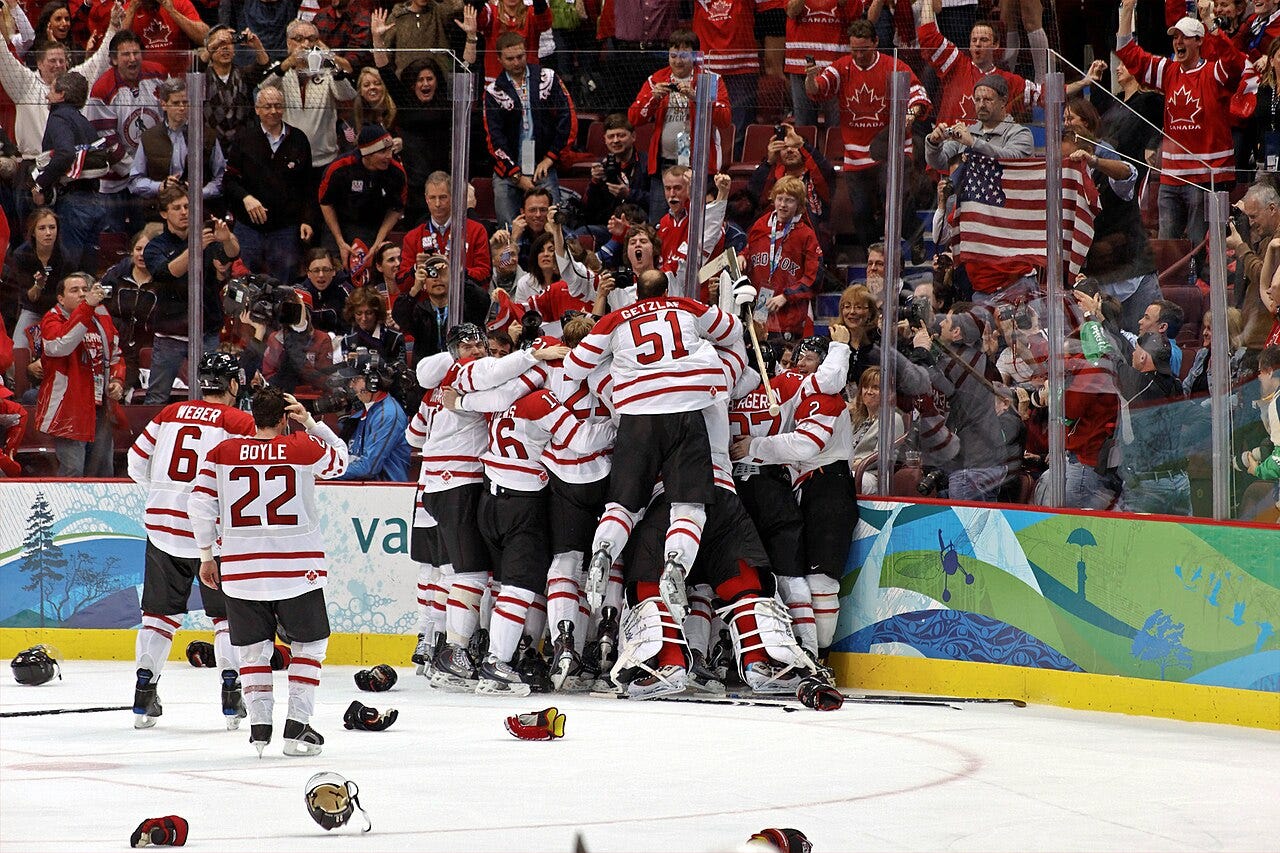
Others gathered at the local bars and filled themselves with beer and greasy breakfast food. They expected another Olympic triumph in hockey, as they had enjoyed in 2002, 2010, and 2014.
Then, in overtime with the score tied at 1-1, the United States defeated Canada for the gold medal on the stick of Jack Hughes. It ended an American Olympic gold medal drought stretching back to 1980.
Humiliation is the only way to describe it for Canada in this political climate. Americans will gloat and frame it as a great rebirth, and a sequel to the Miracle on Ice, written by a country that has drastically improved the quality of its ice hockey.
Canadians must ask, if hockey is our game, why we watched another nation take it away on the biggest international stage. It did so with a team that many described as our most talented ever.
The truth is that the U.S. win at Milano-Cortina is an exception to the norm of Canadian dominance. It is also a warning that our run of excellence may only be an era, unless we choose otherwise.
A string of American victories going forward in men’s hockey will confirm that they have not only reached parity, but finally surpassed us in this decade.
The Canadian women’s national team has lost eight consecutive games to their American counterparts. If the men’s team follows them down the same path, it will be a crippling blow to Canada’s psyche.
Until Sunday, Canada had only lost to the U.S. in the final of a best-on-best tournament once in the last four decades. That was the 1996 World Cup of Hockey.
We crushed the hopes and dreams of American hockey players and fans time after time. We did it in 2002 at Salt Lake City, in 2010 in Vancouver, in 2014 in Sochi, and last year at the 4 Nations Face-Off.
Author Stephen Brunt has rightly written that Canada remains a hockey country, even as alternative sporting options multiply and the demographics of our country change. This game is in our bloodstream, and our “heartbeat”, as Brunt put it.
The stakes of hockey will always be higher for us. If our game is replaced, and ceases to be our shared obsession that we play and excel at together, no other sport will capture the same passion and fervour.
But, young Canadians are playing less hockey than ever.
Youth participation has declined for years, and Hockey Canada’s own registration totals reveal a sharp drop in enrolments between the peak of the early 2010s and the early 2020s.
In 2009, there were 523,785 players enrolled in youth hockey. In 2022, it had plummeted to 340,785, a fall of 35 percent.
In that span, our population grew by roughly seven million people, largely through immigration. This is a sign that ice hockey is declining as a native born tradition and is not being picked up by newcomers.
Attempts to revive enrolments in hockey, such as the First Shift initiative aimed at cutting barriers to participation by providing equipment and affordable ice time, have not meaningfully staunched the bleeding.
Cost, time, and trust are behind this alarming decline. The expenses of buying new equipment, renting rinks, travelling, and accessing specialised coaching for a year-round grind have turned hockey into a sport that most families cannot afford.
This is especially bad considering the state of the economy, where more and more households are living paycheque to paycheque. Consumer debt is among the highest in the G7, there is a slow-burning recession, and the wealth gap is rising.
Paying the fees of hockey has become a class filter. This is most destructive when it comes to goaltending.
Our national goaltending pipeline is perilously thin, as evidenced by our inability to field an elite goaltender for the 2026 Olympics. Jordan Binnington has played superbly for Canada on the world stage, but he will be 34 at the next best-on-best tournament in 2028.
He will be 36 in 2030.
When professional hockey players went to the Olympics in 2014, Canada could boast future Hall of Famers Carey Price and Roberto Luongo manning the pipes. It also had a host of other bona fide starting goaltenders who did not make the cut, but would have been starters for any other nation.
In 2010, Luongo led a goaltending trio of Fleury and Martin Brodeur.
What did Price, Luongo, Brodeur, and Fleury all have in common? They were premier assets who started their careers as heralded first round draft picks.
Price was the No. 5 pick in 2005. Luongo was No. 4 in 1997.
Brodeur was 20th in 1990. Fleury was No. 1 in 2003.
These were not undrafted or late round gems who emerged unexpectedly. Their development in youth leagues was highly anticipated by the NHL and Hockey Canada.
The country was the undisputed factory of top goaltending talent, especially in the province of Quebec. Today is different.
Many have reported on a hockey system that produces “predictable goalies”, who are “robots in the crease”. It produces a style that is heavily technical and less adaptive under chaos.
It is narrowed by win-at-all-costs youth incentives and a brutally expensive private coaching economy. The share of Canadians in the NHL is shrinking, as is the share of Canadian goaltenders overall, largely due to an influx of American talent.
What has happened to hockey in Quebec is a cautionary tale for the rest of the country.
The province that once produced the lion’s share of Canada’s top goaltenders and a hefty complement of elite skaters now produces hardly any top NHL talent. At Milano-Cortina, there was not a single player from Quebec who made the team.
However, what ails Quebec is what ails Canadian hockey writ large, including the economics of the sport for families and the gentrification of hockey. Quebec is proof that Canada cannot pretend that our history of ice hockey supremacy will sustain itself in the future.
People often celebrate the rise of soccer in Canada. Nothing against soccer, and the modest improvement of our national soccer team is objectively great. But do we want Canada to become just one more soccer-loving country, where kids kick the ball around like those in Brazilian favelas or Albanian slums?
Hockey is a sport we developed here, and adapted for the cold. That makes soccer and rugby into secondary hobbies in our national imagination. We should guard hockey selfishly, but economics are understandably pushing young athletes away from it.
How did the Americans catch up in Milano-Cortina? They did so by building their capabilities deliberately and with enough resources to achieve their goal of beating Canada on the world stage.
In 1996, USA Hockey’s National Team Development Program was launched. It centralised the development of elite talent so that pipelines were clear and had institutional continuity.
As evidenced by Team Canada’s many triumphs over Team USA, this has not guaranteed them victories. It has, however, guaranteed their place as Canada’s top competitor.
Their strategy was validated on Sunday.
If anything, the programme will now be awarded more resources to identify and train top talent. There will be no shortage of inspired young Americans who want to become the next Matthew Tkachuk, Auston Matthews, Jack Hughes, or Connor Hellebuyck, all of whom were instrumental in Milano-Cortina.
Canada is not entitled to be the top hockey country due to our love and cultural affinity for the game. Mexicans love and adore soccer, but Mexico’s national soccer team has not covered itself in glory despite that grassroots passion.
It is time to adapt, recognise that other countries are catching up, and turn hockey dominance into a strategic objective.
During the Cold War, the Soviet Union treated hockey as a form of statecraft. It explicitly designed the development of its national team as a way to project power.
It did so by heavily investing in player development, almost from the cradle to the faceoff.
Igor Larionov, one of the greatest to ever play and a decorated Olympian, was raised in the Soviet system. He described its rigid, almost militaristic structure as a path to freedom on the ice.
He likened it to “breathing fresh air”, and described the creativity of his play as a form of liberation. Many will rightly bristle at mention of the USSR, but they should not ignore the seriousness with which the Soviets took the sport.
Some critics will point to Canada’s defeat of the USSR at the 1972 Summit Series. There, Canadian NHL players won the series against the cultivated, elite Soviet players.
They will say this is proof that we do not need a Soviet-inspired system.
However, 1972 was a time when nearly every NHL player was a Canadian. The league was closer to a domestic one in terms of talent, with Western European players hardly present, and few Americans rubbing shoulders with Canada’s sons.
Those conditions are long gone, for hockey is far more global and there is more parity between the nations.
This brings us back to Sunday’s agony, which was a brutal reminder that we are not invulnerable. It shattered our sense of invincibility.
At the 1998 Olympics in Nagano, Team Canada was shockingly knocked out by the Czech Republic in the quarterfinals, after being lauded as the pre-tournament favourites.
Canadian mythology failed to push the national team past a scrappy and determined underdog. In 2002 in Salt Lake City, the nation was redeemed with a gold medal triumph over Team USA on their own home turf.
In that game, Canada walloped the U.S. by a score of 5 to 2. It did so not by luck, but because it treated 1998 as a wake-up call.
A similar rearmament is due after Sunday’s black mark.
Hockey is inherently recreational and fun at its core. For Canada, however, it should also be treated like strategic infrastructure for unity and, yes, the mythical “soft power” we often claim to possess.
There is room for provincial and federal governments to step up further. One route is covering the costs of building community rinks and expanding supply so that more ice time is available and cheaper.
Given the climate where “nation-building” projects are a priority, there is tremendous public good in strengthening the presence of our national sport.
Participation should be aggressively subsidised, with a particular focus on goaltenders. Currently, Team Canada has no elite talent in net.
Picking between Carey Price, Roberto Luongo, or Marc-André Fleury to be Team Canada’s starter in 2014 was a luxury of riches. We should aspire to restore it permanently.
Enrolments in minor hockey have declined, but there remain hundreds of thousands, if not millions, of kids who would play if they could. Families who cannot afford gear may contain a generational talent left unrealised due to the need to pay for groceries or rent.
The country has wasted millions in foreign aid for harebrained initiatives in the Third World for long enough. A relatively minor share of that money can be put to better use finding and developing the next Patrick Roy.
Free marketeers might dislike such a course of action, but it is not as if the government would be trying to steer the direction of the economy or take over heavy industry. Some things should not be left to rational economics, and our game and national honour are two of them.
The U.S. has been explicit about broadening the base of those who play and has professionalised coaching education.
A dedicated, larger goalie school is an ambitious possibility that would pay enormous dividends, with participation from veteran NHL goaltenders and coaches. The end goal should be a surplus of superb goaltending talent in minor hockey, for the talent clearly exists.
Nurturing it has moved beyond the means of most of Canada’s middle-class.
Despite the silver medal, hockey is still our game, but only if we intend to dominate it. We should be smug about it, but not so entitled that we do not treat talent cultivation in a cold, professional way.
It must be generous to aspirants, but ruthless in development.
If government is to be involved and facilitate the participation of young talent across the country for purposes of recreation, and for elevating it in our national consciousness, it has to be cruel and calculating in who it elevates to the top of the national teams.
This is how elite units are developed in the world’s top militaries, and the Soviets used this approach to great effect. Perhaps there is a better solution than that, but the onus is on Hockey Canada to figure out what it is.
The problems are evident.
Americans do not love hockey more than we do, but they won because they intentionally built towards their victory with a machine. Canada has let it become harder and harder for its own children to play.
February 22 was an outlier, and it should stay that way. Hockey unites this country in shared ecstasy, or in the sorrow we now feel.
It is our winter art and a vessel of our national honour.
We have grown accustomed to victory in Canada, and with good reason, with gold in 2002, 2010, 2014, and a first-place finish in 2025 at the 4 Nations.
Now we have been reminded what it is to feel defeat.
It hurts, but the drive to never feel it again is what will elevate us back to the top, if we choose to do what is necessary.
Geoff Russ is the Editor-at-Large of Without Diminishment. He is a contributor to a number of publications, including the National Post, Modern Age, and The Spectator Australia.

Canada isn’t trying to dominate in anything and it’s sad!
I have the unpopular opinion that hockey consumes far too much of our collective time, effort, and consciousness, even as it declines in popularity. Imagine if we took 20% of the time and money dedicated to youth hockey and repurposed it to facilitating academic and intellectual excellence?