


Some days ago, as I was catching up with my messages and notifications on various apps on my phone after morning tea, I came across an article by Sharan Kaur, erstwhile staffer with former Finance Minister Bill Morneau, titled ‘Canada’s strength lies in diversity, not in closing doors’.
As is the default setting in much of Canadian media, it starts with talking about something happening in the US. Following the same template, the article employs the set of semantic and epistemological tactics that we are all very familiar with: conflating non-permanent residents with immigrants, ascribing motives without bothering to prove the insinuation (viz., that the Conservatives are ‘using coded language’) and even portraying as malicious something that is objectively benign (i.e., calling “Canadian jobs for Canadians” rhetoric).
Some friends, who have festooned me with the unofficial designation of a ‘subject matter expert’ on all things related to immigration, asked me if I would be writing a detailed rebuttal of this article. I said no; having spent a few years rebutting the entire spectrum of contentions in the pro-mass immigration narrative, I was exhausted.
Later in the day, as I pondered my reluctance to dive into an issue that I have followed and commented on extensively for several years, it struck me that this is how the Progressive / Leftist / Liberal narrative prevails: its proponents keep coming back with the same arguments over and over again, endlessly, no matter how many times these have been refuted, even conclusively refuted, until the other side gives up out of sheer exhaustion. Their limitless energy (read: funding) is unmatched on the other side by a very wide margin.
Entrenched Strength
The fact of the matter is that over the past half century, and especially in the past decade, a set of ideas about immigration have become so thoroughly integral to institutional thinking that any victory in curtailing the worst of policy excess is bound to be short-lived. This is partly because the federal Conservatives haven’t cobbled together an institutional coalition; they have no permanent friends, or even allies, in academia, mainstream media or the various diaspora communities that can advance its arguments on the public platform.
To the extent that the Conservatives have friendly ‘new media’, these outlets are essentially preaching to the choir; regardless of the worth of the ideas that the Conservatives present on ‘new media’, this does not result in increasing support for their position on any issue.
On the other hand, the relentless efforts and actions of the pro-mass immigration cohort, which already enjoys a position of dominance, keeps the possibility alive that the recent reductions announced in the number of temporary residents over the next few years would be rolled back at the earliest opportune time.
Panic Mongering
You simply have to open a newspaper on any day, or scroll its website or look at your X feed, and you will see at least one article claiming how (insert description of entity here) is hard done by because immigration has been curtailed. For example, as this Global News report hysterically claimed, the British Columbia town of Prince Rupert “is going to collapse … due to federal government changes to immigration and work permit policies”. If this claim is genuine, then it should cause a debate on whether the town is a viable economic entity, but predictably, it hasn’t.
On another front, CBC reported that a bisexual Kenyan’s deportation had been halted “(after) a wave of petitions, protests and an emergency application to the United Nations”.
How mainstream media views the immigration issue was neatly summed up by CBC’s Rosemary Barton some months ago when, in an on-air chat with Minister Dominic LeBlanc about the possibility of temporary and illegal residents in the US fleeing to Canada, she asked, “Would it be moral to deny refuge to people whose lives are in danger?”
My answer to this question would have been in two parts: people in danger deserve to be made safe, and that there are hundreds of millions, if not over a billion, people in the world who face this predicament, whose numbers are orders of magnitude higher than Canada’s ability to rescue them. But introducing this nuance in the discussion would have, I am sure, made me a member of the ‘far right’ in many Canadians’ eyes.
Ecosystem of Support
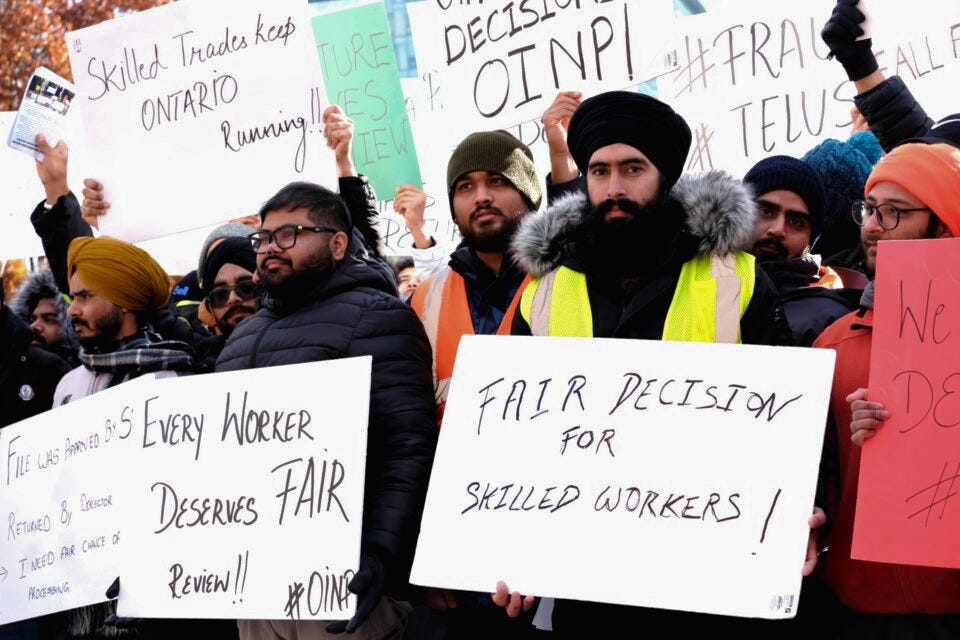
Most of you are familiar with the protests staged by international students and those on Postgraduate Work Permits (PGWP) in Brampton (and elsewhere, such as PEI and Manitoba) last year. The protests in Brampton dragged on for months. From the statements of some of the participants, it appeared that their visas had expired at some point during the protest.
However, the most strikingly obvious question that arose from this situation was never asked: who was keeping them afloat financially? I see only two possibilities: either they were working ‘off the books’, or someone was funding them to defray their living expenses. Who were these entities? We don’t know.
On the front of moral support, we have the Ontario Federation of Labour (OFL) supporting international students in their demand for ‘status for all’. This statement has puzzled me all along: it is well established that high immigration, especially in the category of low-skilled labour, depresses wages. Any union’s overarching objective should be to protect the interests of its members. I find a breathtaking divergence between OFL’s mission and its actions, but that is a separate issue. The key point is that as and when the next election rolls around, all political parties will be seeking the support of unions. Will ‘status for all’ become a bargaining chip at that time?
Supreme Authority
And finally, we have the courts. One aspect of the courts’ recent verdicts in criminal cases involving non-permanent residents that has caught many people’s attention is leniency in sentences (unforgivingly referred to as an ‘immigration discount’ in colloquial quarters), whereby convicted foreigners are given a lesser sentence so as not to jeopardise their chance of becoming a permanent resident of Canada.
Many people expressing anger at each individual verdict of this kind don’t know that this phenomenon originates from a Supreme Court verdict, R. v. Pham, which said that ‘immigration consequences can be considered during sentencing’. It is noteworthy that the verdict dates from 2013, but the trend of judges giving an ‘immigration discount’ in sentences is of more recent vintage. What caused the change from can be, to must? We don’t know, but that is a separate discussion.
My point here is that while the legislation stipulates categorically that a non-permanent resident who gets convicted of a serious crime must be deported, the Supreme Court, in its infinite wisdom, created wiggle room where that law can be rendered ineffective. I would not be surprised if, at some future date, the courts take it upon themselves to decree that any reductions in immigration numbers are also ‘unjust’.
Inconclusive End-Point
Policy is always a tradeoff between competing concerns and constraints. However, in Canada, and especially when it comes to immigration, we are playing with loaded dice. Too many influential constituencies, from pressure groups to vested interests to ideologues, are hell-bent on ensuring that immigration remains high. Fending them off will take megatons of political courage for any prime minister.
The only answer, and it is still an iffy one, will lie in relentless public pressure to keep immigration numbers in the realm of sanity.
Darshan Maharaja is a political analyst, bringing experience of living in diverse cultures in India, Kenya, UAE & Canada to his analysis of Canadian socio-political issues. Read his work at DarshanMaharaja.com.

Excellent summation Darshan.