
Geoff Russ: The erasure of Canada's heritage is deliberate
Symbols of the Canadian people are being eliminated piece by piece, and it has to be stopped.


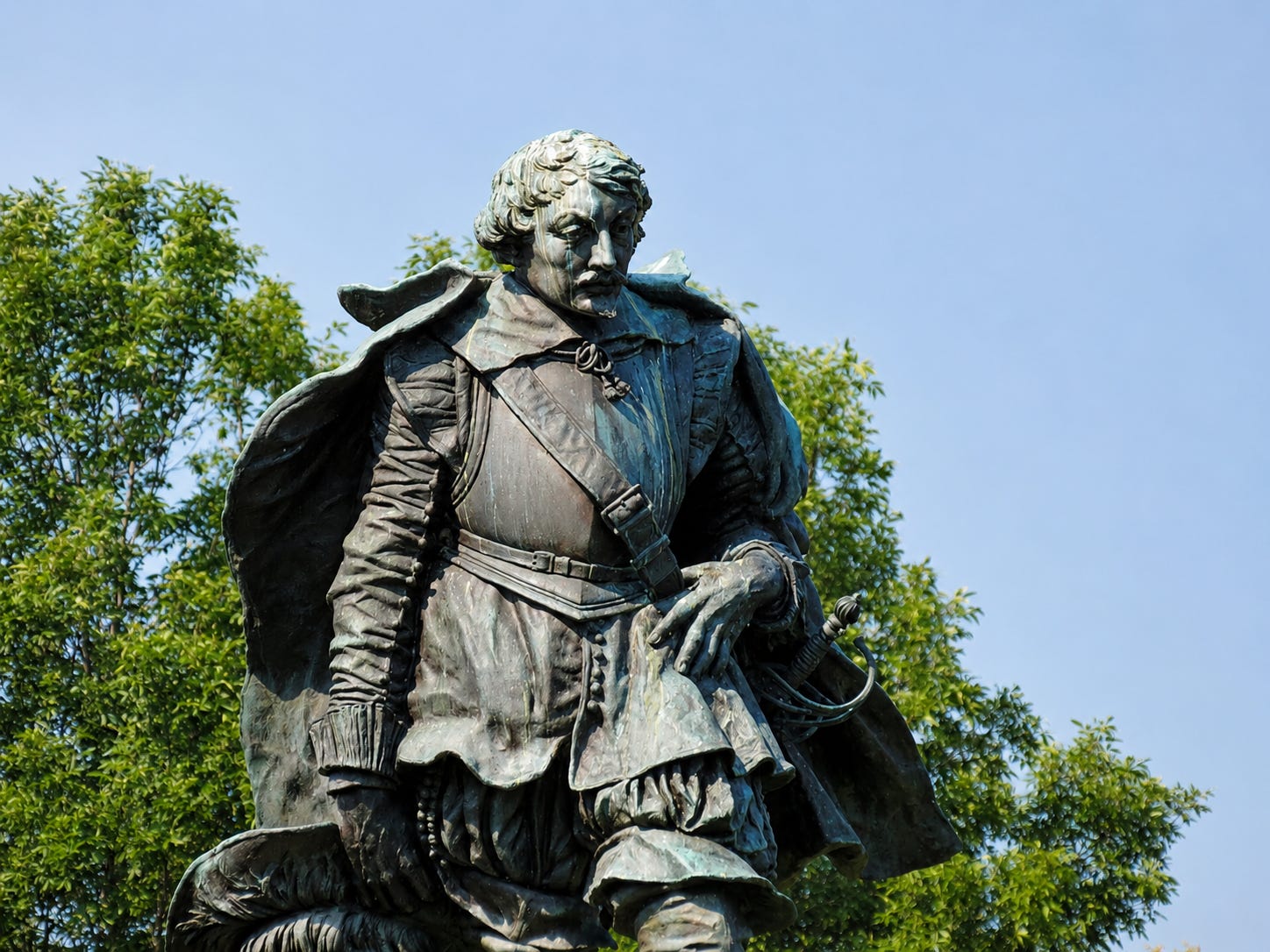
Samuel de Champlain has been erased from Orillia. As early summer raindrops fell last Wednesday morning, the statue of the great explorer and Father of New France was placed on the back of a flatbed trailer and hauled off into storage.
Orillia’s own city council voted 6–3 to remove the statue, with Mayor Don McIsaac among those opposing the move.
It has been 101 years since the statue was erected in Orillia’s Couchiching Beach Park, a creation of the English sculptor Vernon March, who also designed the National War Memorial of Canada in Ottawa. Generations played in the park beneath Champlain’s shadow, now veiled in tarps after years of ideological vandalism, all part of the campaign to stamp out the memory of Old Canada.
The Champlain statue was larger than life in size and majestic in its intent: to honour those who made possible this country, which men like Vernon March regarded as a great achievement. To continue to commemorate Canada with such a monument was an affront to those seeking to deconstruct this country, and Champlain became a magnet for political, cultural, and even racial resentment.
Champlain’s erasure was not an isolated incident in Ontario, or the rest of Canada for that matter. What happened in Orillia will be the method by which the statue of Queen Victoria in Kitchener will be taken down, along with any and all national symbols of the Canadian people.
The symbols of pre-modern Canada are all targets to be delegitimised, isolated, boxed up, and forgotten, along with the memory and heritage of the people who built the country. By now, most who pay attention to the culture war will be familiar with the pattern by which national symbols are removed.
First, monuments and names that had meaning for generations of Canadians are declared harmful, and the attachment of the majority is subordinated to activists in the minority by way of bureaucratic process. This was the case with the removal of Sir John A. Macdonald’s statue in Victoria, which was taken down after a city council vote without any real public consultation.
Any attempts at dialogue or even compromise are treated as insufficient and temporary delays by the antisocial ideologues who spearhead the removals, for whom only elimination is considered to be progress in the moral sense. Then, the twisted vision of those who led the sanctioned or unsanctioned toppling becomes what replaces the statue’s empty plinth.
The case of Orillia demonstrates the futility of attempting compromise. In 2019, Parks Canada announced that they would modify the plaque beneath Champlain’s figure. Other measures were also announced, such as the inclusion of local Indigenous communities, like the Chippewas of Rama First Nation.
Specifically, Parks Canada thanked the people of Orillia for giving their earnest participation and goodwill in the process, while reiterating that the Champlain monument was a testament to artistic skill and historical vision. According to a survey at the time, 70 per cent of respondents wanted the original monument to stay, with additional elements to satisfy ostensibly popular modern sensibilities.
Then-mayor Steve Clarke said the revised statue ‘needs to recognise our whole history, and that is the great and the good, but it’s also the bad and the ugly’.
The public were mistaken if they thought that consultations and bargaining meant a permanent settlement. What was actually meant was a ratchet. In the following years, the Champlain statue was repeatedly vandalised in the name of ‘decolonisation’, despite the explorer’s friendship with the Huron and others.
The Rama First Nation were unsatisfied with the process, and stated that their position as the Aboriginal rights holder for the Orillia area demanded greater involvement. The statue was never about history or local culture; it was about power. Specifically, it was about power over the people of Orillia, who thought they were having a constructive dialogue about art and history.