
Geoff Russ: Out of the smoke, among ghosts
A summer account of rusting trucks, frontier cemeteries, and Red Ensigns in the old towns of southeast British Columbia.


At the height of summer, Osoyoos looks like a theme park based on New Mexico or Arizona. You might call it Fauxrizona, with Pueblo-style, ageing accommodations like the ‘Spanish Fiesta Resort’ and a nearby theme park called ‘Rattlesnake Canyon’.
Osoyoos is gathered around a dark blue lake, with palms and patios near the shore. The green of the vineyards is painted upon the ochre-coloured hills that surround the town. At a certain point, the grapes suddenly terminate as the water lines end, returning the country to little more than dust, rocks, and sagebrush on the slopes of the southern Okanagan Valley.
The wildfire smoke split the sky above, with half of it a lighter blue than Osoyoos Lake and the other half filled with reddish-grey wildfire clouds rolling in from the west. No view was permanent as the campfire-scented plume changed the skyline and the sightlines upon the water. It arrived in sheets that erased the ridges, before lifting and settling once again with the wind.
To the east, the Crowsnest Highway snaked up Anarchist Mountain and Canada’s only little desert further disappeared with each metre of elevation as we ascended. The sage and brittle grass made way for the more familiar, cooler forests of pine and alpine farmland. Looking back down the 1,490-metre slope of the mountain, we saw that the smoke had finally covered Osoyoos in full, like a pungent blanket. But there were true blue skies and sunshine above it where we were, riding along the patchy asphalt through the ghostly surroundings of the Boundary Country.
Here we rode through yellowing mountain meadows, recently verdant in the spring, divided between large agricultural estates. Every single one of them had a pile of dying metal behind the property fence, whether it be a motor pool of decrepit old trucks or a scrapyard of shapeless rust. Why farmers accumulate this junk, exposed to the yearly elements and the decay that comes with it, is a secret known only to them. It is as if dead and living people just forgot to remove the debris, allowing weeds to grow high above the axles.
Not all the lots were clearly inhabited. In the middle of the meadows, many of them bordered by a sheer drop down the mountainside, there were ancient farmhouses leaning over, with silvering boards and roofs folding in on themselves. The yellow grass had swallowed whatever roads or paths once led to the impatiently sagging front porches, making it appear as if these houses had sprouted from the ground. Many of the outbuildings had outright collapsed, and the occupied houses on neighbouring properties looked only a little less abandoned.
Soon after, we descended back into valleys and found ourselves in Greenwood, our base camp for those few days.
As the name Greenwood suggests, the area is forested and indeed very green, especially compared to the areas we had just passed through. The entrance to it is marked by a tall smokestack from the old copper smelter, not used since 1918. Three thousand people once inhabited the place. Over 700 people allegedly live there now. At night, you would think nobody did.
‘Copper Street’ is the main road of Greenwood and is a stretch of the highway that runs the length of ‘Canada’s smallest city’, a category that the place proudly refuses to surrender.
Our accommodation was the Greenview Motel & RV Park, a genuinely superb establishment. Without exaggeration, its spotless rooms and pressed sheets rival those of any Fairmont.
A small town in British Columbia (BC) with a sufficient population will host the following: a Chinese restaurant that serves chicken strips, a Fields (or a Walmart, depending on local affluence), a beloved greasy spoon, a BC Liquor, a ‘historic’ downtown, an old railway station that serves as the local museum, and a Legion bar.
Greenwood is not one of those places. It lacks the theatre, Chinese food, and the Fields. It does have a railway station turned museum, a BC Liquor, and a Legion. The nominal city also has a memorial to the Japanese who were interned there during the Second World War; the memorial is the most modern and sleek structure in Greenwood. The monument, filled with sad stories, even lights up at night.
As we meandered about in the dark with a bag of assorted, uncracked beers, the modern pedestrian signals flashed on Copper Street for only the five of us. We had no use for traffic lights on such an empty thoroughfare; the only signs of life were the occasional car or semi-truck rolling through town in the darkness.
The Windsor Hotel is the most prominent building on Copper Street, with a large sign reading ‘Greenwood Saloon Inn’, and it has sat unoccupied since 2017. Next door to it is an empty commercial building with another sign, ‘Pacific Grill’, with lace curtains still draped across the windows.
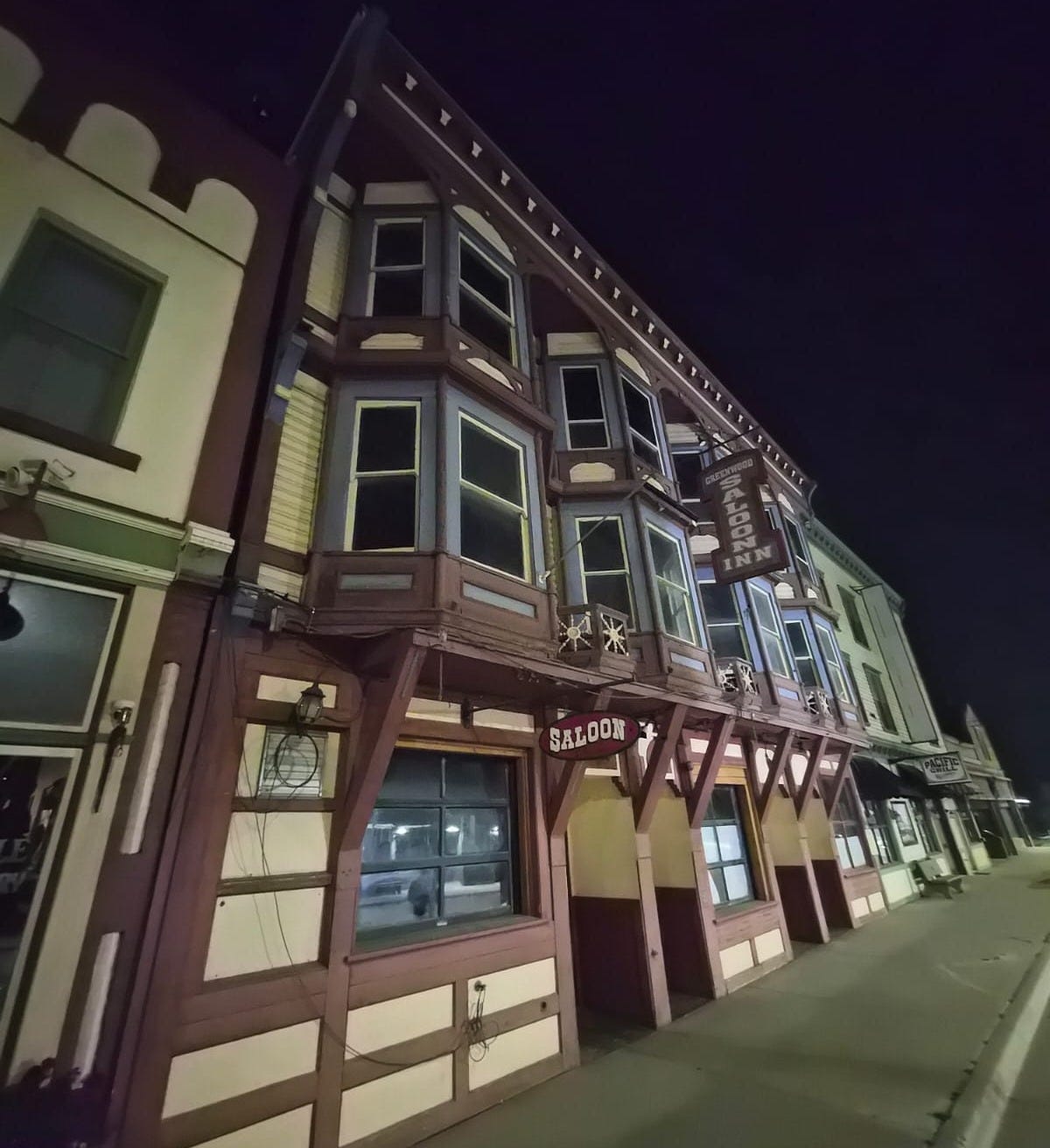
Empty Victorian and Edwardian windows glared from all angles at around 11:30 in the night, with the only sounds apart from our conversation and laughter being the faint sounds of a nail gun thudding somewhere nearby. On the wall of what used to be the ‘Pacific Grill’ is a historical photograph of Copper Street, in a lost world busy with pedestrians and horse-drawn traffic.
In the moonlight, the British Columbia Copper Company’s smokestack was visible on the hillside. Thirty-six metres high, the brick chimney towers over a black slag field.
Much like Fauxrizona and the sign reading ‘Greenwood Saloon Inn’, Greenwood has manufactured a bit of frontier heritage for itself.
‘Fort Greenwood’ is an RV community built behind a twelve-foot timber stockade, presumably to guard the inhabitants of Greenwood against the Indians.
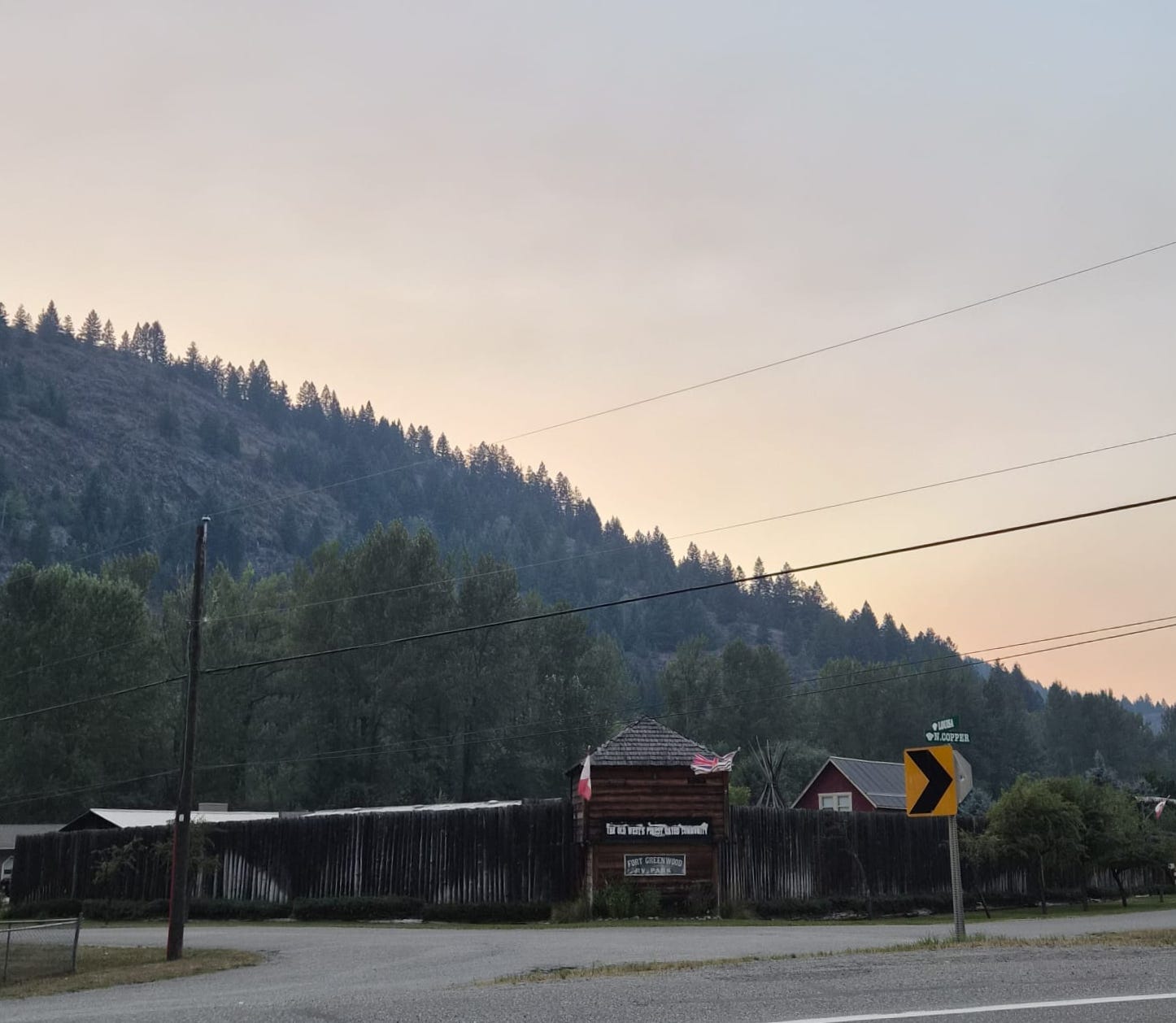
Woe be to their neighbours in the older, unfortified houses across the street. People underrate the pleasure of kitsch, like the Wild West staging of Osoyoos and Greenwood. Such comforts are rare in a Canadian metropolis.
All in all, the Greenwood Saloon and Fort Greenwood sound better than the ‘Windsor Hotel’, which we have lots of in Canada, and the ‘abandoned smelter’, of which there are plenty in this mostly post-industrial country.
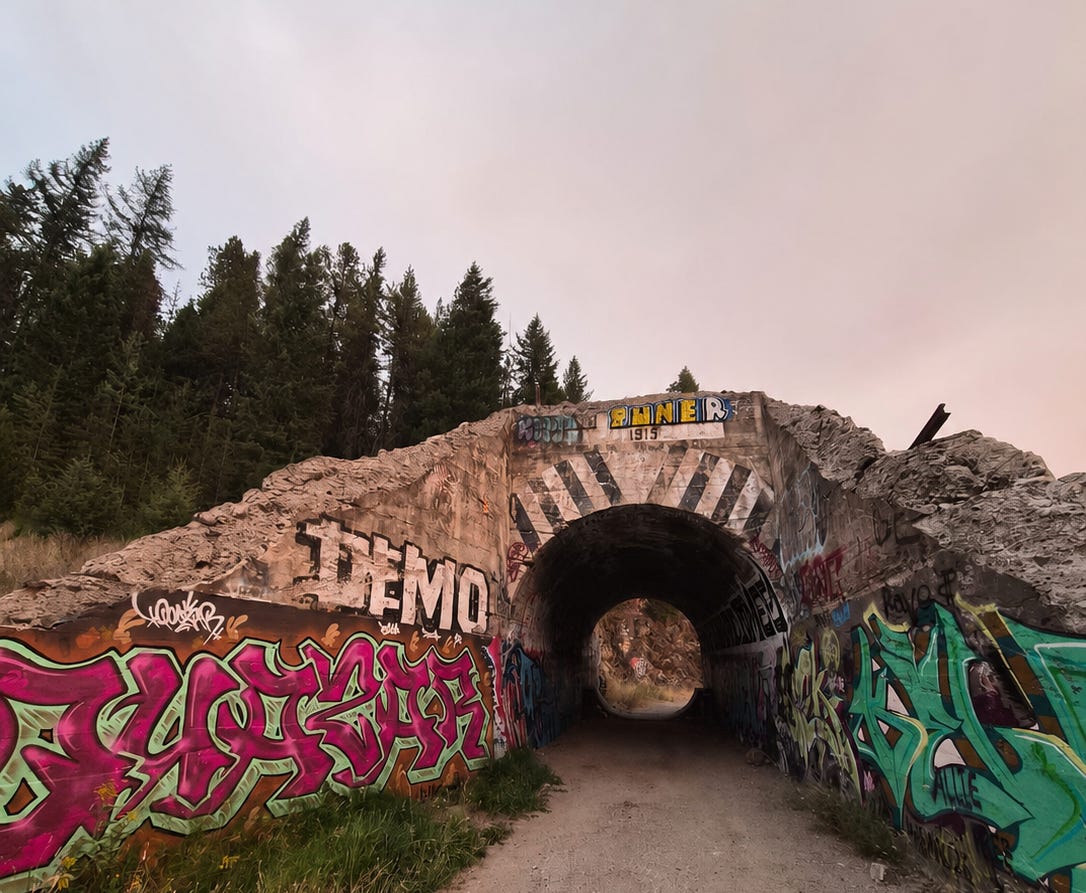
Not far out of town, on the shoulder of the Crowsnest Highway, is a crumbling road tunnel built in 1913, which we explored the next day. It once carried traffic beneath a Canadian Pacific Railway embankment. Bypassed in 1964 and exposed after the railway was abandoned around 1990, the concrete tunnel is decaying like a useless throat, tattooed inside and out with graffiti. It is taller than it looks and is frightening to climb.
On a small mountain above Greenwood lies Phoenix, or rather what remains of it. There is nothing left in Phoenix except for some concrete foundations and rebar hidden beneath a thick layer of overgrowth. Once a copper-mining town like Greenwood, Phoenix completely emptied by the 1950s, with the last inhabitant passing away in 1951.
What sticks above the earth is the well-maintained Cenotaph, honouring the men of the town who died in the First World War. It sits at a dirt road junction, across from a sign directing people to the aptly named Phoenix Mountain Ski Area.
Back down the mountain lies the Phoenix Cemetery, built on the slopes. Unlike those commemorated on the Cenotaph, who were almost entirely of British stock, those buried in the cemetery were mostly continental Europeans.
The whole of eastern BC was, and still is, filled with people with heritage from the old Austro-Hungarian Empire and its neighbours. Bearing Croatian, Serbian, Italian and Lithuanian names, they formed a major share of the region’s mining workforce. By far the most common cause of death listed in the Phoenix Cemetery was a mining accident. The second most common cause was Spanish flu, with a concentration of fatal cases dating from 1918 to 1920, many of the victims being little babies.
Our next stop was Grand Forks, situated in a broad, golden valley and home to large farms and signs demanding that drivers embrace Jesus.
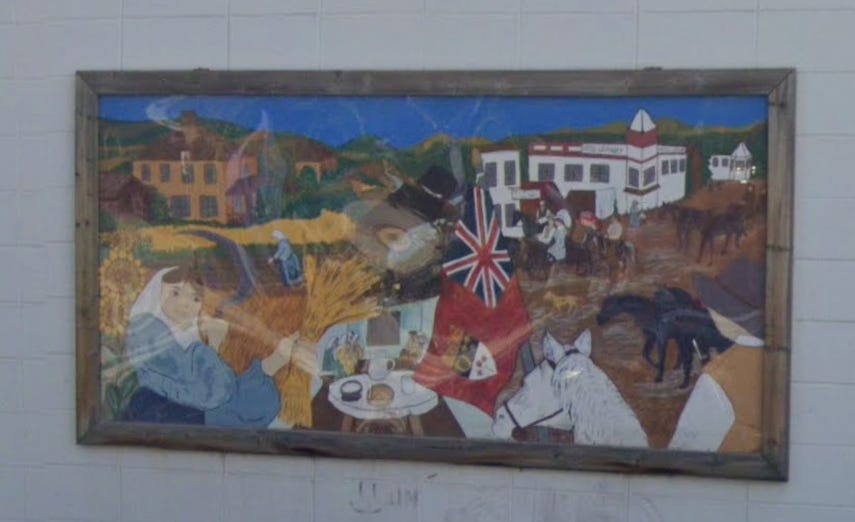
The place has true bustle and traffic and Red Ensigns flying from the beds of old Dodge trucks outside a rudely modern coffee shop. That same old, honourable banner is portrayed in a piece of street art on 3rd Street. The mural itself is dominated by the old flag, but also shows horses, grain, and the earlier life of the town. It feels less like a museum piece when you know that a truck with the same banner is parked around the corner, and lucrative farms surround the downtown.
Around the corner from that is a venerable Chinese-Canadian restaurant where you can still get chow mein and chicken strips in the same order. Both the aforementioned flag and that particular type of Chinese restaurant are slowly fading or gone in Vancouver, making each a pleasant surprise to find. Ginger beef itself is a delicious Canadian dish, created in Calgary in the 1970s, and tastes better than most modern, ‘authentic’ Chinese options.
After we had enjoyed a succulent Chinese meal in Grand Forks, Castlegar was next on the list. Officially, Castlegar has some of the highest incomes in the region, with its economy anchored by the Mercer Celgar pulp mill and other industries. Depending on the flow of the wind, the pulp mill makes the whole area smell like a unflushed, dry toilet.
Downtown Castlegar, much like Greenwood, was eerily quiet. We could hear a faint honky-tonk piano playing somewhere we could not identify, and the few people seemed to mainly congregate in the local café. There was no smoke and the sun was blazing hot, the piano being the only sound apart from the frequent whoosh of cars driving through on the highway, which cuts through the middle of town. The history of Castlegar is on display, with murals dedicated to miners alongside preserved ore carts dotting the landscape.
After Castlegar comes Nelson, whose appearance is a jarring experience. The populations of the other places were rather old, with the average age sitting between 60 and 70.
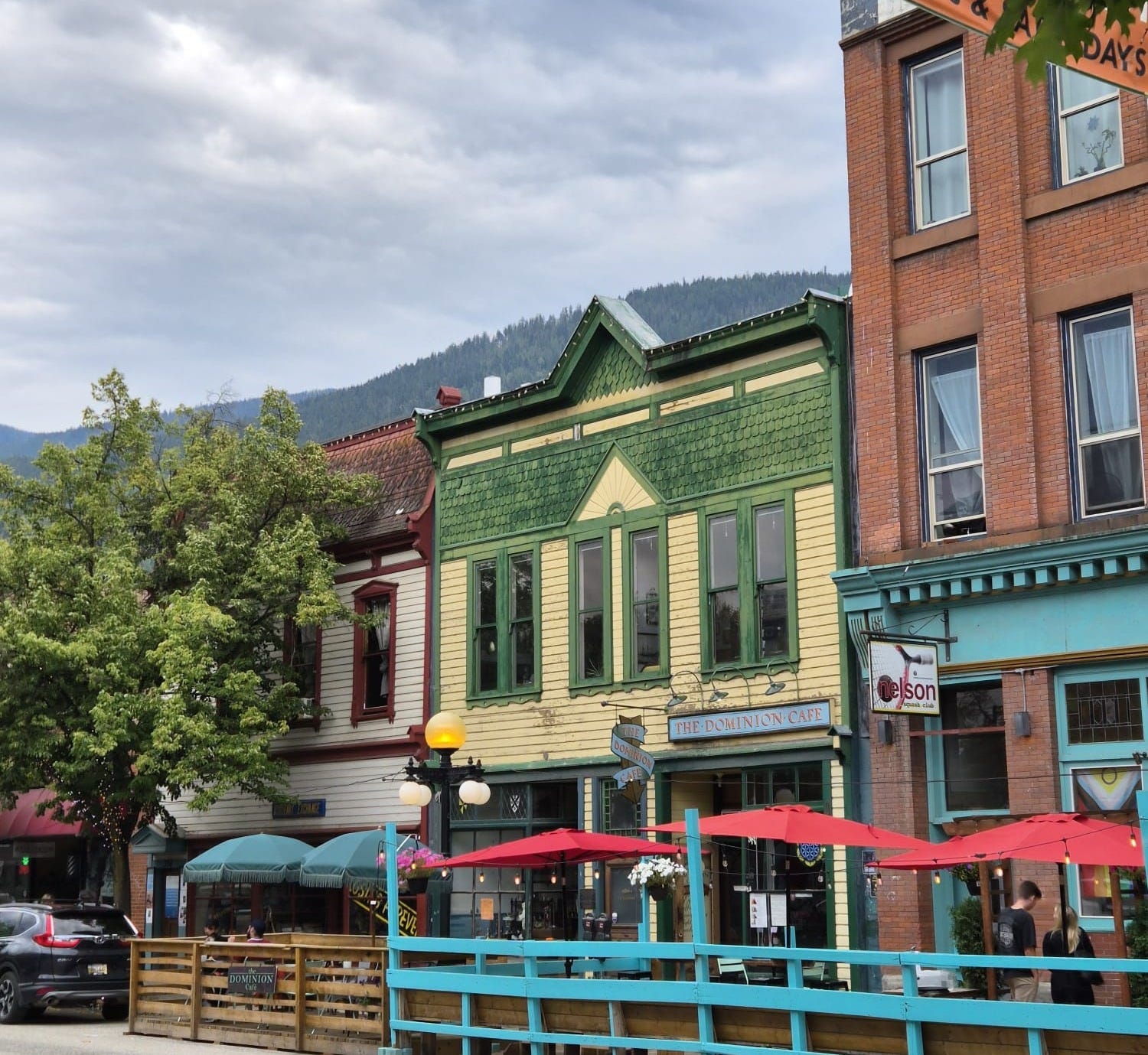
By contrast, Nelson has a multitude of youth. It is like an island of Whistler-style social modernity dropped in the middle of a different set of mountains. The core is exceptionally well-preserved, even more so than Victoria, with the century-old buildings maintained by frequent customers and millions in ski resort revenue. There are rainbow crosswalks and even an Italian restaurant that looks as though it makes carbonara without cream. They must be very proud.
More than 350 heritage buildings have been restored, and the city is the regional citadel of arts, tourism, commerce and government, containing the local courthouse. The coffee is naturally very good, at places like the Dominion Cafe. Nelson also has a working tram for tourists that runs beneath the magnificent steel bridge crossing Kootenay Lake. The city has a tremendous, youthful energy and is one of the few spots in the province where it can credibly boast that its best days lie ahead.
A short distance south of Nelson lies Salmo, where the forest thickened in previous decades as the human presence grew sparser. According to the 2016 census, nearly 1,200 people lived in the village, which sits on the flat plain at the bottom of a valley. It lacks a Fields or a movie theatre but has a hotel and pub, a private liquor store, and a coffee shop. As with Castlegar and the other spots, it is difficult to believe 1,200 people live in Salmo when you are there.
Salmo also has a retrofitted school bus that sells seafood about 650 kilometres away from the Pacific Ocean, including prawns, which none of us were brave enough to purchase. Unlike those in most other places, the former railway station does not serve as a museum but is instead a modestly maintained shack. The line itself stopped running in 1989.
At the Historic Salmo Hotel, you can buy a pretty damn good bacon cheddar burger and play pool with some very friendly locals. Local laws allow patrons to smoke on the outdoor patio as they sip an excellent local beer. Even if you personally do not enjoy cigarettes, you should patronise businesses that allow adults to partake in the small pleasure.
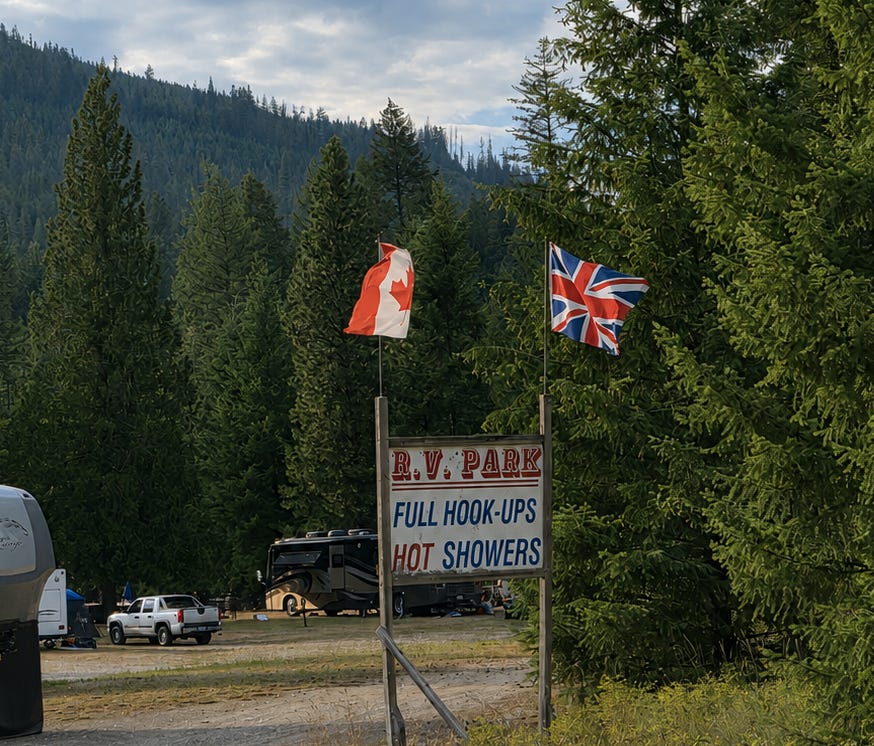
At Salmo’s Silver Dollar Liquor Store, a Union Jack can be seen in the upstairs window. Just outside town, there is another flying beside the Maple Leaf, flying over an RV park promising ‘full hook-ups and hot showers’ on a hand-painted sign above gravel and in front of mountains dark with trees.
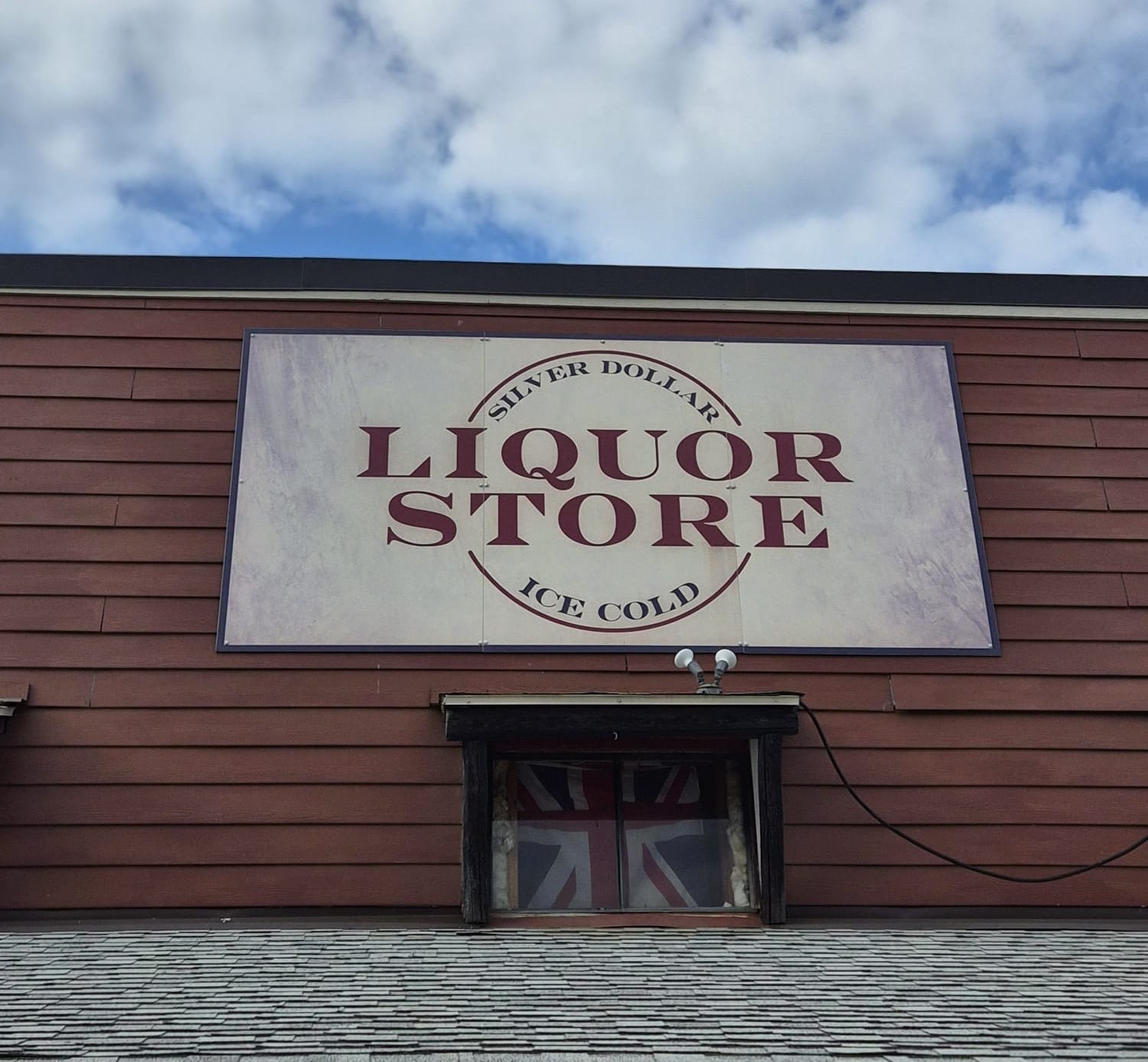
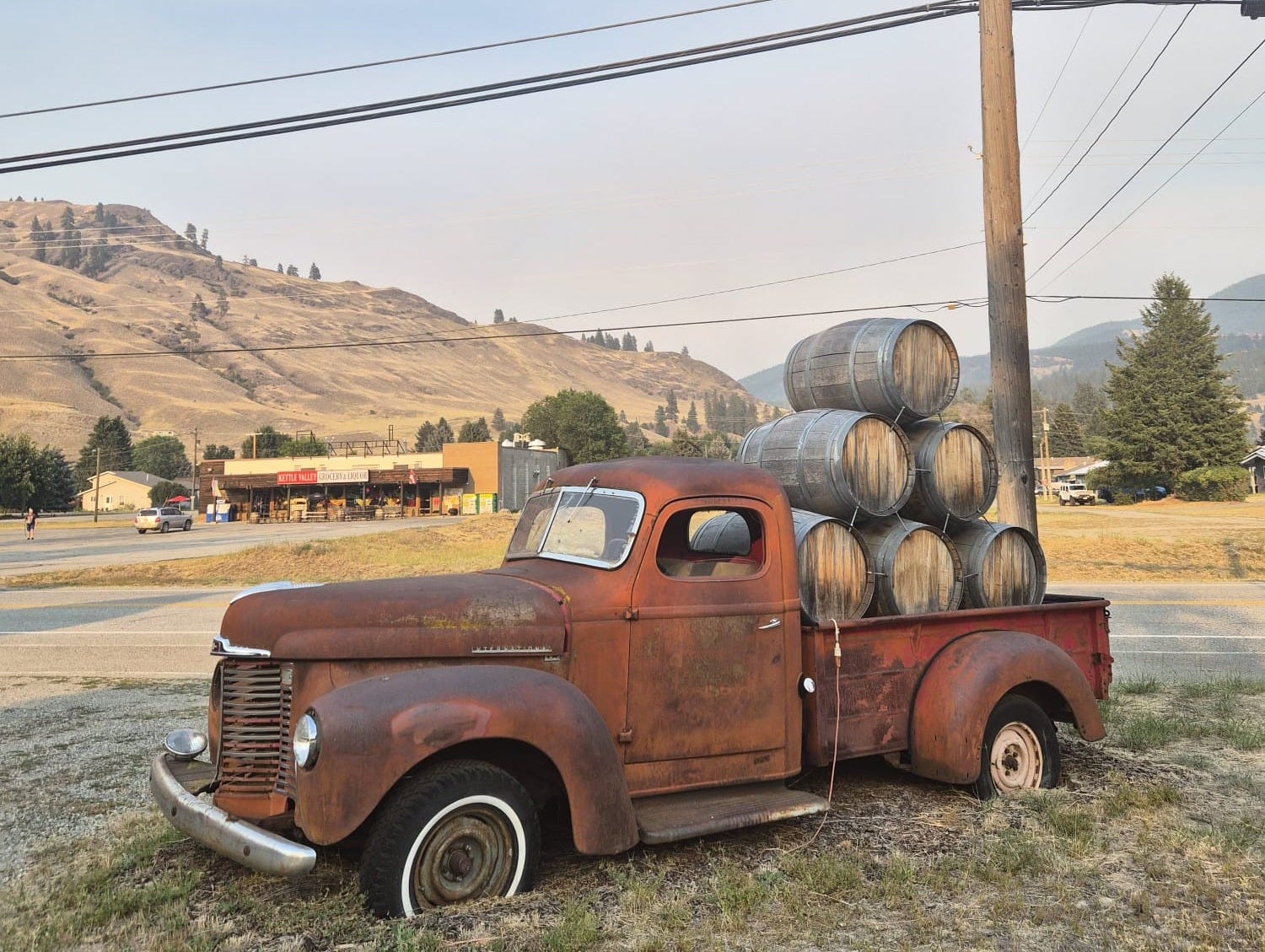
From Grand Forks to Salmo, our route was dotted with Red Ensigns and Union Jacks, which were the brightest objects in a landscape of fading lumber, rusty trucks, and hills coated in smoke. It is also a landscape of sweeping vistas, changing from dark green woods to fertile hills in minutes, girded by running rivers and teeming with wildlife. The buildings of the towns are old but have been the setting for history older than anyone alive. Old rusted trucks and industry serve as landmarks, blending in perfectly with the land.
Things move more slowly out there. A person may know Vancouver like the back of their hand and be satisfied with all the comings and goings of that fine city. But how could anyone ever begin to understand this province, or this country, if they have never been to places like Salmo, Grand Forks, or Greenwood?
We were due to return the day after. So we left, following one last night at the motel in Greenwood, travelling through those same forested valleys and mountain meadows on the Crowsnest before heading back down into the smoky desert of Osoyoos.
Geoff Russ is the Editor-at-Large of Without Diminishment. He is a contributor to a number of publications, including the National Post, Modern Age, and The Australian Financial Review.

For more from Without Diminishment and its contributors, follow along on X, YouTube, and Instagram.
Without Diminishment is a project of the Without Diminishment Foundation, a registered non-profit in British Columbia. If you value the unique perspective we bring to Canada’s cultural landscape, consider supporting our work with a generous donation.