
Geoff Russ: Alberta separatists do not get to define the Canadian West
The West was made by the Canadians who secured and fought for it, from Red River to the Pacific.


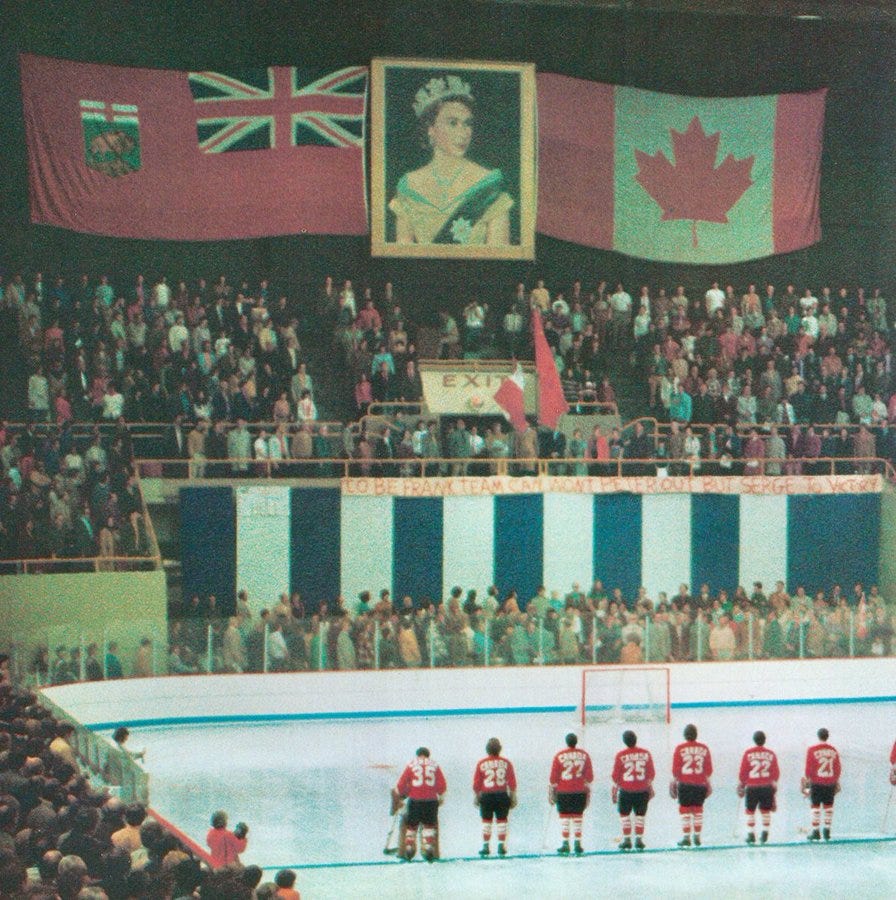
At Winnipeg Arena in 1972, Team Canada took the ice to stand for the national anthem before Game Three of the iconic Summit Series. They faced the south wall, gazing up at the arena’s iconic youthful portrait of Queen Elizabeth II, flanked by the seven-year-old Maple Leaf flag to the right. On the left was Manitoba’s own Red Ensign, bearing the Union Jack and the province’s escutcheon, which portrayed a bison beneath St George’s Cross.
Game Three ended in a frustrating 4–4 draw, but the image of the players standing before those symbols of Western Canada has recently enjoyed a resurgence in popularity.
Last week, it was suggested by an Alberta separatist that Winnipeg is ‘barely the West’. His assertion emerged from a debate about what values define Canada. Apparently, because Alberta, Saskatchewan, and northern British Columbia represent regional alienation and an ostensible predilection for separatism, they are more authentically Western.
Boiling the ‘true’ West down to wherever people are more disposed to a political manifesto is a laughable exercise in pseudo-mapmaking.
There are many visions of Alberta separatism. Some are honourable and historically literate. Writing off every proponent of Alberta separatism as a lunatic is a bad practice, for many are rational and good-hearted people who deserve to be honestly debated. Others express utterly inane arguments, like playacting as arbiters and gatekeepers of more than half the country.
Manitoba’s politics are not identical to those of Alberta or Saskatchewan. However, all three share the history and folkways of the people who made the Canadian West and opened it up to settlement by others.
Rather than being ‘barely the West’, Manitoba is its eldest daughter, being the first province admitted into the Dominion after Confederation in 1870. It is the province of the Red River Settlement, the buffalo, and Fort Garry, as well as being the birthplace of the Métis people. These are all icons of the West, and Manitoba is its eastern gateway.
Alberta separatism and its proponents often fall short because it is largely driven by material grievances and fluid political doctrines rather than by people, geography, and history.
Manitoba and British Columbia are therefore inconvenient for separatists because they are not defined by distinctively Albertan currents, such as Jacksonian-style individualism and the metaphysics of oil prices. They are instinctively federalist, and form the right and left flanks of the Prairies.
The land is not a bundle of policy preferences, nor are the ‘true’ people of the West some malleable focus groups. Trying to define any piece of land by a set of ideas leads to thin inspiration. If Alberta’s separatists want to make a stronger case than mere economic frustration, they can start by ceasing to define themselves and others almost entirely by policies like lower taxes, pipelines, decentralisation, and a fairer equalisation regime. Barry Goldwater’s Conscience of a Conservative poured over ice from Lake Louise is not the basis for a new national identity.
The vision of an imagined new state is ironically Trudeau-like in its methodology. The Trudeau family’s version of Canada is one defined only by rights, ‘values’, and a paper understanding of what makes a Canadian. Many separatist theories of Albertan identity simply swap in different ideas, without defining who Albertans are or Westerners more broadly. It is, at its core, another version of liberalism.
People, not pure ideological abstractions, make a country.
In fairness, the same separatist who shortchanged Manitoba’s place in the West went on to mention that Western culture is more than the Anglo-French duality of Ontario and Quebec, due to the historic influx of Scandinavian and Eastern European immigration. There is a case to be made there, even though Ontario had a larger number of Ukrainian-Canadians than Alberta in 2016, and Manitoba had the highest proportion of them.
There certainly is an important continental European presence on the Prairies, particularly among those of Ukrainian heritage. Their ancestors helped to transform the land into an agricultural powerhouse, and took full advantage of the liberty offered by Canada.
Others still came before the first Ruthenian migrant set foot on the banks of the Bow and Saskatchewan rivers. They came from England, Toronto, Glasgow, Red River, and Trois-Rivières as soldiers, police, pioneers and priests. To the land, they gave names like Chestermere, Batoche, Beaumont, Edmonton, Lac La Biche, and Calgary, long before Galicians were invited by Ottawa to work the land around them.
Sir John A. Macdonald’s government was ‘resolved to do all they can short of war, to get possession of our western territory’, and believed that Canada had to take ‘immediate and vigorous steps’ to counteract American territorial ambitions, so that the newly won lands became ‘what British Columbia is; wholly English, with English laws, British immigration and, I may add, English prejudices.’
To assert that the passage of time and demographic change weakens Canada’s claim to the West once again reflects a progressive and Trudeau-lite way of thinking. It is little different from Islamists laying claim to Toronto because their swelling ranks parade for Palestine in the city’s streets every other day.
The first Canadians of the Prairies made the region resemble Ontario and Quebec far more than it ever will resemble Bukovina or Bessarabia. That is not to diminish famous Canadian names like Gretzky, Trebek, Romanow, and others like them, but it is a reminder that Canadians won the West prior to others arriving.
That West includes the West Coast, as the name implies to anyone with half a brain.
It would be remiss not to mention that British Columbia is guilty of pretending that it stands apart from Alberta or Saskatchewan, especially in Vancouver, where many locals imagine it to be a sort of maritime city-state. No matter, for if Winnipeg is Western Canada’s eastern gate, then Vancouver is its counterpart. The idea that only natural gas-rich northern British Columbia qualifies as Western is ridiculous. Imagine thinking that the West magically ends because Vancouver lies too far in that direction. If the Canadian West has a definitive endpoint, it is the shores of the Pacific.
Symbols like the buffalo and the cowboy are often used by Alberta separatists in their media campaigns, as if their vision held a monopoly on them. Does the bison on Manitoba’s coat of arms, the Williams Lake Stampede in southern British Columbia, or the preserved Gold Rush town of Barkerville not count as Western too?
Everything west of Ontario is the West because everything west of Ontario was the continental prize of colonial Canada and, later, the Dominion of Canada, from Rupert’s Land and Red River to the plains, the Rockies, and the Pacific.
In 1793, the explorer Alexander Mackenzie finished his journey across the continent near Bella Coola, writing the words, ‘…from Canada, by land, the twenty-second of July, one thousand, seven hundred and ninety-three.’
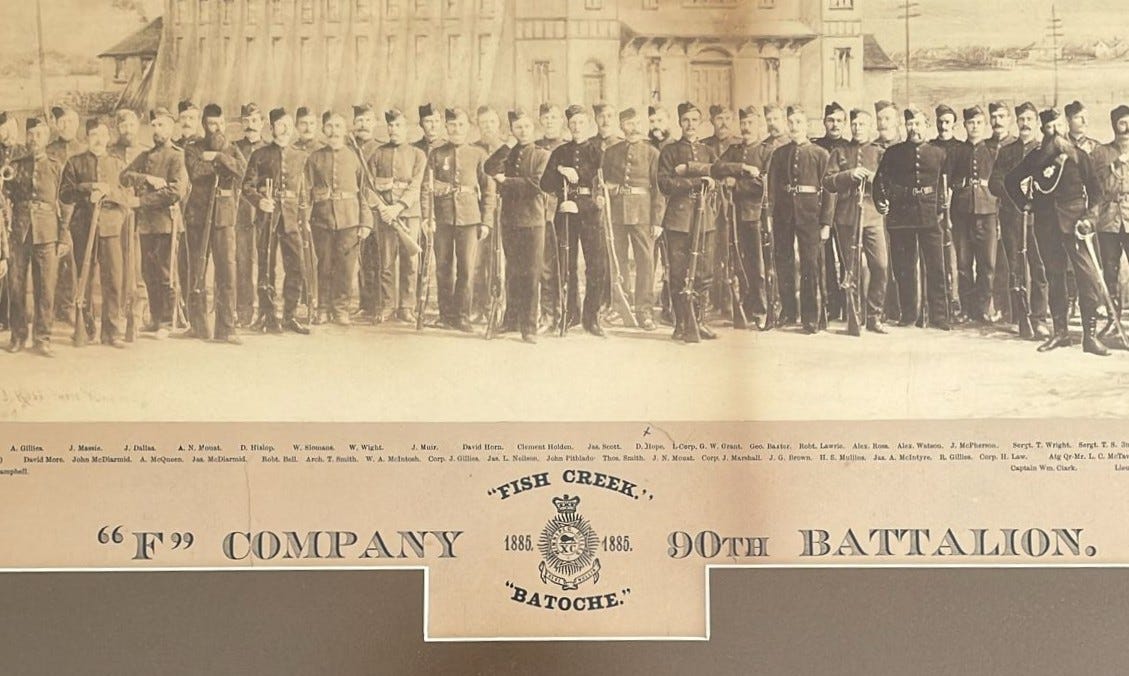
The West, including British Columbia, benefits from the heritage of a strong frontier culture. Those who tamed that massive frontier included pathfinders like Mackenzie, the officers of the North-West Mounted Police and soldiers from military formations like the 90th Winnipeg Battalion of Rifles. Together, the latter two helped put down Louis Riel’s rebellion in 1885 and win the largest stretch of this country for Canada.
It has been a long time since the late nineteenth century. Canada beyond Ontario deserves far more autonomy and freedom to make its own decisions within a united Canada without undue federal interference. The upcoming referendum on whether or not the Alberta government should pursue a ballot question on independence will test the strength of separatism. But regardless of the result, it is an opportunity for a new federalism that treats Alberta and its neighbours as the future of the country, rather than a halfway colony.
Those who want more freedom for Alberta include both loyal Canadian autonomists and outright separatists. The latter have every right to define who and what make up the various subcultures of their movement. However, they will never get to define the boundaries of the West or who is a Westerner. That was already established long ago, and will never change.
Geoff Russ is the Editor-at-Large of Without Diminishment. He is a contributor to a number of publications, including the National Post, Modern Age, and The Australian Financial Review.

But will Ottawa, and Canadians of a certain persuasion and age acknowledge that Canada must decentralize if it is to remain a successful country?
One notices quite quickly that in Alberta it is the left that are both the most strenuously nationalistic and the most centralizing. That isn't a coincidence. They can't win over a majority of the locals so they hope Central Canada "civilizes" Alberta.
Great piece, Geoff.