
Joshua Hart: Firearms are part of being Canadian
The Liberals' latest gun bans are cynical attacks on an honourable part of our culture.


As of December 2023, more than 2.35 million Canadians held a firearms licence (PAL), a number that has almost certainly grown since then. This represents roughly 5.9 per cent of the population, yet this group has been thoroughly demonised by our Liberal government.
In a country built on restraint and self-reliance, that smear corrodes civic trust. It has not always been this way, but things will get worse before they get better for lawful Canadian gun owners unless the public narrative is confronted head-on.
First, it is important to note that Canada has a deep tradition of firearms ownership that successive governments have worked hard to downplay or erase. Contrary to the popular myth, especially in a country that prides itself on “peace, order, and good government”, that only Mounties carried guns on the frontier, the reality was the opposite.
In our historically lawful society, ordinary Canadians were trusted to possess and carry firearms for protection, hunting, sport, and other legitimate needs in a vast and often harsh land.
In the 158 years since Confederation, Canada has transformed from a sparsely populated, pioneering dominion into one of the world’s most urbanised nations.
Most people in this country today find guns a strange and exotic topic, primarily associated with war films and history books. That does not mean urban Canadians are excluded from our heritage of firearms ownership. On the contrary, many Canadian cities boast thriving indoor shooting ranges with strong memberships, and despite, or perhaps because of, recent government overreach, enrolment in firearms licensing courses has risen sharply since the pandemic.
Clearly, more Canadians than ever are interested in joining the long tradition of responsible firearms ownership. With this growing interest in firearms, why is the government more apprehensive than ever?
My answer is the political economy of gun control in Canada. What we have witnessed over the past decade is a straightforward political calculation by the Liberals.
If the average suburban voter, after watching their nightly dose of American crime news, believes that most guns are inherently evil, dangerous, and unfit for civilian hands, then any non-Conservative political party has a powerful incentive to pursue gun-control measures, regardless of whether those measures actually help police or reduce firearm-related crime.
On the whole, Prime Minister Carney would gain no political advantage by dropping the gun-control agenda. Progressive voters are hungry for gun control, and neglecting the issue may cost Carney a significant number of seats in battleground ridings. In other words, compliant Canadians are being scapegoated in the headlines while violent offenders are ignored.
In Indigenous, rural, and farming communities across Canada, the practical value of firearms requires no sermon. Those who live close to the land have always understood their necessity for protection, predator control, and food security. For generations, this understanding was shared by Canadian policymakers as well.
Canada never enshrined an American-style Second Amendment in the British North America Act. Under our inherited common-law tradition, the right to own and use firearms was taken for granted in a young country of vast wilderness and scattered settlements. Hundreds of thousands of ordinary citizens, farmers, First Nations people, hunters, and frontiersmen, kept and used guns as a matter of daily life, without controversy or restrictive licensing schemes.
The issue was not revisited in the Constitution Act, 1982 either. By that time, even though gun control had become stricter, Canadians had settled into what Tim Thurley aptly calls “the great Canadian gun compromise” of a new urban nation. The compromise was that gun owners were willing to accept a licensing programme, as well as other safety restrictions and regulations, while generally maintaining broad access to the firearms they needed, without excessive government burden. This was a conservative bargain of responsibility in exchange for respect.
As this compromise developed, a divorce of understanding began to emerge between firearm-using communities, policymakers, and the general public. Fear filled the vacuum left by that broken understanding.
Appearances can be deceiving, and this is part of the problem.
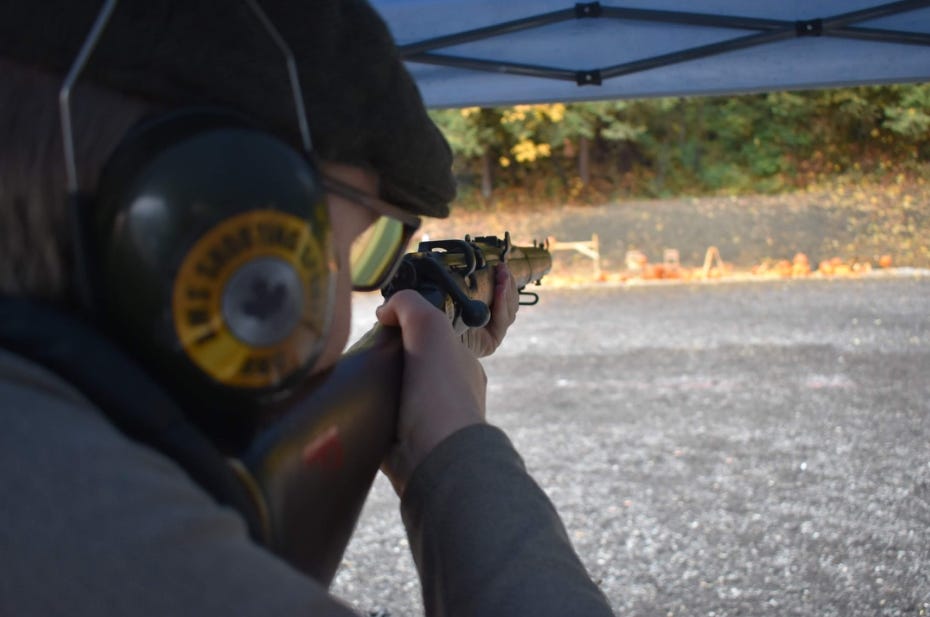
For example, a wooden Lee-Enfield rifle is far less frightening than many modern, black “tactical” firearms, despite the Lee-Enfield being one of the most storied military rifles of the 20th century. Many ominous-looking “tactical” weapons from the 21st century are poorly suited to police or military duty, but are excellent for hunting and sport shooting.
Ironically, thousands of these newer, supposedly “tactical” firearms have been banned for their alleged lethality, while the Lee-Enfield is still widely available. That does not mean the Lee-Enfield poses a grave danger to the public, for it is a bolt-action rifle prized by hunters, not lunatics. Those who own them are likely to be among the most conscientious firearm owners in the country.
The ban is driven purely by optics, but Canadians are asked to pretend otherwise.
As long as this dynamic persists, and is reinforced by a governing class that amplifies fear rather than facts, every new restriction will be pursued, even when policies are half-baked, poorly implemented, and ineffective. The ongoing “assault-style firearms” buyback debacle is a prime example.
A criminal’s handgun is used to sell a ban on a farmer’s rifle. Evidence be damned, it is not Canada’s sport shooters who run extortion rings or shoot up homes.
Fortunately, you do not have to take my word for it. In an excellent hot-mic moment, our very own Minister of Public Safety was happy to admit that these programmes are driven by pure electoral opportunism. Even with half a billion dollars committed to the programme, the initial results in the Cape Breton pilot of the buyback have been laughable.
Overwhelmed police services across the country have shown little appetite for putting resources into this boondoggle. Ottawa should be embarrassed that people tasked with real public safety are being asked to play theatre instead.
This is a cultural problem, not just a policy one.
Credit must also go to the conservative governments of Alberta and Saskatchewan, which have both taken steps to support licensed firearms owners in their respective provinces, where the law leaves only limited avenues for provinces to assert authority. At least those two governments have recognised that treating vetted citizens as suspects is poor, contemptuous governance.
Where much of that work falls short, however, is in addressing the root of the problem: culture. It bears repeating that politics is downstream from culture.
As long as the dominant image suburban Canadians have of firearms is gang members exchanging gunfire in downtown Toronto and Montreal, or extortion in the Fraser Valley, the default mental picture of a gun and its uses will remain strictly negative. That image fuels support for bans on “that evil AR-15 no one needs”, even when the firearm in question has nothing to do with crime by licensed users. This causes permanent misdirection, as law-abiding Canadians are cracked down upon and the lawless get a soft touch.
So how do we change that? We do so deliberately and without apology.
Culture cannot be flipped overnight, but we can move it when ordinary people get to see reality for themselves.
The first and most practical step is to encourage as many Canadians as possible to obtain their firearms licences. Luckily for us, the interest is there.
Talk to anyone who offers the Canadian Firearms Safety Course, and they will tell you demand is at an all-time high. The licensing process itself is eye-opening for the masses. Most people are shocked to discover just how strict Canada’s laws already are.
The more Canadians who learn about firearms, the less they see them as scary tools of criminals, and the more they recognise them as the everyday equipment of everyday people, hunters, sport shooters, and others who do not live inside the bubble of suburban comfort.
Culture changes one new shooter at a time. When parents watch their teenager safely punch bullseyes at the local range beside an off-duty police officer, or a hunter, the “scary black rifle” caricature dies quietly. That is the Canada we used to have, and the one we can have again.
We cannot write off urban and suburban Canadians, for they are the centre of gravity. We must work hardest to reach them. Encouraging city dwellers to visit a range, take the PAL course, or try competitive shooting in a safe, supervised environment is precisely the kind of grassroots exposure that shifts perceptions. If the goal is national cohesion, misconceptions have to be broken where they are strongest.
Firearms culture also needs to re-enter the cultural mainstream as part of the Canadian canon.
Trapping, hunting, and shooting clays at a trap range should be seen as just as Canadian as enjoying the great outdoors of our beautiful nation. We can no longer allow firearms to be associated with a backward or lowly culture, an attitude that reflects a kind of cultural snobbery among the Canadian elite.
In fact, it is quite the opposite. For example, two of Canada’s greatest painters were deeply knowledgeable about, and fond of, guns. Tom Thomson was an avid hunter, and Lawren Harris served as a musketry instructor during the First World War. To them, and to a wider tradition of Canadian leaders in arts and letters, outdoorsmanship and firearms went hand in hand as a natural way of life in remote places like Georgian Bay.
In an increasingly unstable world, a large population trained in safe firearm handling is a national asset. The Canadian Armed Forces have recently floated the idea of a supplementary volunteer reserve force.
Why not partner with existing civilian shooting clubs and ranges to build that capacity? Millions of licensed Canadians already pay out of pocket for training and equipment. A pool of more than 2.35 million pre-screened, safety-trained citizens is a cost-effective foundation for a robust supplementary reserve, far easier than building one from scratch.
When headlines are filled daily with shootings and disorder, many Canadians, rightly or wrongly, lose confidence that ordinary citizens can be trusted with firearms. Until streets feel safe again, and violent repeat offenders are actually held accountable, cultural rehabilitation of firearm ownership will remain an uphill battle.
Licensed firearms owners are not the problem. They never have been. Rebuilding a healthy, broadly accepted firearms culture in Canada will take time, deliberate effort, and leadership that treats law-abiding owners as the responsible citizens they are, not as scapegoats for crimes they did not commit.
Joshua Hart is a fourth-year student studying International Relations at the University of British Columbia, and formerly served as president of the UBC Conservatives.

Canada's gun laws are written by and for Quebec. As long as French Canada is deeply pacifist and statist, and as long as firearms laws are one of their many sacred cows, the Liberals are beholden to them.
You don't have to like it, but that is Canada as it is.