
John Weissenberger: English Quebecers are a decapitated minority
Many accepted the myths of their place as supposed oppressors, and helped drive the self-hatred of modern English Canada.


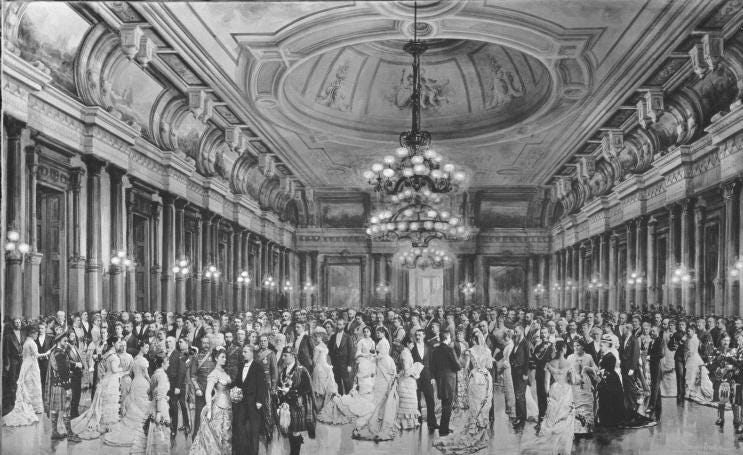
The “Golden Square Mile”. It’s a name that conjures up images of a lost Homeric age. And so it was during Canada’s formative years.
The Mile housed the architects of our nation, from Sir Hugh Allan, George Stephen and Cornelius Van Horne, the builders of the Canadian Pacific Railway (CPR), to sugar magnate John Redpath and utilities tycoon Sir Herbert Holt. These grandees of Anglo-Quebec, after long days managing the nation’s business on St. James Street, Canada’s financial hub, would retire to their mansions on the leafy slopes of Mount Royal. These silent monuments, many of them stylistic wonders, can still be seen when exploring the downtown streets north of Dorchester Boulevard (now René Levesque Blvd.), either well maintained or in various stages of disrepair.
Most notoriously, the Van Horne mansion at the corner of Sherbrooke and Stanley Streets was demolished by the City of Montreal in 1973. It could not be preserved for its “cultural value”, said then mayor Jean Drapeau, because it was “not part of Quebec culture”. Drapeau was stating “his truth”, as one would say today, essentially the Québécois historical narrative rather than the truth.
The Anglos and their business leaders, despite their foundational contributions to Quebec and Canada, were just in Quebec, not of Quebec. This business elite was the chief initial target of Québécois vitriol during the province’s Quiet Revolution of the 1950s and 1960s. Quebec intellectuals invented a narrative inspired by Marxism and post-war decolonisation, wherein the English were the colonial oppressors and French-Canadians were a subjugated underclass. It is, after all, easier to blame others for one’s situation than to look in the mirror. In reality, French Quebecers had long-standing political control of the province and an outsized role in Confederation, plus a hammerlock on the bureaucracy. But seeking work at English businesses, particularly in Montreal, which was then 40 percent English-speaking, was too much for fragile nationalist egos.
Separatist leader René Lévesque channelled the post-colonial narrative, calling Anglo businessmen “Westmount Rhodesians”, in reference to the Europeans who governed what became Zimbabwe. “We can’t be an inner colony any longer,” he said in 1968. “You know, quaint old Quebec — a sort of nice reservation inside the country.” Despite railing against the business elite, Lévesque’s movement ultimately targeted all English Quebecers, with increasing restrictions on English education, arcane signage laws and so on.
For us Anglos on the lower rungs, as the linguistic conflict was heating up, we waited. Waited for our community leaders to stand up, step up and speak up. Crickets.
Of course, Pierre Trudeau’s Liberal government was nominally committed to minority language rights and included several prominent Quebec Anglos, like Michael Pitfield (Clerk of the Privy Council) and Solicitor General Francis Fox. In practice, however, Trudeau’s bilingualism project was asymmetrical: bilingualism everywhere except Quebec, which itself became unilingual French. No help there.
Then, as the nationalist noose tightened, business leaders fled. Montreal, which had been the country’s business capital, bled head offices — Sun Life, Royal Bank and many more. The community’s ostensible leadership went “down the road”, the 401, to be precise, and settled comfortably in Toronto. The rest of us managed as best we could, but political turmoil and discrimination ultimately drove out almost 700,000 Anglos (1966–2021). Interestingly, Quebec, desiring more French speakers, accepted almost 500,000 Muslim immigrants, mostly from North Africa and the Middle East, and about 140,000 Haitians in recent years.
Ultimately, it was the Jewish community that provided the most articulate critics of Quebec’s nationalist excesses. Famed novelist Mordecai Richler scorched the linguistic Jacobins in “Oh Canada! Oh Quebec!”, detailing the petty stupidities of the nationalist project. Writer and filmmaker William Weintraub poignantly documented the destruction of English Montreal by myth-driven Québécois tribalism.
More shocking still was that many in the province’s Anglo establishment bought into the oppressed-Québécois narrative. When journalist William Johnson, himself bilingual and part Franco-Ontarian, energetically defended the minority’s rights, he was labelled an “angryphone” because he was insufficiently conciliatory towards the Québécois. While criticising the province’s excessive targeting of Anglophones in the Montreal Gazette, he routinely locked horns with his editor, later Liberal senator Joan Fraser. It turned out that our community leaders were disconnected from us, socially detached, with different values and priorities. When push came to shove, they simply left or actively worked against us.
What we also didn’t know was that the failure of Quebec’s Anglo leadership was actually a dress rehearsal for the cultural capitulation of the entire Laurentian Elite in the face of 21st-century wokeism. What began with the repudiation of the English Quebecers who built the province and the country ended with the toppling of statues and renaming of places and institutions. The performative self-hatred of our ostensible elite culminated in Justin Trudeau declaring Canada a systemically racist country with no “core identity”.
English Quebec’s demise also reveals the power of false narratives to drive society and historical outcomes. What Thomas Sowell calls “poetic truth” is often much more personally satisfying and politically useful than the actual truth. In Weintraub’s documentary, a Montrealer recounted how one of his students accused him: “You, you Anglos have been exploiting us for 300 years!” He replied: “I’m 35 years old. Give me a break. Have I personally exploited you for 300 years?”
Fact check: the Québécois were not and are not an “oppressed” or “colonised” people. But because that narrative was believed by the French and Anglo establishments alike, it taints Canadian politics to this day.
One important lesson from this history is that compelling narratives matter in achieving social and political change. Those opposing the failed narratives of the Laurentian Elite must studiously craft their own. And those narratives should be true.
John Weissenberger is a Calgary geologist, originally from Montreal, who speaks English, French and German. He was formerly Chief of Staff to the federal Minister of Citizenship and Immigration. His political writing appears in the National Post and C2C Journal.

As we continue to tear apart our Country for reasons I fail to completely understand, I take solace in the knowledge that I knew Her when She was at her best.
Oh, Canada, indeed.
It may help if anglophones in Quebec voted Conservative and created a bloc of voters that could balance off the Laurentian elite.