
Étienne-Alexandre Beauregard: Does citizenship matter to the Supreme Court?
If non-citizens can access the same programs and privileges as citizens, the concept of citizenship loses its purpose.


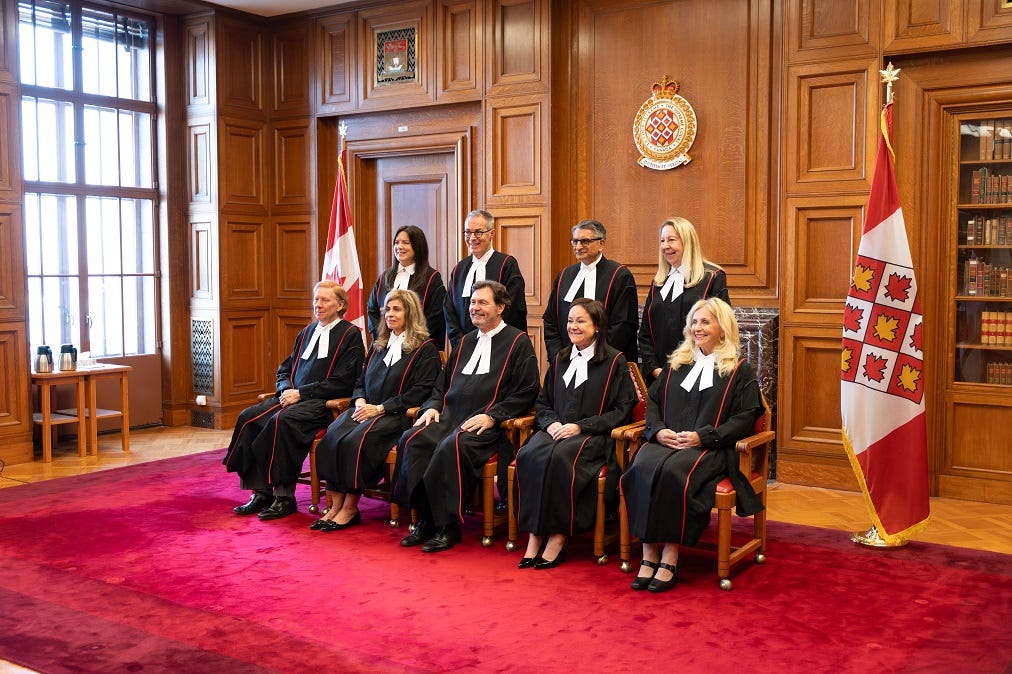
Since 1982, supreme power in Canada has no longer been held by elected officials, but by judges. We often forget how much Pierre Elliott Trudeau changed the soul of the country by replacing the British principle of parliamentary sovereignty with an imported form of judicial review that mimics the American system.
From then on, the Supreme Court went from being a constitutional court that mainly arbitrated disputes over jurisdiction between the federal government and the provinces to something different. It became a higher authority with the power to invalidate any law on the sometimes vague basis of the Canadian Charter of Rights and Freedoms.
A loss of confidence in the courts
For a long time, Quebec nationalists and a few autonomists in the Western provinces were the only ones sounding the alarm about the consequences of this regime change for the entire country. Now, more and more Canadians, like my colleague at Cardus, Brian Dijkema, are losing confidence in the courts because they see them as “twist[ing] themselves into pretzels to reach the decision they wan[t], entirely contrary to their own precedents”.
Many recent judgments have proven that judges have ceased to interpret the law and have instead begun to create new law. Chief Justice Richard Wagner candidly admitted as much when he stated that the legal value of judgments issued by the Court before 1970 was “quite minimal”, which should concern us all in a system that is said to be based on precedent.
Some recent rulings have illustrated the excesses of judicial power in an almost comical way. The decision by the Ontario Court of Appeal forcing the Ontario healthcare system to pay for an experimental vaginoplasty in which the patient also retains his penis made headlines around the world.
Similarly, the Ontario Superior Court recently halted the Doug Ford government’s plan to remove bike lanes in the name of the “right to life”. This is a very curious interpretation, particularly in a country where the right to life was not perceived by judges as contrary to the institutionalisation of euthanasia.
No welfare state without borders
The decision in Quebec v. Kanyinda, in which a Congolese asylum seeker who entered through Roxham Road sued the Quebec government for access to its subsidised-daycare centres, is less bizarre than it is disturbing. First, it is important to note that, currently, more than 30,600 children are on the waiting list for daycare in Quebec, so there is no abundance.
Above all, the principle at stake is fundamental: can a state reserve certain public services for its own citizens?