
Tyler Brooks: Between Marxism and America, choose the Kingdom
Lessons from John Farthing's “Freedom Wears a Crown” for the New Right.


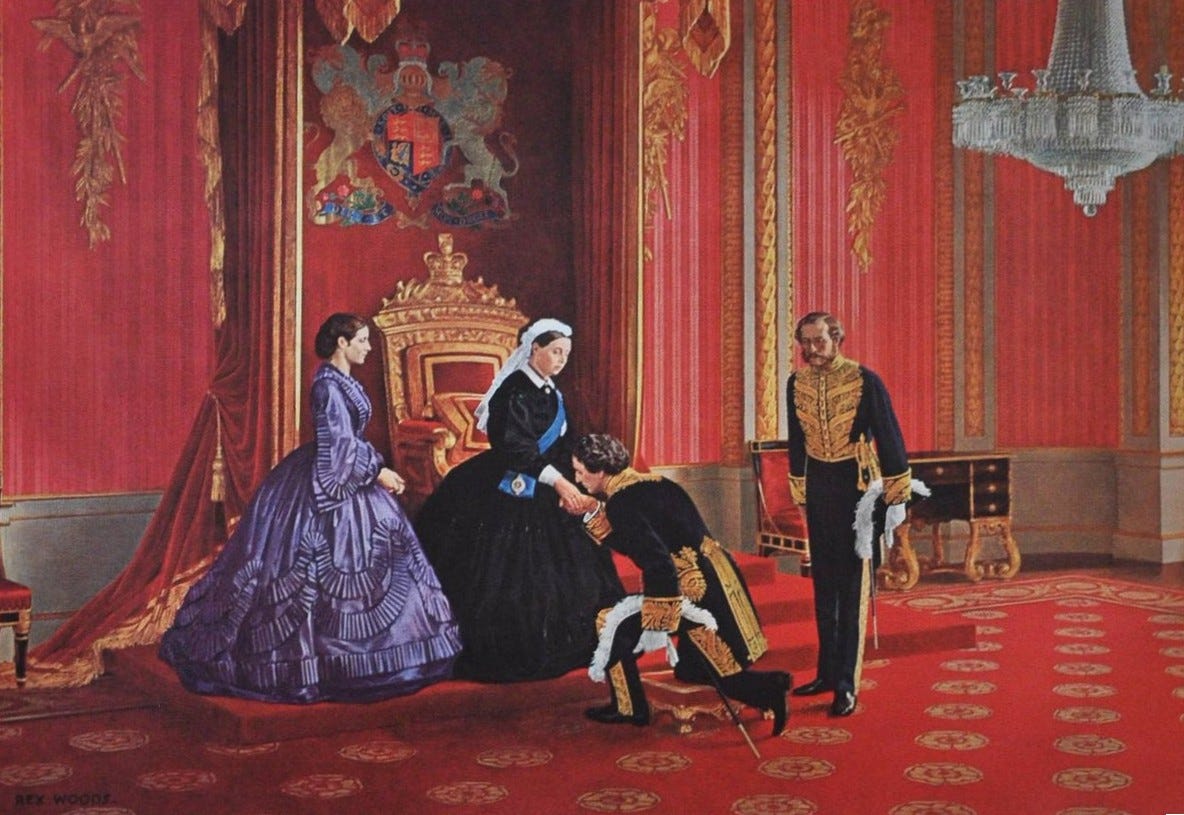
Next year marks the 70th anniversary of the release of Freedom Wears a Crown by John Farthing. I first came across this text during my search for historical conservative thinkers in Canada earlier this year. Each page is filled with noteworthy commentary on today.
Given that we are at a turning point for the conservative movement in Canada, I believe it would be beneficial to reintroduce Farthing to the intellectual public square. Discussions about what it means to be conservative, how best to position conservative policy, and similar questions should be informed by historical approaches.
It is beyond question that John Farthing unapologetically resides in the classical Tory school of thought. His affinity for the monarchy, concern for a virtuous society rather than a pluralistic one, and sharp criticism of American republicanism may be enough for outright dismissal by many conservatives.
However, Freedom Wears a Crown is also a hopeful, sober, and thoroughly Canadian political treatise that deserves to be on the same bookshelf as George Grant’s Lament for a Nation. I would argue that those two books should sit right beside each other.
To demonstrate its importance, I will highlight what I believe are the three main takeaways from the text.
The “British tradition” is a third path against Americanism and Marxism
Today’s geopolitical climate is not so different from the 1950s. We have two dominant powers representing two ways of political and social being: American republicanism and Marxist communism. Farthing critiques the American constitution, and its general political outlook, as a static perfectionism stuck in 18th-century liberal beliefs. As for Marxism, it cannot rid itself of the passion to tear down everything in society associated with the existing order. Both traditions are weaponised by a great power, and both are rooted in an idealistic, rigid outlook.
Farthing believed that the British tradition is the third way between these competing extremes, though he did not frame it in the way our current Prime Minister did in Davos earlier this year. He begins his text with the following:
“Politics is simply the meeting ground between basic belief and economic circumstance. The background of my political thinking is the King-in-Parliament. The words king and kingdom are not words of political significance only, but of personal also. If they were not, they could not express the ideal of social life so well.
“The British tradition has these two characteristics: a king and an organic order. Nor is it surprising that they should go together, for a kingdom is essentially an organic order of growth. Thus the illogical character of British institutions and their tendency to take the middle course can be seen to be perfectly logical, but it is the logic of a changing organic order and not that of a fixed system. The middle position is not a mere compromise; it is essentially a third position.”
Canada has all that it needs to be distinct in the world — and certainly from the United States — baked into its institutions: the series of checks and balances among our government branches, the efficient and dignified working parts of our constitution, and the primacy of the person over the primacy of the law that implicitly guides our governance.
Canada was formed when the British North American colonies banded together because they knew that, together, they would be stronger. There was plenty of tension between these founding peoples, but they chose to work through these issues together in a union. As Farthing alludes to, the Canadian way is not entirely a compromise or via media, but a new third path.
This third way is provocatively referred to as the kingdom:
“The essential idea of a kingdom is not a fixed system of law deriving from a state of nature, not an already perfect system of law-providing liberty, but rather a free and freely-developing order of life, inspired and informed by an ideal of perfection, yet claiming for itself no absolute perfection whether now or at any future time.
“The ideal of perfection that inspires it knows nothing of any such absolute end. Indeed, to claim knowledge of the end would involve an implicit denial of the freedom. It would be tantamount to attempting to lay down in advance the future course of human history. There is no such pride and presumption in the ideal of a kingdom. It knows nothing of absolute perfection, whether of a present state of liberty or of a future state of communism. It seeks only to retain what it knows to be good and to attain to whatever is better. And meantime to perform the duties of the moment in which past and future are fused.”
The first lesson from Farthing is that the Canadian approach is the British tradition applied to a new land. It is the demonstration of its success. Its Britishness, found in our institutions and social outlook, is our foundation to stand on, and the fuel for navigating this everchanging world.
Conservatives ought to celebrate and proclaim this third way. If they shy away from this duty, then this treasure will surely be forgotten by subsequent generations. Instead, Canadians will be presented with shallow fads from fleeting trends.