


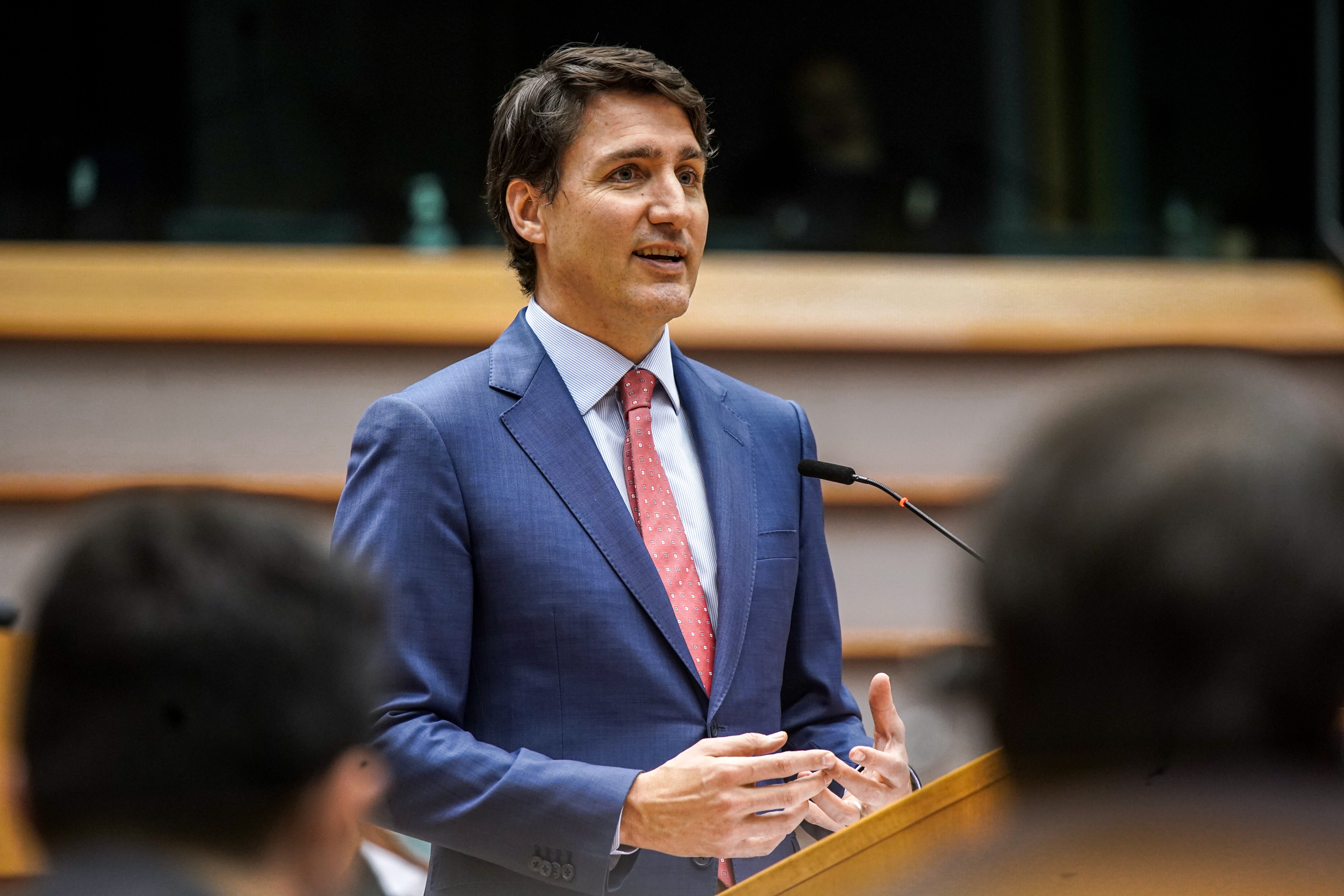
Among the many questionable statements made by former prime minister Justin Trudeau, few have drawn more ire from Canadian conservatives than his suggestion that Canada is the world’s first “post-national state”. It therefore came as something of a shock to many Conservative Party supporters when Canadians rallied around the Liberal Party of Canada, and not the Conservative Party, in response to Donald Trump’s tariff drive. From their standpoint, it was simply incomprehensible that a party that had openly promoted the idea of “hotel Canada” would somehow still get to claim the mantle of Canadian patriotism.
Many factors played into this development. One was the concerted effort by the Liberal Party, starting in the 1960s, to construct an expressly left-leaning Canadian identity that persists to this day. But at least equally consequential was the ongoing incapacity of Canadian conservatism to offer an alternative vision of Canadian identity, whether rooted in the past or oriented toward the future. Going back to at least the same period, Canadian conservatism has instead tended to be defined by its own, more honest brand of post-nationalism, one that does not benefit from the new symbology crafted for this purpose by the Liberal Party.
It is tempting to point to those Canadian conservatives who oppose continued attachment to the monarchy as the best embodiment of this post-1960s conservative post-nationalist philosophy. However, the best illustration is provided by Anglo-Canadian conservative attitudes toward the status of the French language. While opposition to official bilingualism undoubtedly exists on the Canadian left, it is, by all appearances, more pronounced on the Canadian right. Indeed, one poll conducted ahead of the 2023 Conservative leadership convention showed that fewer than three in 10 Conservative Party members consider bilingualism to be important to Canadian identity.
Recent events track this perceived hostility towards French among certain segments of the Conservative Party’s base. In the aftermath of the plane crash at LaGuardia Airport last month that claimed two lives, including that of a francophone co-pilot from Quebec, Air Canada’s CEO held an English-only press conference. This decision prompted objections from Quebec’s political class, which in turn prompted counter-objections from Anglo-Canadians, and especially from Anglo-Canadian conservatives. Although they began by focusing on Quebec’s perceived overreaction to the Air Canada press conference, these counter-objections soon devolved into attacks on official bilingualism and the continued relevance of the French language in Canada as a whole.
These objections to bilingualism, and to the status of French in Canada, are nothing new, of course. Nor have the arguments against official bilingualism changed all that much since the Official Languages Act and related federal legislation were adopted in the 1970s. As it turns out, these arguments are rooted in entirely post-nationalist premises. They differ from the assumptions undergirding Justin Trudeau’s infamous statement only in that Trudeau likely intended to direct them at English Canada alone, and to spare any direct confrontation with francophones in Quebec. In contrast, the Anglo-Canadian conservatives advancing these arguments would extend the post-nationalist vision to Quebec as well.
Consider the interventions of well-known Vancouver-based commentator J.J. McCullough, who weighed in early on the Air Canada controversy with a denunciation that included a rejection of Canada’s continued attachment to the monarchy, a favourite hobby-horse of his. He then followed up on his objections to bilingualism in a full-length post titled “There are no good arguments in favor of official bilingualism”.
In that more fulsome post, McCullough argued that “the two founding nations theory” often used to justify official bilingualism at the federal level in Canada “is so at odds with the realities of both Canadian history and Canada’s modern form that it cannot be used to justify public policy without inflicting enormous undemocratic harms upon the country.” He then continued:
To presume that French Canadians, and for that matter English Canadians, possess inherent rights that derive from their cultural identities rather than their status as free individuals is a profoundly illiberal idea that frames Canada not as an egalitarian democracy, but as a hierarchy of peoples, wherein one’s ancestral identity can override competing interests of Canadians of different backgrounds. Canadians, in fact, explicitly rejected enshrining these values into the Canadian constitution when they voted down the Charlottetown Accord in 1992, a package of amendments the aging Pierre Elliott Trudeau criticized as a project of turning Canada into a nation governed by “a hierarchy of categories of citizens.”
The point here is not so much to single out McCullough for attack, as it is to focus on his arguments as a particularly developed example of a more widespread post-nationalist attitude that the Air Canada controversy brought to the fore on the Anglo-Canadian political right.
The question raised by McCullough’s arguments against the status of French in Canada, which should be evident from his citing Trudeau the elder to support them, is whether their underlying assumptions differ substantially from the “post-national” premises of Trudeau the younger that Canadian conservatives so often claim to despise.
The answer, simply put, is that they do not. In fact, these arguments go further in the direction of post-nationalism than either Trudeau ever advocated openly. While Quebec nationalists have long criticised Trudeau père’s vision for Canada as entailing the reduction of Quebec francophones to the status of one minority among others, he and the Liberal Party were never so crass as to advocate openly for this outcome. The post-nationalisms of both the elder and younger Trudeau were confined, in word, though perhaps not in deed, to marginalising the distinctively English collective identity of Anglo-Canada. When Trudeau affirmed that “[t]here is no core identity, no mainstream in Canada,” he did not explicitly mean to include Quebec.
In contrast, Anglo-Canadian conservatives in the mould of J.J. McCullough have no such scruples. They believe that Trudeau-style post-nationalism is just fine, but that it should not be limited in its application to Anglo-Canada. It should instead be extended to Canada as a whole. They would go so far as to outright reject Canada’s founding compact, entered into between the French Canadians and the British Crown with the aim of preserving the French language, culture, law, and religion against a common American threat. In its place, they would erect a form of individualism reminiscent of that espoused by the Trudeaus, but without exceptions conceded on the basis of political expediency. They would also erect a “collective identity” synonymous with the premises of philosophical liberalism, under which individuals are free to define themselves however they want. To borrow McCullough’s formulation, “their status as free individuals” demands it.
In case the parallels between these two competing post-nationalisms, distinguished primarily by the former’s more tactful approach towards the management of Quebec, are not yet sufficiently compelling, consider also the role that appeals to “diversity” play in both arguments. When Trudeau the younger claimed that “a Canadian is a Canadian is a Canadian,” he meant to say that supporters of the Islamic terrorist group ISIS were no less entitled to Canadian citizenship than anyone else. That is, he invoked the notion of diversity against suggestions that Canadian identity should be tied to specific beliefs or political commitments.
Those on the Anglo-Canadian right who oppose the recognition of French make a similar appeal to diversity as part of their argument. In their view, Canadian diversity is such that granting preferential treatment to any particular language would simply be unjust, and indeed discriminatory. To quote McCullough at length once more:
It is difficult to justify nationalizing “official” status for the French language purely on the basis of an appeal to the inherent rights of a linguistic minority, given that linguistic minorities have long comprised a broad and diverse community of Canadians who exist in different proportions in different provinces, for example, only 57,420 British Columbians claim French as their “mother tongue,” whereas over 417,000 claim Chinese. Yet that is what Canada did.
In McCullough’s estimation, and in the estimation of the many who agree with him, French is simply one of many minority languages in Canada. It still happens to be spoken by a larger minority than any other minority language. But this may change. Canada’s diversity, present since the beginning and growing since that time, means that it is unjust and undemocratic to accord any special status to the French language in Canada.
Put differently, as against the Quebec nationalist suggestion that Trudeau the elder’s post-nationalist vision would eventually relegate francophones to the status of one minority among many, the brand of post-nationalism embraced by Anglo-Canadian conservatives in the McCullough mould is one that already recognises them as such. Having rejected completely the idea that language, culture, history, and tradition can serve as legitimate touchstones for defining Canadian identity, all they are left with is an idea of Canada based purely on voluntary association. Quebec, in their view, has to abide by these rules just as much as anyone else, and it is unfair that it does not.
Anglo-Canadian conservatism now stands at a crossroads. One path involves the pursuit of post-nationalism, as suggested by those among its number who oppose federal bilingualism and the recognition of Quebec’s distinctive linguistic and cultural inheritance. It means abandoning all references to the ideas that have historically defined Canada as Canada, and moving forward with a post-nationalist vision of the kind expressed by both Trudeaus, but one that expressly subjects Quebec to this vision as well.
The other path means choosing to resile from the post-nationalist temptation that has existed as at least a latent subcurrent of Anglo-Canadian conservatism since the 1960s, and consciously attempting to forge a new conservative Canadian national identity. Such an identity might be grounded in the twin ideas of the founding compact, namely the monarchy and the French language. To be clear, these touchstones are not enough to sustain Canada in the future, at least without an active commitment to preserve and foster the principles that underlie them. But they at least provide a place from which to build a common identity for all Canadians that is more profound than post-nationalism and the sterile symbols imposed by the Liberal Party under Pearson and Trudeau.
Undergirding these two alternative paths are two different understandings of diversity and of the best way to manage it. The first path, the post-nationalist path, is the one we know, and the one that has led Canada to its current, less than satisfactory state. This path rests on the contention that the fact of diversity implies the impossibility of any truly shared identity. The best we can hope to say is that “a Canadian is a Canadian is a Canadian,” or, to borrow language from the CBC, “It’s not how Canadian you are. It’s who you are in Canada.”
The second path rejects these claimed implications of diversity. Indeed, it recognises that the fact of diversity makes the construction of a collective identity more important, not less. But taking this path also means favouring some reference points over others, and seeing these choices as positive. At minimum, it should mean that a convicted ISIS terrorist is not simply “a Canadian” like any other. But it also likely means that the languages that are constitutive of distinctive political communities within Canada, such as French, are given higher recognition than languages that people in certain Canadian cities happen to speak.
There is a difference between a place like Toronto, where many, if not a majority of children, now grow up in households where another language happens to be spoken, and a place like Quebec, where that language is constitutive of a political community with a distinctive past, present, and future.
Regardless of the path chosen, Canadian conservatism must be conscious of the nature and implications of that choice. From a partisan political standpoint, choosing the first path is likely an electoral loser for the Conservative Party. These pragmatic considerations probably explain why the Liberal Party has never expressly applied its own post-nationalist commitments to Quebec. To the extent that these premises have been applied to Quebec by supporters of the Conservative Party, it is likely that they have had a negative impact on the Conservatives’ electoral fortunes, and conversely this explains much of the Liberal Party’s overall dominance at the federal level.
Now, it may be too late for the Conservative Party to change the minds of francophones in Quebec. Perhaps Quebec should be regarded as a write-off. Even then, the path chosen has other implications.
At minimum, there remains a choice of what Anglo-Canadian conservatism more broadly represents. If it wishes to follow Canadian liberalism down the path of post-nationalism, then it needs to be aware that this means playing into the vision of Canada consciously created by the Liberal Party.
It means that Anglo-Canadian conservatives can no longer complain when Canada is called the first “post-national state”, or when a Liberal Party led by Mark Carney draws on this imagery to position Canada as a “progressive” alternative to a Trump-led United States.
It means that Anglo-Canadian conservatism will have chosen to play within the Liberal Party’s post-national sandbox, and will continue to be bound by the Liberal Party’s vision of what Canada is and should be.
Andrew Averay is a social studies teacher and writer with interests in politics, current affairs and public education.

I invite Andrew Averay and J.J. McCullough to spend a month in any Quebec town or city other than Montreal.