
Brent H. Cameron: Amid revolution, Canada's foundations lay on the roads not taken
"Peters was not opposed to his neighbours, nor was he a British stooge."


I live in southeastern Ontario on land homesteaded by my great-great-grandfather in the 1850s. My family’s cemetery plots lie a short distance away—my father, grandparents, great-grandparents, and even my great-great-grandparents. Each morning, I see the spruce trees my grandfather and I planted when I was young, trees he said he wouldn’t live to see grow, but I would.
People often define “being Canadian” as a deep attachment to a place, and in some ways, I do too. But that assumes identity is passive, simply what you’re born into.
It’s an easy, and therefore lazy, way to define nationhood; you were born within Canada’s borders, so you are Canadian. In calmer times, that may be enough. No one questions it, and you never have to justify it.
But there are moments when you are challenged, when you reach for a deeper explanation of who you are and why.
Everyone has to answer the question for themselves, but for me, it is in contemplating an alternate reality.
In that timeline, I was born on the outskirts of Hebron, Connecticut, a town of around 9,000 about 20 miles outside Hartford. I would have grown up pledging allegiance to the flag and, if I were particularly clever, I might have followed in the footsteps of some of my relatives who had been attending Yale since the early 1700s. I might have been a moderate Republican, or a Democrat. I may have participated in Independence Day celebrations and been told about my brave forebears, who included a governor and several war heroes. Maybe I would have been a member of the Sons of the American Revolution.
Maybe, on a Sunday morning, I would have cheered as the United States won the gold medal in men’s hockey at the Winter Olympics in Milano and Cortina.
That timeline may exist on another astral plane, but the reason I don’t live that existence is because of the events of the early fall of 1774, and the choices that emanated from them.
My ancestor chose loyalty to the Crown during the American Revolution, a decision that shaped my family’s history and made me Canadian by default. He left no written record, but his cousin, Colonel John Peters, made the same choice and documented his experiences.
His perspective, featured in the recent Ken Burns PBS documentary, reminds us that the Revolution wasn’t simply noble patriots versus tyrannical British. Mob violence, intimidation, and public shaming were also part of the story.
Peters was sent by his community to represent them at the First Continental Congress in Philadelphia. On the way, he was mobbed by the Sons of Liberty who thought him to be a “Tory”, sympathetic to the Crown. When he arrived at the Congress, his observation of the attendees was this:
“Teachers, bankrupts, dissenting teachers and smugglers meant to have a serious rebellion and a civil and religious separation from the mother country.”
An oath of secrecy was required, which he refused, and he was sent away. On his return trip home, he was once again attacked by the Sons of Liberty. Arriving back at his home, he was harassed, banned from leaving town under threat of death, and, in his words, was plundered of “most of my movable effects.”
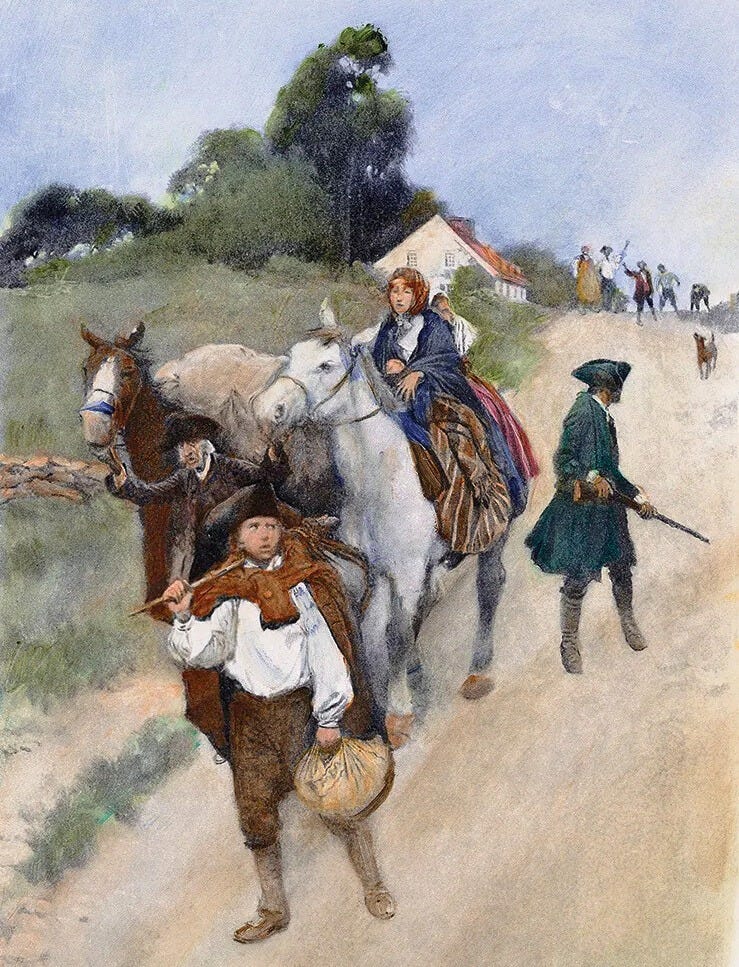
Eventually, he would make a full break, and in Quebec, he organised a force, the Queen’s Loyal Rangers, that he would command. In the meantime, his wife and children were turned out of their home and farm, and forced to hike toward Quebec in the dead of winter.
This behaviour was replicated all across the thirteen colonies. Committees of Correspondence would open people’s mail to look for Loyalist sympathies, with the intent of making their names public. In Virginia, Charles Lynch was the presiding judge over kangaroo courts designed to target and punish Loyalists without due process. It is in honour of him that groups of vigilantes who set about detaining and hanging people without trial are called “lynch mobs.”
To understand how vicious and personal the war became, Peters’ experience at the Battle of Bennington in 1777 is a potent illustration:
“A little before the Royalists gave way, the rebels pushed with a strong party on the front of the Loyalists which I commanded; as they were coming up, I observed a man fire at me, which I returned. He loaded again as he came up, and discharged at me again, crying out: ‘Peters, you damned Tory, I have got you!’ He rushed on with his bayonet which entered just below my left breast, but was turned by the bone. By this time I was loaded and I saw it was a rebel captain, Jeremiah Post by name, an old playmate and schoolfellow, and a cousin of my wife. Though his bayonet was in my body, I felt regret to destroy him…”
Peters was not opposed to his neighbours, nor was he a British stooge. He supported the Crown because he saw it as a safeguard against mob rule—not a threat to liberty, but a protector against the fickle impulses of an angry crowd that often mistakes vengeance for justice.
Americans speak of “life, liberty, and the pursuit of happiness,” while we speak of “peace, order, and good government.” Yet without peace, order, and good governance, the foundations for life, liberty, and happiness simply don’t exist, unless one leads the mob and claims the spoils for himself.
Peters’ loyalty was to stable institutions that shielded society from the arbitrary power of the self-appointed. Many Loyalists, French Catholics in Quebec, and Indigenous nations viewed the Patriot cause as a danger to their rights, languages, religions, lands, and ways of life. For them, Canada became a refuge, a place where they could remain themselves.
The Crown was, and is, an avatar for something bigger than ourselves, and more lasting than our emotions and personal ambitions. It forms a secular covenant. That was well understood by those caught in the maelstrom of revolution.
Suggesting that the Canadian identity is some reflexive expression of anti-American sentiment is disrespectful to the beliefs and sacrifices of those who built the founding coalition of Canada, but that attitude is served by those ignorant of our own foundational story.
Like those on the Patriot side, the Loyalists, Québécois, and Indigenous nations that opposed the Revolution were rational actors. They were no less driven by the factors that motivated the other side. They had a choice.
For me to understand what it means to be Canadian, I must understand why I wasn’t born American. That means understanding why my family made that choice 250 years ago, a choice that placed me in Ontario rather than Connecticut.
To paraphrase Robert Frost, “two roads diverged in the wood and we took the one less travelled by, and that has made all the difference.” That is a difference that forms the entirety of what I know and who I am.
We do not need to build or create a Canadian identity. It is there and always has been. We just need to rescue it from years of neglect, ignorance, and disrespect.
Brent H. Cameron is a writer and political activist. A former assistant to a member of the Ontario legislature and a former municipal councillor and Deputy Mayor in his community, his 2005 book “The Case for Commonwealth Free Trade” presaged the CANZUK movement. A former editorial board member for the Kingston (ON) Whig-Standard, he has contributed articles to The Hub and other publications.

This is a wonderfully written essay.
I have spent my life despising the "we are not American" sentiment as being the singular notion of Canadian identity.
Perhaps it is my age, or just my disposition, but I have always been astonished at the beneficence of our dual founding, our British Heritage, and our close relationship to the United States.
Between 1775, and 1820, the largest source of immigrants to Canada were United Empire Loyalists, and "late Loyalists" from the United States. I was taught we stood on the shoulders of giants.
Are young folks taught these lessons today? Or did Canada's history only begin in 1867, 1965, or 1980?
Is the goal of an unhyphenated, pan-Canadian identity abandoned as unachievable, or is it just unworthy?
My maternal grandmother's family (Sulis) were United Empire Loyalists who settled in Digby, NS. The family had lived near Boston. Last year I visited that city and was immersed in the story of the Revolutionary War. After a day of touring the historic sites, I just shook my head and said, "Couldn't they have just talked it out and come to a peaceful agreement?" My country was born from negotiations between the people and the mother country and I am proud of that.