
Adam Zivo: Could Eric Lombardi be the solution to Ontario's Doug Ford problem?
The Ontario Liberal leadership contender provides moderate conservatives with a pragmatic, and arguably more conservative, alternative to the status quo.


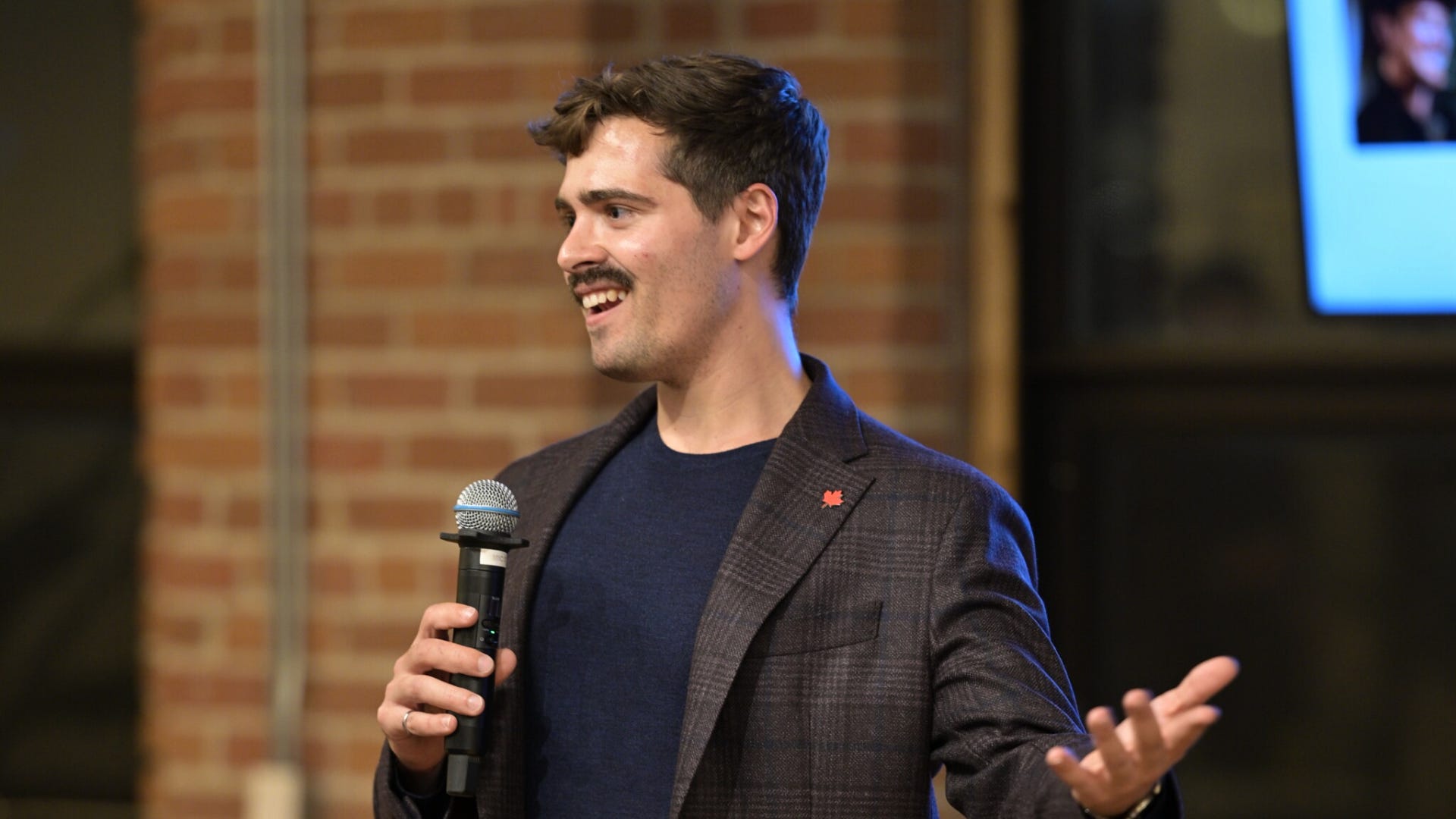
When housing activist Eric Lombardi entered the Ontario Liberal Party (OLP) leadership race this week, many conservatives throughout the province were thrilled. The 32-year-old political outsider is popular among moderates for his pragmatic centrism, and could find himself uniquely qualified to build a cross-partisan coalition that can topple the Ford government and end an era of populist incompetence.
Lombardi, an engineering graduate who has worked in tech and finance, burst onto the activist scene five years ago when he founded More Neighbours Toronto, a YIMBY (‘yes in my backyard’) housing advocacy group. He was among the first and loudest voices in the city to criticise restrictive housing policies (e.g. exclusionary zoning) that throttle residential construction and keep home prices artificially high.
When I attended a More Neighbours Toronto social event in late 2021, I personally witnessed how the organisation attracted a young, wonk-ish, and non-ideological crowd where evidence-based policymaking mattered more than partisan affiliation – earnest nerds, essentially.
Within a year, these people were giving consultations to Ontario’s Housing Affordability Task Force and getting op-eds published in the national press. ‘Thanks, More Neighbours Toronto, for your leadership and advocacy!’ wrote then-leader of the Ontario NDP, Andrea Horwath, after her party adopted many of the group’s recommendations.
Having helped revolutionise the provincial housing debate, Lombardi began to write essays for The Hub (a policy-focused conservative media outlet) that not only excoriated the Ford government, but called attention to national failures on affordability, corruption and generational fairness.
His writing often went viral and seemed particularly resonant with frustrated Millennials. Among other things, he argued that Canada risks becoming a ‘neo-feudal’ society where homeownership is functionally a hereditary privilege, and that Canadian policymakers are betraying younger generations by ignoring our ballooning debt, decaying institutions and bureaucratic bloat.
Yet, despite being an avid critic, Lombardi also knows how to build bridges – as was demonstrated by his rapprochement with the OLP’s previous leader, Bonnie Crombie.
As Mississauga’s mayor, Crombie fiercely opposed Ontario’s YIMBY movement and championed overly-restrictive housing policies. When she became leader in 2024, though, Lombardi joined her team; helped persuade her of the virtues of pro-supply housing reforms; and eventually co-authored the party’s new platform. By focusing on facts and air-tight arguments, he brought a former adversary on-side, much to the benefit of the Ontario Liberals.
When Lombardi told me earlier this year that he was exploring a run for OLP leader, I was ecstatic. Although he and I are personal friends, which creates some bias, he is, genuinely, one of the smartest people I know (and I know a lot of people). As word got out, most moderate conservatives in my social circles shared this enthusiasm, because, despite partisan differences, they respect him for his common sense on issues such as crime and immigration reform, and deep understanding of public policy.
There is another factor at play, though: the chronic misgovernance of Premier Doug Ford – a man who, in the eyes of many conservatives, lacks discernible principles.
It is an open secret that many among Ontario’s conservative intelligentsia possess disdain toward Ford for his perceived lack of intelligence and disregard for conservative values. He governs with a simple-minded populism that, guided by short-term polling considerations, provides neither the economic nor cultural leadership that the province so sorely needs.
When Ford was elected in 2018, he promised to eliminate Ontario’s deficit and significantly reduce its $324 billion net debt. Yet, the deficit persisted and the provincial debt remained undented, reaching $459 by 2026 (approximately a 1.5 per cent increase, after adjusting for inflation and population growth). Instead of fostering a more competitive economy, he poured money into the public sector and corporate subsidies, prioritising managed decline over innovation.
Normal conservatives care about the return-on-investment of their infrastructure projects. Ford, on the other hand, wants to build a mega-tunnel under the 401 highway, even though this wildly expensive project – with an estimated $130-billion price tag – would explode the province’s capital budget without providing commensurate benefits. Burning mountains of taxpayer dollars in front of Queen’s Park would make about as much financial sense.
And while he markets himself as tough on drugs and crime, his government continues to distribute hundreds of thousands of free crack pipes each year despite having no evidence that this promotes public health. He publicly opposes the provision of ‘safer supply’ opioids, yet the province has done absolutely nothing to curtail this failed harm reduction experiment, leading addiction doctors to describe Ontario as the ‘wild west’ of opioid diversion.
This constitutes just a small sample of Ford’s reckless decisions and innumerable hypocrisies, which, collectively, have made it clear to many conservatives that he cannot be trusted.
When skeptics have voiced their concerns, though, they have been met with bullying and censorship. For example, when conservative activists launched Project Ontario, an organisation that advocates for principled governance, last autumn, Ford’s associates allegedly called potential supporters and threatened to sabotage their careers and businesses if they got involved.
If Lombardi manages to become leader of the OLP, there is a good chance that the Liberals can hoover up disaffected conservatives, creating a grand coalition that can finally dislodge Ford from his gravy-encrusted throne.
‘I’ve had at least a dozen friends who voted PC in 2025 tell me they’d vote Liberal with Eric as leader,’ wrote Nolan Welsh, a Montreal-based Liberal organiser, on X this week. His sentiments were shared by Daniel Bordman, a conservative-leaning activist, who posted: ‘This guy will win the Ontario election with 70% of the vote if he becomes leader of the Liberal party.’
‘Eric is one to watch!’ concurred conservative journalist Elie Cantin-Nantel in another post.
Of course, Lombardi first needs to win the leadership race – which is a problem as he is currently an underdog. The fact that he has never been elected to office may increase his cross-partisan appeal, but it also means that he lacks deep party connections.
In contrast, the current presumed front-runner, Navdeep Bains, is a former federal Liberal cabinet minister. Two of the other candidates are sitting MPPs (Rob Cerjanec and Lee Fairclough), with a fourth one (Dylan Marando) being a former advisor to Justin Trudeau.
Lombardi may also find himself thwarted by the sizeable contingent of OLP members who want to move further to the left, and who reportedly engineered Crombie’s ouster in January.
Should these members get their way, though, Ford’s reelection prospects would grow substantially. The OLP desperately needs more votes, and there are roughly twice as many to poach from the Progressive Conservatives (PC) than the Ontario NDP (ONDP), who are polling at 38% and 19%, respectively. Not only is the PC vote generally more elastic and vulnerable to defections, the ONDP have almost never polled below 17%, which suggests that there aren’t that many leftist votes left to steal.
If Lombardi can convince his fellow Liberals that the path to victory hews towards the centre, and that expanding the base requires a fresh face, then perhaps he can neutralise his opponents. To this end, it could be useful to cite the B.C. Liberal Party (which brought together federal liberals and conservatives) as an illustrative, albeit imperfect, comparison.
Moderate conservatives, for their part, should consider supporting Lombardi’s leadership run. (Lombardi’s past Covid comments have proven to be a sticking point for some, and have recently been addressed.) They should remember, however, that compromise goes both ways, and that they certainly will not get everything that they want.
Coalition politics aren’t easy, but, given the failing state of the status quo in Ontario, some outside-the-box thinking is in order.
Adam Zivo is a freelance writer and journalist, director of the Canadian Centre for Responsible Drug Policy, a columnist with the National Post, and a correspondent with The News Forum.

I mean no disrespect to the author, and no malice intended toward his article.
I enjoyed the read, and I recommend others take a look.
I do, however, take exception to the use of his terms “normal” conservative and “moderate” conservative. I take exception not because I am somehow offended, but because I have no idea of whom he speaks.
The author’s thrust seems to be our left-of-centre Premier has failed to advance the cause of conservatism after years of Liberal Party dominance -and the destructive policies that occurred as a result- and that we should rectify this by voting for another Liberal Party candidate who apparently occupies some nebulous, undefined centre of the political spectrum.
Kathleen Wynne was not only the worst Premier in the history of Ontario; she was the worst Premier in the history of our Country.
I agree that Doug Ford is a basket of goods that were different from those advertised; but to suggest that a neophyte with a porn star moustache could somehow rectify the problems that face this Province, while heading a FarLeft political party is incredulous.
I’ve reliably voted PC in every Ontario election for the last few decades. Except, that is, for 2023 when I didn’t vote, deciding I had nobody worth voting for given the Ford government’s horrible mismanagement and lack of principles. Ontario Liberals, please, please, please give Ontario voters a conservative option next election by choosing Eric Lombardi. Choosing a Liberal squish like Navdeep Bains will only serve to guarantee four more years of Doug Ford. One not so small problem for Lombardi is that he must be seen to be leading a party that has crossed the Rubicon on the failed policies that put Ontario Liberals in the political wilderness after Kathleen Wynne’s disastrous tenure. No easy task.