


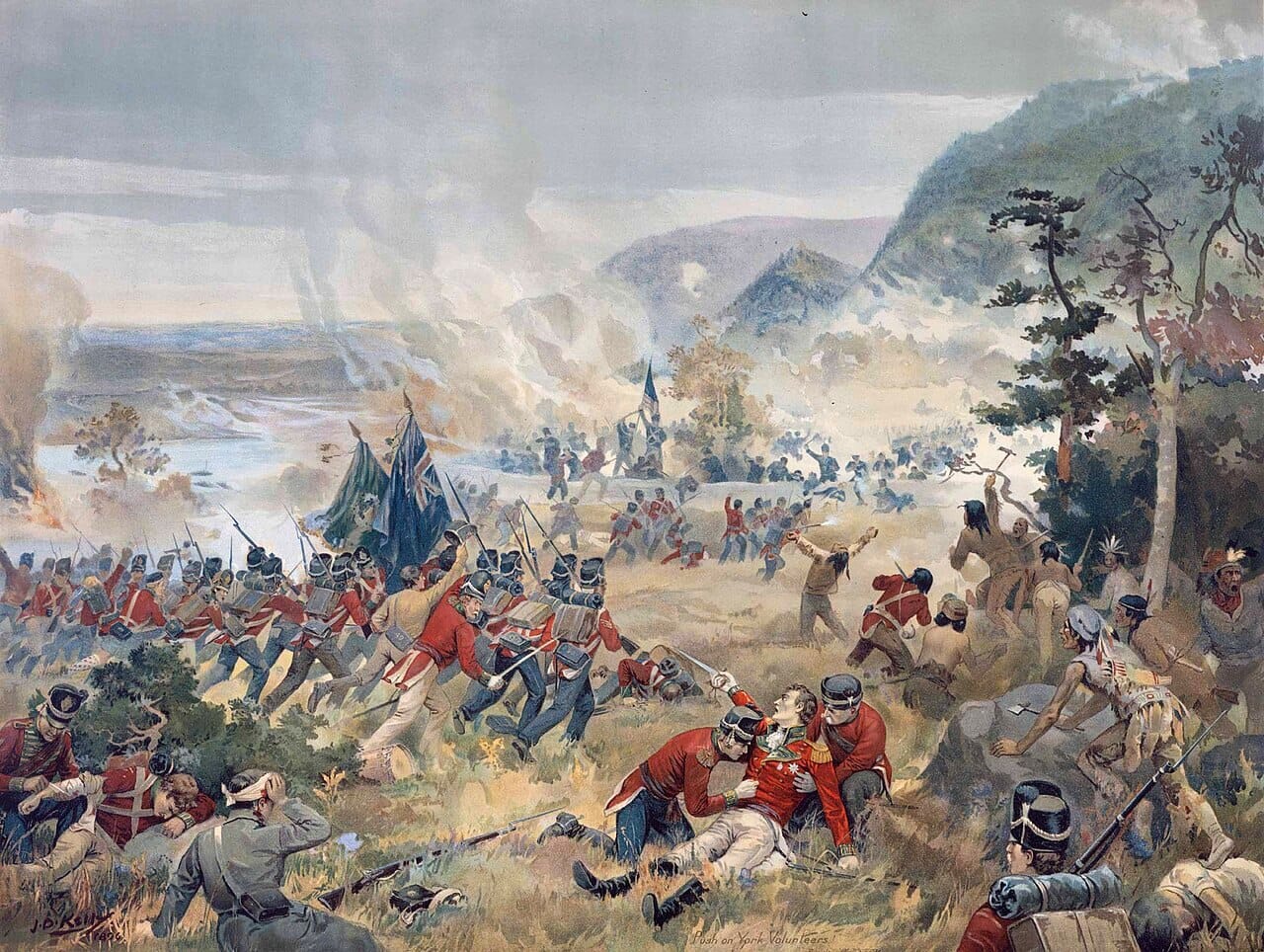
Growing up in the Niagara Region gives me a unique perspective on today’s new wave of anti-Americanism. I was taught in school that Niagara was “ground zero” for early flashpoints between British North America and the United States. If you drive through the region, you will see monuments that attest to this history.
Many settlements in Niagara were established by former Americans who were expelled for their loyalty to Britain during the American Revolution. The War of 1812 produced many famous battles in Niagara, including the bloodiest battle on Canadian soil at Lundy’s Lane, and the death of General Brock at Queenston Heights. Additionally, the 1838 Patriot rebels often found shelter across the river on American soil. Finally, the Fenian raids of 1866 to 1871 were launched into Niagara from the United States.
The 1867 Canadian patriotic song, “The Maple Leaf Forever”, highlights some of these flashpoints:
“At Queenston Heights and Lundy’s Lane,
Our brave fathers, side by side,
For freedom, homes and loved ones dear,
Firmly stood and nobly died;
And those dear rights which they maintained,
We swear to yield them never!
Our watchword evermore shall be
‘The Maple Leaf forever!’”
The first 100 years of the United States involved constant conflict with British North Americans in Niagara. You might think that a history of these hostilities would produce deep-seated hatred, or at the very least wariness, among Niagara residents. But those were not the lessons drawn from the past, nor the path chosen for the future.
Consider the coat of arms for the city of Niagara Falls, my hometown:
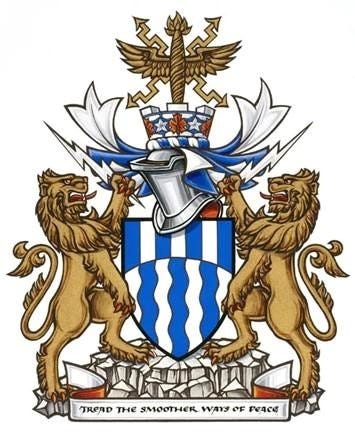
The two lions allude to the relationship with the United Kingdom, especially during the early defence of the Niagara Region. Each lion holding a lightning bolt shows the importance of hydro, which both Canada and the United States cultivate. The crest contains a royal crown with both maple leaves and stars, alluding to the city of Buffalo, New York, with which Niagara Falls has a long association. The motto at the bottom of the crest is an excerpt from the 1924 poem “Niagara” by Arthur William Fisher:
“May border nations ne’er surcease
To watch the useless strife and toil
Of buffeting and foul embroil
And the swift current’s sure recoil,
Then tread the smoother ways of peace.”
The values infused into the spirit of Niagara were not those of revenge, hatred, or animosity. The battles were already fought, and there was no need to reopen old wounds. For the betterment of both Canada and the United States, cooperation was necessary.
Each side of the border has something to offer the other. Many Americans come to our side for the attractions on Clifton Hill, or for the better view of the Falls itself. We Canadians go to their side for professional sports teams and casinos. Many Niagara residents, including me, also have relatives across the border, and even prefer a trip to Buffalo rather than to Toronto. More importantly, we have benefited from Buffalo cuisine, with an abundance of pizza and chicken wing establishments.
It has not always been easy, but Niagara chose to work with the United States rather than remain trapped in resentment or fear. Instead of staring down the American flag across the Niagara River, we chose to hang it beside our own. We chose the spirit of friendship rather than the spirit of adversaries.
This brings us to the anti-Americanism ushered in with the second Trump presidency. I understand the appeal. I get it.
In fact, I often fall into the trap set by my own heritage. Each time President Trump trolls Canada online, I immediately feel the urge to blast “MacDonnell on the Heights” by Stan Rogers, wrap myself in my Niagara-on-the-Lake flag, and venerate the martyred General Isaac Brock. Sometimes I give in to that temptation.
Yet that is not what my home region taught me. We were taught to remember the past, but not to revel in conflict. We were taught that we can be Canadian and still cooperate with the Americans. Once we traded cannon fire, we chose to trade goods and pleasantries.
Perhaps the current Canadian government should look to the Niagara ethos as a model to imitate. I am not a policy expert, and I do not presume to offer specific recommendations. I also recognize the complexities posed by the current president. What I do wish to express is that I believe our current direction needs to change. Our closest neighbour, historic ally, and even former enemy cannot be ignored. Our countries are too interconnected in every way to contemplate a complete divorce.
The spirit of cooperation is not only Niagara’s history, it is also Canada’s history. As Prime Minister Carney said in his speech on January 22, 2026, concerning Canada:
“A bold project: that two peoples, recently enemies, speaking different languages, practising different religions, living under different legal traditions, could share a single country, and build it together.”
Canada was created by the coming together of various peoples, even while living in tension.
Compromise is in its constitution.
If we can build a country with once-warring peoples, we can build a continent with a troublesome neighbour.
Tyler Brooks works in Ottawa for the Government of Canada. He holds a BA and MA from the University of Ottawa, and an MTS from Saint Paul’s University.

Stand up and walk away from the cuck chair. If you think “Anti-Americanism” is the problem, you live in your own reality. Other than the hyper-partisan left, there is no Anti-Americanism.
The vast majority of non-partisan Canadians are reacting with anger to the continued interference and insults of the current US administration.
To win the next election, the Conservative position must be that Liberal incompetence has left Canada vulnerable to interference—not “just lie back and let it happen.”
In a little under 3 years, if/when the US elects a left-wing populist dem to the White House, I expect you’ll be backpedaling on a more integrated continent.
We welcome the Europeans working collaboratively for their benefit, including peace on their continent. Surely we can get along with our southern neighbour. We don't have nearly the same history of conflict.